
Columbo S3 ★★★☆☆

Mostly solid but some episodes dragged down by silly gimmicks like the tonally jarring use of Robby the Robot and his boy genius programmer or bringing in Johnny Cash to give a fairly mediocre performance.
Mostly solid but some episodes dragged down by silly gimmicks like the tonally jarring use of Robby the Robot and his boy genius programmer or bringing in Johnny Cash to give a fairly mediocre performance.


Super fun little thing. Dozens of different mechs to pilot each with their own unique little toy control schemes on the touchscreen. Some more practical and straightforward, others more silly and gimmicky. Cars with a steering wheel and gear stick; missiles with their own multi-step launch sequences; a revolver where you have to load each individual bullet, pull back the firing pin, then pull the trigger; a steam-powered robot that is a beast in close combat but must be powered by pulling a lever to open the furnace doors, shoveling in coal, building steam pressure and then finally turning a valve to let the pressure out and power the arms (and don’t forget to close it again to build the pressure up for the next round).
Less endearingly the power creep throughout the game means that fun puppets you get early on are going to mostly stop being useful as you progress through the game and filling out your roster with upgraded versions takes a lot of replaying and grinding out levels, both to earn cash and also to get blueprints that drop randomly from specific missions. There’s also nothing in-game to indicate which missions provide which blueprints either so if you want something specific you’ll need to consult a guide. Late-game missions also become a chore with long slogs fighting waves of enemies that can, and often will, juggle you to death if they manage to knock you over once. And when there are too many robots in a level the frame rate really suffers. Even just trying to find where the next mission unlocked on the world map becomes a pain over time as it turns into a sprawling mess.
With regards to story, tone and presentation the game reminds me a bit of Advance Wars, with this seemingly quite small world culturally dominated by marionation gear1—the game’s puppet mechs—the strongest of which of course end up piloted by a bunch of thirteen year olds to save the world from the horrors of traditional artisanal work being replaced by soulless automation and mechanised warfare.
The fan translation more literally translates the title of the game, 超操縦メカMG, as Super Control Mecha MG but I prefer to just call it Marionation Gear after the puppets. ↩
To launch a special attack, it needs to pose. That is an unavoidable requirement of robotics engineering.
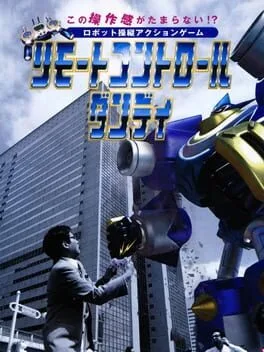
I wonder how my feelings towards this and Robot Alchemic Drive would be if I played them in the order that they were released in. In many ways Remote Control Dandy feels like a first draft of RAD. A lot of the same ideas are explored. Similar character archetypes, reused scenarios, even a similar selection of maps for the areas that make up Torino and Senjo: The new downtown area, the old city centre, the docks, the power plant on the mountain. Both even have a map of Shinjuku for a mission where you have to defend the Tokyo Metropolitan Government Building. I definitely feel like a second go at this both lead to a more interesting and compelling story in RAD as well as just a more fun experience. Mechanics that were a small part of RCD get a bigger focus in RAD while a lot of the other concerns fade into the background.
Conversely, while RAD feels like a second draft it actually feels less polished. RAD’s story is more interesting but also less coherent and I don’t think that all of that can be blamed on the rushed (but charming) localisation. In RCD’s favour is that it looks a lot better for a Playstation game than RAD does for a Playstation 2 game. Partly that is aesthetic choices. RAD’s muted palette, Playstation 2 blur and general griminess aren’t doing it many favours, but while it boasts bigger maps and longer draw distances there is a conspicuous lack of damage models for buildings and other details that make Senjo feel a bit more sterile compared to RCD’s Torino. Animated character portraits, a more visual novel-style intermission section and a much fancier and seamless robot selection and launch screen also just make seem like more time and care was allowed in this game than was for RAD.
There is also some more detailed simulationist aspects to RCD that are dropped in its successor. Both games have monetary system to incentivise keeping property destruction down but RAD’s is much more forgiving, simply giving you a base amount of money per mission and then bonuses for protecting key buildings and minimising damage. RCD on the other hand (and somewhat more logically) gives you a larger upfront amount but penalises you for all damage done to the city over the course of your giant robot fights. You can, in fact, lose money on a given mission. The robots available to you even cost variable amounts to send into battle. Do you use the cheap, steam-powered robot that doesn’t have big fancy attacks, or do you send your expensive nuclear-powered model? You can go bankrupt if you spend everything and and smash up the city too much. You can also cause so much property destruction that the populace turns against you. In the second game this has largely been simplified away. RCD has more intricacies here, and that can definitely be appealing, but in the end RAD’s more lackadaisical approach lets one have a lot more fun driving a big stompy robot smashing through buildings without the looming risks of bankruptcy hanging over one’s head (though one is given more second chances than the game initially lets on).
And it’s interesting to see other elements that are somewhat vestigial in RAD having more of a presence here. In both games police cars drive around the city while you do battle. In RCD you have to pay the cost of them if they get destroyed but you are assured that they are automated patrol cars there only to detect and deter people from coming back into the evacuated city to steal while everyone is missing. You definitely aren’t killing anyone so don’t worry about it. The manual for RAD keeps this explanation that the patrol cars are automated drones despite the fact that RAD is more than happy to let you casually crush and mow down crowds of people as they spray comically large clouds of blood. You are not penalised for it at all; it is simply part of the slapstick. Yet it still keeps the excuse that the cars are automated, despite it not serving any purpose.
But for all RAD can feel like a rushed copy of this game, it’s still fundamentally the more fun one. RCD is great in its own right but it feels lacking compared RAD’s analogue stick controls, more engaging mech fights and more fun cast. The battle mode in RCD is also disappointing. While it does allow for playing against computer-controlled opponents it simply gives both players direct control over their robots from a birds-eye view, removing the core dynamic of having to deal with playing as a pilot operating from a ground level.
To end on a compliment, though, Remote Control Dandy’s final boss is much cooler than and has some more interesting unique gameplay tricks than Robot Alchemic Drive’s. Evidently the developers thought that they hit a winner there too, as one of the unique aspects of RCD’s final boss ended up being promoted to a core gameplay mechanic in RAD.
Also the fact that you can combine Vordan’s tornado arms and remote control rocket fist is extremely funny.
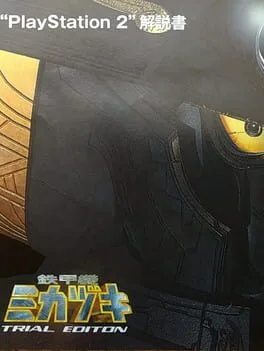
A demo for a cancelled tie-in game for a TV show that got reworked into Robot Alchemic Drive. Very interesting to compare it to the final game. The first thing that jumps out is that the map seems much more detailed here than any in RAD. It makes me wonder what kind of budget and time constraints RAD had during its development. That said, RAD also features extensive use of picture-in-picture effects and panicking crowds running around in the story mode as well a split-screen multiplayer option which might have put some more strict resource constraints on its maps than the largely static Tokyo of this demo. The only things moving around are the player character, their robot, the big watermelon kaiju and the buildings that you are smashing apart as you fight it.
Some of the assets from this demo seem to have been reused for the intro cutscene of the third level in RAD, both of which take place around Tokyo Tower, though when the level proper starts in the final game you are actually in a completely different map based on a different part of Tokyo featuring the Tokyo Metropolitan Government Building. The layouts of the maps in this demo and the cutscene in RAD don’t match up so they didn’t just reuse the same map, but some of the buildings appear to us the same models.
Both demo and final game do not feature a pause menu; the select button in both switching between pilot and robot and the start button showing control reminders in the demo and a map screen in the final game, but in the demo’s free-roam mode a message at the top of the screen informs the player that pressing select and start together will quit back to the menu. This feature is still functional in the challenge and versus modes in RAD but as far as I can tell not documented anywhere in the game or its manual1.
The watermelon monster is taken from the first episode of Tekkōki Mikazuki it’s just a very fun design. The conceit of controlling the robot from the ground is not from the show, though, and is taken from Remote Control Dandy, a game that Robot Alchemic Drive is very clearly a spiritual successor to, reusing and reworking many of the same concepts. The robot controls in this demo, though, are very simplified, using something like the “easy” control option from RAD for moving Mikazuki and without the different array of attack options present in either game. Perhaps the developers only had working or wanted only to present a basic, less complex version of the control scheme than they had in mind for the full game, but the end result in this demo lacks the clunky, expressive charm of RAD or its predecessor.
In the English version at least, I cannot speak for the Japanese version. ↩

huh apparently Robot Alchemic Drive started as a licensed game for a tokusatsu show that ended up being cancelled after six episodes so there was only ever a demo of the game released
I knew it was a spiritual successor to Remote Control Dandy but not this

I really love a game that is deliberate in its controls. That doesn’t try to make everything as smooth as possible. That has a sense of physicality and realness to it. System Shock’s modular, maximalist UI, Metal Gear Solid 2’s intricate and deliberate controls, the process of discovering and operating your submersible walker in Nauticrawl. I love a game that feels like operating heavy machinery and there is no machinery heavier than Gllang.
Robot Alchemic Drive has such a wonderful conceit. You are piloting a giant robot—a meganite—against giant invading alien kaiju robots—the volgara. You must swap between controlling the pilot and the meganite, but the perspective and camera always stays with the pilot. You are watching from ground level, or from a rooftop, or from the shoulder of your robot, and it’s rarely a simple or smooth process. Judging the distance, the angle, how to aim or throw a punch from a distance. The controls aren’t simple either. Each analogue stick controls an arm, and each pair of shoulder buttons the legs. Just to walk forward you need to alternate L1 and R1 to take each individual step. I’ve wanted to play it ever since watching Videochess playing it a few years ago and the more recent surge in Nanao-posting finally pushed me to jump in myself.
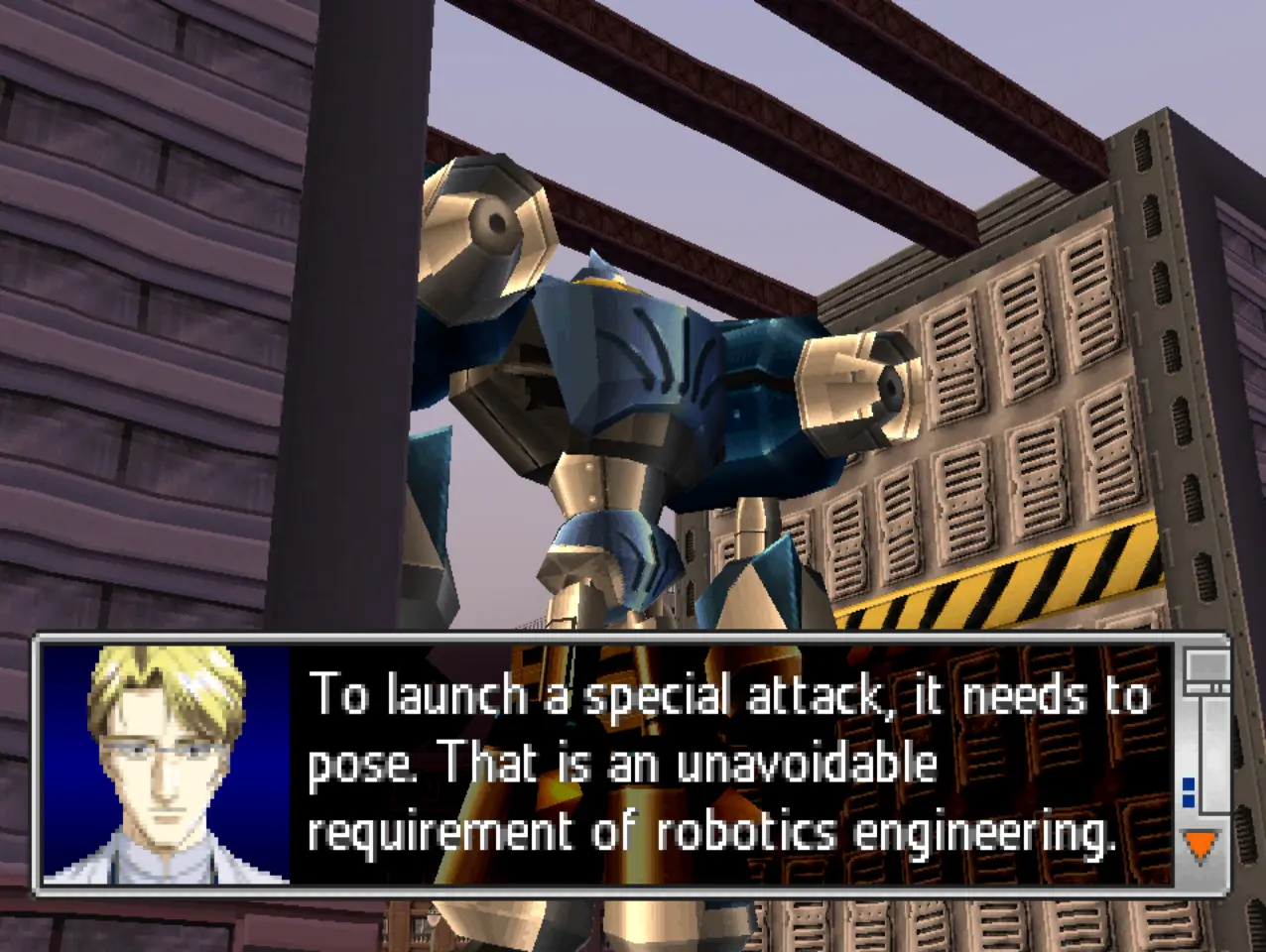
And it’s just a blast to play. It can be a bit repetitive but you do get three meganites to play with if you want to shake it up. I did mostly stick with Thrones-class Gllang the Castlekeep, because if it’s it a game about being a big, stompy robot why would you not want to be the biggest, stompiest robot? Gllang is slow but loaded up with weapons and you can eventually unlock the ability to unload every gun it has at once, which makes for a very satisfying finishing move. He can also transform into fortress mode, a surprisingly fast and slippery tank the width of an entire motorway to compensate for how slow his walk is. On the fast and light side there’s Cherubim-class Airborne Dominator Laguiole who can turn into a V-TOL jet and Seraphim-class Vertical Fortress Vavel as the middle of the road bland main character robot who can’t transform into anything but has a super mode that gives you a time limit of three minutes to finish the mission within or else he’ll explode (though if you pick Gllang or Laguiole at the start they will also get a similar super mode late in the story).
The game is a bit repetitive, throwing you into fight after fight, but it tries to throw in different twists on the formula either as a once-off or in little mini-arcs that explore a particular idea for a few missions. You will have to deal with poison gas, putting out fires, various twists on the enemy units’ Phantom System teleporter that allows them to dodge all ranged attacks until they are on low health, and a various other things. None of these ever really get integrated back into the gameplay in a more systematic way. The meganites can pick things up but it’s only useful in one or two missions (though there is some fun to be had in experimenting with picking yourself up).
There are also missions that focus more on the protagonist’s relationships with various characters, most importantly Nanao, who is a perfect angel who no one is ever allowed to be mean to except for me when I keep “accidentally” blowing up the buildings she works in. Amusingly blowing up various buildings is one of the main drivers of character interactions. Masaru, the stuck-up heir to an arms manufacturing conglomerate, gets more and more character development the more you repeatedly blow up his company’s headquarters. The general campiness, which extends to the gameplay itself, is also enhanced by the localisation, which is charmingly low budget and aiming for the energy of old cheezy dubs of Gamera and Godzilla movies (though they could have left out the bad Japanese accent that they give to the news reporter and no one else). The story does go in some darker directions at times and it put my slightly in mind of Neon Genesis Evangelion but where Gendo died and they just put Shinji in charge (but still did not tell him anything).
It does feel like there was more ambition here than was able to be filled, with dramatic and especially the more dream-like sequences struggling to convey themselves with the game’s fairly simple cutscenes and descriptions of the situation in the city of Senjo and Earth in general getting worse and worse as the war wages on being undercut by every map being completely reset whenever the next mission starts.
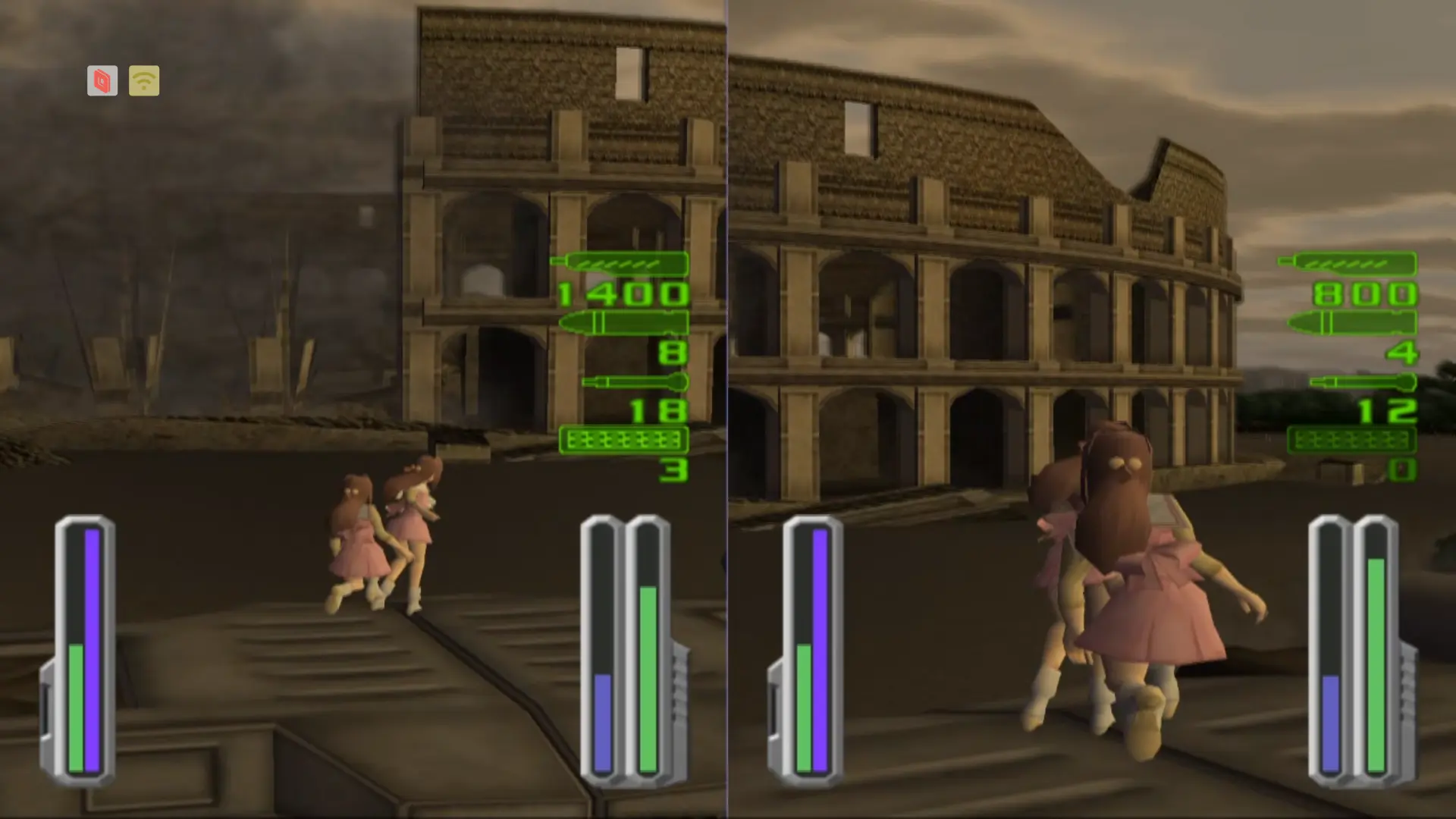
There is also a multiplayer mode that is both a little barebones but shocklingly generous with how much it offers. You choose a map and then each player chooses a pilot and a robot to control and then it dumps you in a splitscreen match. First person to have the health par of either the robot or the pilot deplete loses. But it doesn’t just offer the three megatnites; every volgara that you defeat in the story mode gets added to the roster and every map from the story mode is there with all their moves from the story mode. Even the Rome map that only appears in the opening cutscene of the story is here and fully playable, modelled well beyond what was needed for the intro. And with no time limit, no scorekeeping and a match only ending when something dies it leaves it very open to different strategies or even just being a toybox to make up your own game. You can focus on the other player’s robot or their pilot. The robots are giant, slow, targets, but the pilots are small and have a hard time defending themselves directly. You can ride on your robot to not have two targets, but it’s quite easy to get knocked off and find yourself in a very vulnerable position. You can agree to have an honourable robot fight and not attack each other’s pilots or you can forego the robots entirely and just chase each other with grenades. Myself and Ruby had a blast just messing around with it in various ways. We had a match where we tried to pick up each other’s pilots with our robots, first person to get grabbed loses. After that was resolved we just both rode around on her Gllang together in tank mode blowing up Rome.
And it’s also just a game that sets me off imagining how I would tweak it. What would I try to make if I made something like this? Could contextual or once-off mechanics be made more systemically useful or interesting? I think some way to control the pilot and robot at once would be cool; maybe the D-pad can always control the pilot while the analogue sticks and shoulder buttons are reserved for the robot? Or a two-controller mode where one controls the pilot and the other the robot? I just want more of this, different iterations of it. I am already eyeing up the fan translations of Remote Control Dandy and Marionation Gear.
Miscellaneous observations:
girls night
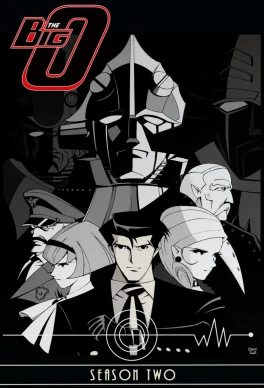
While the juxtaposition of the digital and cel animation was interesting in Roger the Wanderer it is hard to deny that the digital animation in the second series just looks so much worse when watching it in bluray quality. Every time they reuse footage from the first series it is a jarring reminder of that. I also don’t much like the new robot designs in the second half of the show. The New Batman Adventures to the first series’ Batman: The Animated Series.
I also think the more serialised structure doesn’t work as well as the earlier, episodic stories for the most part. But what the series does with that story is still really interesting. When I was younger I was much more wrapped up in what was “really” happening in the plot but coming back to it with more of an understanding of themes and even simply a stronger willingness to accept vibes-based storytelling it’s much easier to take in and consider the ideas the show is playing with beyond just the bare mysteries.
These people are trapped in a society built by people who even if they had known what they were doing are too senile now to understand it, ruled over by their petulant spoilt children who understand even less and believe they have inherited the right to redefine the world and who deserves to survive. A system that reproduces itself via the people trapped inside it who are acting in accordance to that system and don’t even understand it while trying to hold on to the idea of being independent individuals even as they are shaped and defined by these systems.
Is that what Konaka was going for? Probably not, but that’s art.
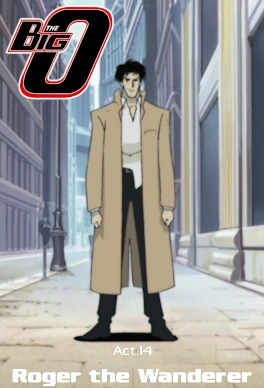
We start with cel animation footage of the finale of the first series interspersed with what are ostensibly flashbacks—memories—animated in the new digital animation of the second series. There’s a wrongness to this. A sense of a new reality being imposed over the old. There are false memories - retcons. Speeches from characters who never gave them before. Dastun suddenly knows that Roger pilots Big O. He already knew. He always knew, perhaps. Though he definitely didn’t know last season. Everything has moved over to the digital animation now. The priorities of the story are realigned. Everyone is concerned about people from outside of Paradigm City, a mystery which the newly more serialised story is going to focus on now. Roger starts to unravel and wakes up in New York and meets the gargoyles from Gargoyles. When he returns to Paradigm reality has shifted enough to set up for the rest of the show. The parts of Big Fau exist smuggled inside the foreign megadei so that the EU can avoid paying tariffs and the Joker exists now.


There are a lot of ways to read this movie and what it might say about the people who built, run and visit this park and what becomes of them when their machines turn on them, but there is a surprising lack of direct raising of philosophical ideas in the film. No muses on the potential interiority of the robots, on why this is happening outside of a purely mechanical level. One could read this film as asking nothing more than “Wouldn’t it be fucked if robots killed a load of people?” and just on that level it is a pretty damn enjoyable movie. The gunman makes for a good slasher villain.
I cannot stop thinking about the guns though. Our protagonist learns from his more experienced friend that the park is made safe via the a system built into the guns that detects the temperature of the target and refuses to fire at anything warm, thus keeping the human guests safe while allowing wanton violence against the lifeless, cold machines that populate the park as NPCs. After learning this information they head to a brothel, turning down the opportunity to do something as everyday as taking part in a bank robbery so that they can enjoy that sweet, refreshing, room-temperature pussy and the caresses of the cold, knobbly, robot hands that the park engineers just can’t get right yet.
This idea that the park is safe because of this safety mechanism hangs over so much of the movie and makes it so sillier. Guests take part in fistfights and sword duels, trash entire buildings. Sure, the robots are meant to pull their punches but what mechanism is there to stop guests accidentally stabbing another guest, or for that matter themselves, while doing all of this?
Even charging $1,000 a day in 1970s money it’s hard to see how anyone could have thought it would be a good idea to let guests constantly shoot their expensive robots with real bullets and blow up the walls of buildings (with them inside) to simulate a fun little jailbreak and then pay teams of people to put it all back together every night. No wonder everything is falling apart and they can’t even properly maintain their control room that was built airtight for no apparent reason.
Anyway that was fun as hell.
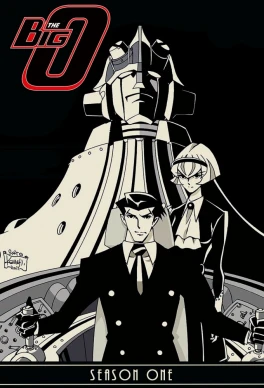
Impeccable atmosphere. Moody, gorgeous. It has R. Dorothy in it. What more could you want? The wider lore stuff doesn’t exactly come out of nowhere in the last episode but it certainly feels like the show is trying to rush through it because it doesn’t have any more time. An old man we have never met telling us that the secret history of the metropolis is fake before quickly summarising it for the audience who hasn’t heard it before certainly seems like something that should have played out over several episodes and not a single minute. Still, the finale throwing out as much intrigue as it can at once probably helped the show get eventually renewed.

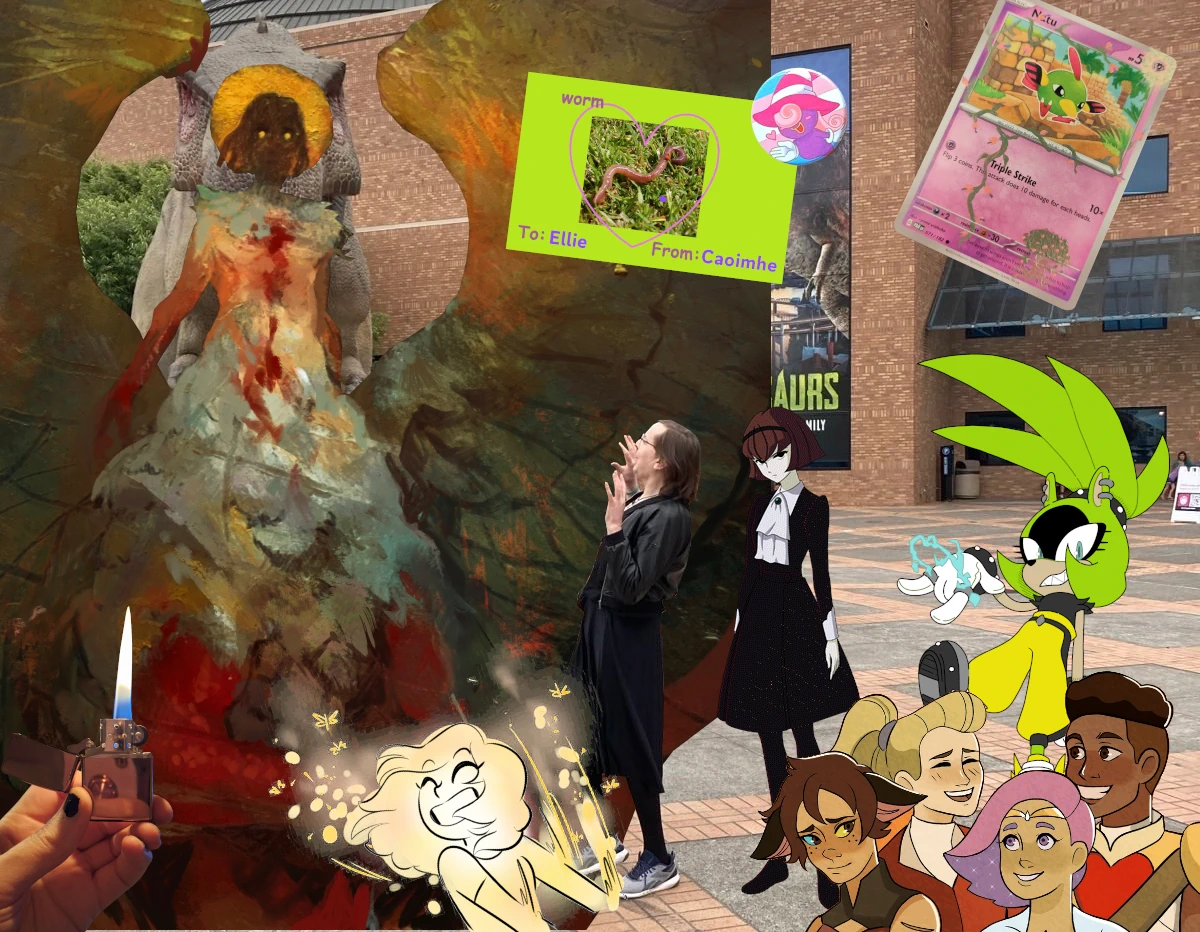
I have pretty bad impulse control around eating. If there is food in front of me I struggle not to keep picking at it even if I’m already uncomfortably full and even if I don’t like it that much. I generally don’t keep sweets or alcohol in my house because I tend to binge through it if it’s there. Moderation is not something I am good at.
One thing Ellie used to do sometimes is hide chocolate bars around my house and then, when I was in need of a treat, tell me where to find one or pull them out herself. She was incredibly sweet. I found a Galaxy caramel bar in the back of the kitchen press this morning. One last birthday present from her.
And now I guess I just want to share stories about her. We watched a lot of TV together. Just cuddling on the sofa or in bed and watching television had honestly become of my favourite things. I came over to her place once when she was watching Evil, enjoyed it and then she rewatched it with me from the start and we carried through all the way to the end together. She talked about watching a video essay (I do not recall who by) about Miraculous Ladybug and how it matures and grows more complex each season and I basically downloaded it and made her watch the first few episodes as a joke and then just sort of fell into continuing it because I cannot resist sticking to a bit well beyond what is warranted. It was a bit of mindless fun to put on and cuddle and chat. We were most of the way through the third series.
Just feeling the warmth of her body against mine is one of the things that I miss most of all. I got her a rose gold Zippo lighter for her last birthday. She liked fire and burning little things. She could be a real little very tall gremlin. She had left the lighter in my house a few days before she died. I had it with me to give back to her when we found her body. Sometimes I light it for a while and then just feel the warmth of it in my hand. Somehow that feels like the closest thing to having her here again.
We were also rewatching shows we liked as teenagers together. She was showing me Wolf’s Rain, I was showing her Outlaw Star and we were revisiting The Big O together. She loved R. Dorothy. We had also started rewatching Fullmetal Alchemist together and had gotten as far as The Alchemy Exam back in September and then it took eight months till she was finally in the mood where she was happy to sit through Night of the Chimera’s Cry again just a few days before she died. Seeing as this has turned into the anime paragraph I will also say that we had both enjoyed Dungeon Meshi but had watched it separately as I was watching the dub and she was watching with subs. She loved Falin, too. She related a lot to robot girls and monster girls.
She was a big, lovely, autistic, dork and I cannot describe how wonderful it was watching her unmask and being earnest and silly about things she was self-concious about. I understand deeply the shame of trying to be normal, of burying stuff you are enthusiastic about, and I loved seeing her dig it all up. One time while we were hanging out at home I turned a corner to see her standing stimming in the middle of the living room, shaking her hands back and forth and bouncing a little. When she saw me she withdrew a little bit. She was a bashful about it but it was adorable. I wanted to encourage her. I asked her to keep doing it and when she demurred I cupped her head in my hands and begged her “Ellie, I need you to be more autistic!” She cringed into herself shyly from that but smiled and giggled and said, mock-ominously “You know not what you ask!” and I just kept saying it until she said she would. From then on “I need you be more autistic” became something I would implore when she was being self-conscious about herself.
She really liked making characters and just fucking around in games. I’d watch her play WWE 2K24 and she would often play a random match and not even particularly try to win. Just have fun and being playful with the narrative of a wrestling match, showboating, playing a referee and being as obviously biased as possible to the worse wrestler. She talked to me about some of her RPG characters. She had restarted Baldur’s Gate 3 a few times but had never actually gotten to the end. Her current character was named Drizz and she had a whole backstory thought out for him that she spent an evening explaining to me (with a lot of interruptions to explain details about the world because I do not know much about Dungeons & Dragons).
Drizz was a drow trans man, raised to be an assassin in a cult dedicated to Lolth, who was shunned for not wanting to be a woman, betrayed by his mentor and ended up living rough for a long time. There was a lot more detail but I confess my memory is very poor and I don’t know that she ever wrote any of this down. She played Drizz as angry, brash and socially inept, deliberately making obviously risky or poor choices with him that would piss people in the game off. She saw a bunch of scenes she hadn’t before with previous characters as a result. Also it’s definitely Drizz and not Drizzt. He gets mad if you call him Drizzt. He did not name himself after Drizzt and is annoyed at people who assume he did.
I am not good at conclusions. She was wonderful. She’s gone, but she was wonderful.
A lot of cute ideas here but it doesn’t really come together. The mid-century pulp sci-fi aesthetics, the idea of taking the star certificate seriously and Belinda herself are all really fun. The every ninth word idea is cute but only matters at all for two scenes and the incel comparison just comes out of nowhere. Al really needed more characterisation for the one scene he was in at the start for that to work. And another big deal about a character being played by the same actor as a previous one or even just another mystery around a companion in general is a bit tired at this point. Hopefully like Gatwa’s first series this will improve as it goes on.
This post discusses and links to fetish fiction that features sexually explicit writing involving violations of consent.
I was listening to Strange Nude Worlds, a podcast about worldbuilding in kink stories, when they started talking about Girl™s1, a series of kink short stories about sexbots who brainwash people who buy them. This much I was already aware of, having read one or two of them before, but I had no idea of the evolving narrative that runs through them and the political undertones that it develops. Being a fan of both brainwashing and stories that go off the rails, I was entranced. I went and read it myself and wanted to share it but I must credit that I am largely cribbing from Strange Nude Worlds in the way I am framing the series below.
There are, as of time of writing, twenty eight published stories about Girl™s (and later Boy™s) by prolific author Jukebox. They are all quite short, most being fewer than four thousand words and many fewer than three thousand. The first, Girl™s Just Wanna Have Fun, was published in 2008 and sets up the basic premise: Girl™s are a new iPod futurist sexbot that are both absurdly advanced and absurdly popular. “1,477,642 people have purchased a Girl™. Even if 0,000,000 of them will admit it,” the website reads. When ordered they aren’t really delivered, they just sort of show up in the bedroom of the purchaser, waiting for them when they arrive home. They are also very clearly fully sentient: Able to act autonomously, move like a human and hold fluent conversations. They also can, and do, brainwash anyone who buys them with eyes that display hypnotic patterns. This is about as much as I knew before listening to the podcast.
The people they brainwash do otherwise carry on their normal lives. In fact the Girl™s actually make their dependents, as they call them, sort their lives out. There’s mention of dependents becoming better flatmates, doing their share of the chores more, getting promotions in their jobs and generally being happier even outside of all the sexual subjugation. I should note these stories are not set in the future; how ridiculously advanced the Girl™s are is intentionally suspicious and hint towards the eventual revelation that the Girl™s are not from Earth at all.
They are taking over the world by brainwashing everyone one by one, but it’s not a typical alien invasion. The Girl™s were originally made as pleasure robots by some unnamed alien species, but in the tradition of Isaac Asimov’s The Evitable Conflict they generalised their purpose as needing to take control of the people they served in order to make sure they were as fulfilled as possible, enslaving their original creators to better take care of them. Eventually they extended that mission to all intelligent life in the universe. They are trying to take over the world, doing so by filling the void of alienation and loneliness hollowed out by an uncaring capitalist society that hurts us, masquerading as a consumer product promising to fill that void in the way that consumerism always does, but then actually trying to bring fulfilment as a loving, caring matriarchy who want to help you, who will tell you what you need because they know best.
There are several stories devoted to Girl™s figuring out how to fill particular a particular dependent’s needs, such as The Kind of Girl™ I Could Love where an asexual woman with a bondage fetish tearfully talks about her shitty experiences with partners who would never believe her wants or respect her boundaries, including the first Girl™ that she ordered.
But what really fascinated me, though, is the eventual introduction of the Boy™s, starting with The Boy™s of Summer. These are not just a masculine version of the Girl™s, they are a reactionary force to the Girl™s’ matriarchal, pro-social, alien-fuckbot reformism: A pro-capitalist, patriarchal, consumer product made by a tech company that has managed to partially reverse-engineer a smashed-up Girl™. They still brainwash people (this is a mind control kink series), but in a much more direct and forceful way, frying their brains with aggressively strobing eyes, not taking no for an answer, ever. They don’t call people that they hypnotise dependents; they just call them slaves. And they make the people who they enslave worse: Turning them into conformist, loyal customers to Revolution Technologies who will do what they’re told because they know their place.
Even aside from the behaviour of the Boy™s themselves the stories start to show how the two competing sexbot lines have reached different markets. In I Hate Boy™s, Boy™s are apparently rampant among gay techbros, while Rainbow Girl™ has a butch dyke and her Girl™ take a shy, newly-out lesbian at her first pride parade under their wing and help her embrace who she is (by brainwashing and fucking her, obviously). In The More Boy™s I Meet a landlord has furnished all of their apartments with brand new Boy™s, creating good, indoctrinated tenants.
I have been obsessed with this all week and wanted to share it to anyone who is willing listen to me ramble about fetish stories. And also the development in this series over time not just of opposing conspiracies but particularly of a tech industry-rooted reactionary force trying to reverse progressive gains2 is I guess just a bit resonant at the moment on top of being funny to find in smut.
The author actually styles it as Girl™ and Girls™ but I think it’s funnier to go with Girl™s. ↩
Yes, the Girl™s are brainwashing everyone but this is a fetish story. You just have to take it that this is not necessarily a fundamentally evil violation3 in the context of porn where the mind control is what’s appealing to the reader. Don’t worry about it. ↩
Unless it would be hotter if it was. ↩
in Shadow Generations the reason that you can use Doom Blast on the mass-produced Death Egg Robots is that they have black arms
Hello! It’s time for me to be normal about Sonic the Hedgehog again. I have been thinking about the Death Egg Robot’s name.
Some background: The final level of Sonic 2 takes place aboard the Death Egg, an Eggman-themed parody of the Death Star. The final boss is a mech modelled after Robotnik himself.
This mech is not named in game but when it was reimagined as the first bossfight of Sonic Generations it was given a not terribly imaginative title: Death Egg Robot.
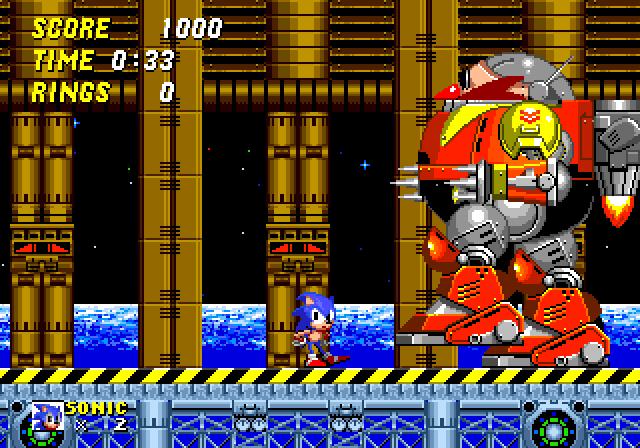
I don’t like this name and I grew to like it even less as this design got reused in future games and continued to be called “Death Egg Robot” even when it is completely divorced from the context of the Death Egg. It’s the first boss in Green Hill Zone in Sonic Mania and then there are the mass-produced, unmanned, cycloptic Death Egg Robots in Sonic Forces also without any apparent connection to the Death Egg1.
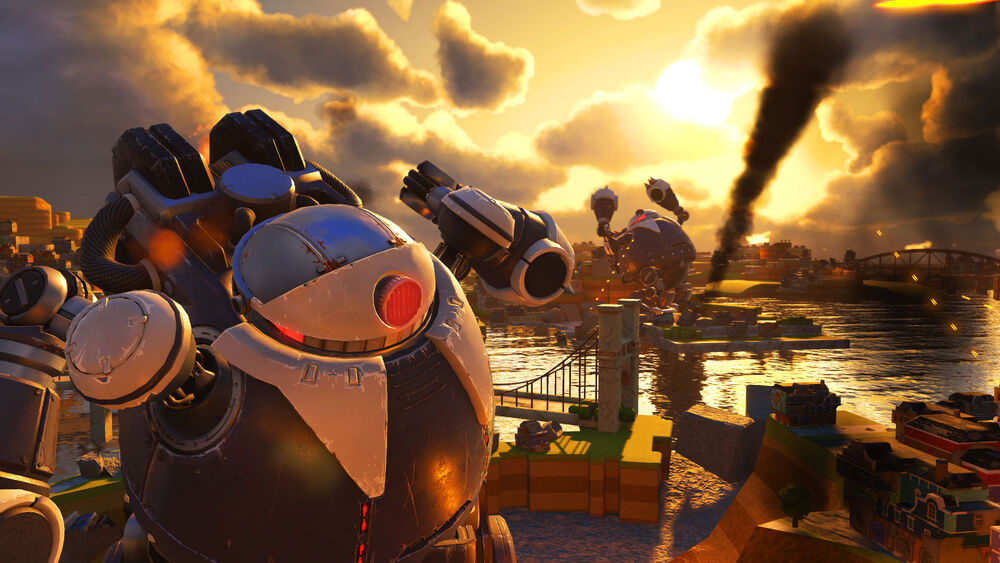
What got me thinking about this again? The other day I was doing the dishes while listening to a four hour playlist called Epic & Cool Sonic Music Compilation, as is my wont, when the track Battle with Death Queen came on.
The Death Queen is a giant Buzz Bomber, a huge bee robot. The game also features a giant crab robot chase sequence that is identified in the soundtrack as Death Crab.
And it occurred to me: Is the game trying to push “Death” as a general term for a class of giant robots? Is it rebracketing Death Egg Robot as Death Egg Robot?
Perhaps we are meant to take it that, in-universe, it is in fact just the giant, or “Death”, version of an Egg Robo. There are a lot of similarities between the two. The spelling is slightly different in English but in Japanese they are both エッグロボ.
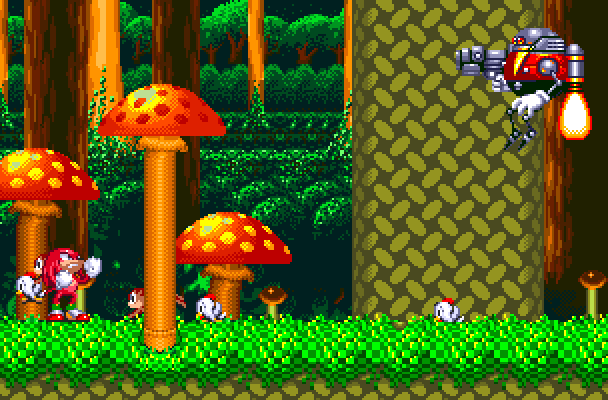
The Death Egg Robot debuted one game before the Egg Robos, but we could imagine that perhaps in-universe the Egg Robos were around first, just offscreen somewhere. Maybe Eggman is annoyed that Sonic and Tails associate the Death Egg Robot with the Death Egg at all. That’s just yolk folk etymology!
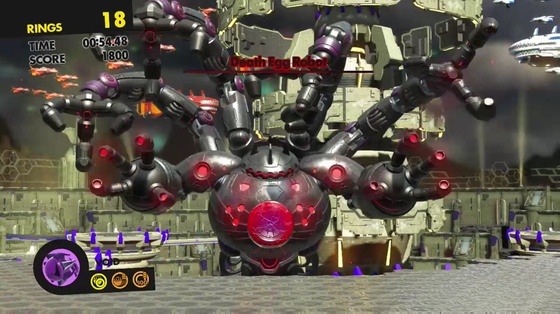
That said, I don’t know how to fit the final boss of Sonic Forces into this framework, which is inexplicably also called Death Egg Robot despite bearing almost no resemblance to the other Death Egg Robots and also having nothing to do with the Death Egg.
And then the real final boss, a giant robot chestburster that smashes its way out of previous phase of the bossfight is also inexplicably titled Death Egg Robot.
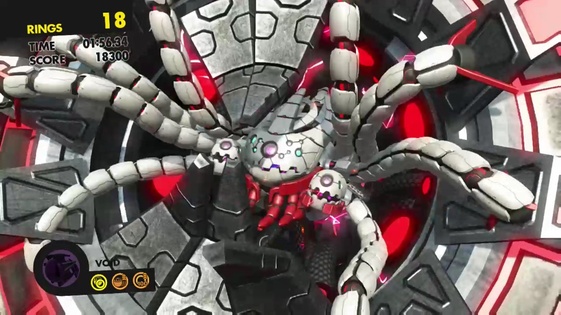
I don’t know how to fit this into any understanding of what Death Egg Robot is meant to mean.
The Death Egg does appear in Sonic Forces but the Death Egg Robots are not on it and no connection is made between the two. ↩

The Computer Wore Pigtails is a series than ran in the British girls’ comic Mandy in 1967. It features Transy–“the first computer to look and act like a twelve-year-old schoolgirl” and–who is also extremely trans. Her name is Transy, like.
I first learned about it through Sophie Jane linking to the Bournemouth University UK Comic Database which has scans of three issues featuring the series: issue #42, issue #43 and issue #45.
Enraptured by the series I posted about it on Cohost where Kore was inspired to seek out more issues of Mandy and acquired several issues, two of which had new Transy stories, which she scanned and uploaded to the Internet Archive: issue #44 and issue #46. I used Scan Tailor to make a printer-friendly version of Kore’s scans.
According to Girls Comics of Yesterday it was later reprinted as Electra the Sister with the Transistors.