 Resident Evil

it’s called Resident Evil: V eronica because it’s the fifth REmake game
These games contains scenes of explicit violence and gore.
it’s called Resident Evil: V eronica because it’s the fifth REmake game

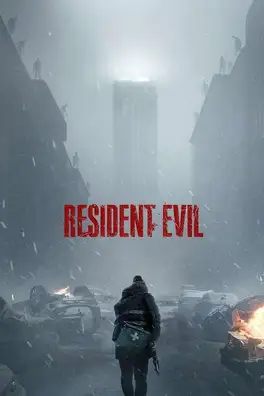
I did not realise that this was going to be a comedy. It is very funny but in a way that I am not convinced will hold up on a rewatch. Doesn’t really have the tone or style of Resident Evil that much other than throwing in a bunch of visual references and some of the mutations made me think of Slither more than the games, but there’s already been enough bad attempts at putting Resident Evil’s cast on film that doing its own thing well was a much better idea.

I am disappointed that Capcom did not go with my idea of calling the game Resident Evil: SⅨ, but
Before I started playing this game I knew that it was divided into playing as Grace in first person and playing in Leon in third person, but I did not know just different the two experiences are. Leon Scott Kennedy, now pushing 50, is a zombie-killing veteran, but Grace Ashcroft, the world’s most timid and pathetic
My only experience with first person Resident Evil prior to this was the teaser demo Resident Evil 7: Beginning Hour, so skulking around as Grace was new for me, or rather something that at first feels something more like Penumbra than Resident Evil, and not because of the first person perspective. As the player initially begins exploring the Rhodes Hill care centre Grace has no means of defending herself from the recently zombified staff and patients, and even when weapons are acquired, ammunition is very, very scarce. There is a satisfying power curve as one explores, opens up new areas, new resources and slowly gains the means to fight back. The crafting system is made a bit more interesting in this game by the fact that he primary crafting ingredient is zombie blood, which as well as being gnarly also makes every enemy a resource rather than just a drain. Zombies bleed more if you shoot their limbs off which means going for the head is not always the best option if you are low on blood but have plenty of bullets. I would like to say that this also turns the series-stable bloodstains that leak out from defeated zombies into not just an indicator that they are going to stay dead, but also a resource, but unfortunately the harvestable bloodstains are a second, different type of bloodstain that appear in addition to the normal one, making it feel very arbitrary.
Complicating matters further is that zombies don’t actually stay down. The crimson heads from the original
After thoroughly exploring the care centre as Grace, Leon steps in to clear the place up. Playing as Leon is all about empowerment. Playing as him it is a breeze to mow down a room full of zombies in the time it would take Grace to deal with a single shambler. If he is sneaking around it is not to avoid fighting but to land a easy stealth takedown, decapitating a zombie before it even realises that he’s there, and while Grace might want to avoid killing enemies lest they come back as blisterheads, Leon is rewarded for killing as much as possible. I complained that the
There’s a lot of fun choices in how this is handled, in how it tries to honour both
And oh yeah apparently Umbrella had a second even more secret virus research lab under Raccoon City the whole time that has never been mentioned before. Of course they did. And it has an even more awesome ultra secret virus that the bad guys have been trying to unlock for twenty years but they don’t know the password. Also there’s a guy here who looks and sounds exactly like and has the same powers as Wesker. Except don’t worry at the last minute the real final boss calls him a cheap imitation and kills him before he can do anything or have any backstory explained. Like, yeah, having another replacement Wesker was stupid and I’m glad the game backed away from that, but you could have just not had him in the game in the first place. The game becomes over-indulgent in general towards the end. Some of this is, I grant, very gratifying: A rematch with a Mr. X where Leon can now parry what was an instant kill attack in knife axe fight, being able to unleash a licker on Umbrella goons and then do a silent takedown on it, but it also has that Resident Evil brand of over-complicated conspiracy nonsense.
The series has stepped away from the zombies as War on Terror framing of the 2000s and 2010s, but it has not left politics behind. The
This is all part of the biggest frustration I have with
I was quite bad at the original Mercenaries and in comparison this feels far too easy, even putting aside the silly mayhem mode powerup win button. But it’s a bit of mindless fun and the different movesets all the characters get are nice to play with.
It’s funny how this works to siphon off Wesker and a few other sillier elements of the main story from the original game away from the slightly more serious
Otherwise I do appreciate Ada and Luis’ plot both being expanded on a bit and the unique fights on offer here. Ada’s long range grapnel attacks and low health pool help to differentiate her a bit more from Leon than she was in the original, and better use is made of her ability to traverse the environment with the grapnel gun than the original as well, though its still very inconsistent which ledges are flagged as hookable and how much freedom it affords you. She feels like an awkward middle ground between normal
It might sound strange to say but I think that the Resident Evil 2
The basic plot has not been changed much, less than
I am not as fond of
The game suggested that fans of the original play hardcore mode and I obliged, but I think I might have actually preferred a lower difficultly. It’s a tough game and often much more hectic and reactive than the original. Enemies are more complex and more unrelenting than the original and it feels like different types of enemies with their own concerns and mitigation strategies are thrown at you together earlier and more frequently. While combat in the original was often about careful positioning and crowd management, the
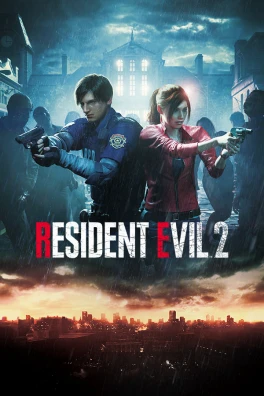
It was easy for me to be cynical about this game going in and assuming that it would be taking a wonderful game and throwing out the things that made it special in order to make something acceptably modern, but the
That feature does feel quite necessary though, as the densely detailed environments can make it easy to overlook important resources. I tried briefly to play with the heads up display disabled but between missing things constantly from the lack of interaction prompts and it removing crosshairs entirely it was too much for me on top of playing with hardcore mode on. I would have appreciated a little more granular customisation in display elements and difficult modifiers similar to how automatic reloading can be disabled (which I also did). The risk and tension of dying is great but ruined by actually dying constantly. Lack of checkpointing in hardcore mode can also be sometimes frustrating with multi-stage setpieces that include instant deaths. Amusingly in trying to recapture the survival horror experience some convenience features that were present in the original game have actually been removed. Keys and ink ribbons must be selected from the inventory rather than being used automatically and you are no longer automatically prompted to discard key items that have been fully utilised.
That core tension of balancing scarce resources is still the heart of the game. Weapons, ammunition, keys, health, inventory space and (in hardcore mode) saves need to be weighed constantly against known and unknown risks ahead. Zombies are legitimately scary and a large part of that is the uncertainty in facing them. Sometimes a single lucky shot with the basic pistol will be enough to pop one’s head open, sometimes they can take an entire magazine to the face and barely flinch while both you and the player character scream curses at them, and their staggering and sudden lunges can make them very tricky targets when they close the gap, which they can do with surprising speed. It is still possible to weave past them, but is much more to do difficult than it was in the original game, and sometimes they will not notice you at all if you sneak past them slowly enough. Tiptoeing around oblivious zombies, past sleeping corpses, or under the powerful, fast, but blind licker clinging to the ceiling is a wonderfully tense experience, sold not just by the gameplay but the lighting and incredibly detailed animation work that that responds to exactly how much or how little the analogue stick is gingerly nudged forward.
I am not one to gush about graphics too much but I must admit the game does look fantastic. Locations are redesigned in a way that feels true to the original game while being more detailed and realistic while still being being readable gameplay spaces. The changes that are made are interesting and almost all contribute to a more serious, even more tense atmosphere than the original. The original
What scant characterisation there was in the original game has been focused on, with Claire’s optimism and Leon’s naïveté emphasised, Annette made into just the worst mother, and Ada being genuinely manipulative. One odd note in the story is that Leon and Claire run into each other even less than in the original game, leading to them barely interacting at all. I suppose that in a story that is trying to be more grounded them splitting up for no good reason after meeting up again would chafe a bit.
Overall just a fantastically stressful reimagining of a classic game.
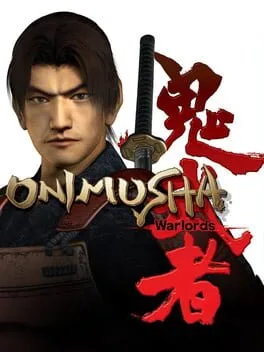
I said that I wished that Devil May Cry was a bit more like Resident Evil and so I decided to revisit a game that sits somewhere in the middle of them. I do largely prefer Onimusha: Warlords slower and more deliberate combat, though it didn’t challenge me as much as Devil May Cry did. I never really got the hang of counters against most enemies but you also never need them unless you want to show off.
While you get to explore Inabayama Castle a bit more naturally than Mallet Island Castle it’s still a fairly straightforward location compared the Spenser Mansion and seeing as there is no inventory limit and enemies are a resource source rather than a resource drain (other than the brief sections where one plays as Kaeda) the central tension of exploration is not really present. If you are at least somewhat competent at the game then you can get back up to full health and magic just by grinding against basic enemies for a while as you wander from place to place and earn a few upgrade points at the same time. The biggest point of tension is that if you die to a boss or that really annoying timed sliding block puzzle then you will have to sit through several unskippable cutscenes again when restarting.
The climax hits rather abruptly, with the game both being a bit shorter than I was expecting and the story also being very slight. Why is Oda Nobunaga set up as the villain? He’s barely in the game and does nothing.
how I spent the evening
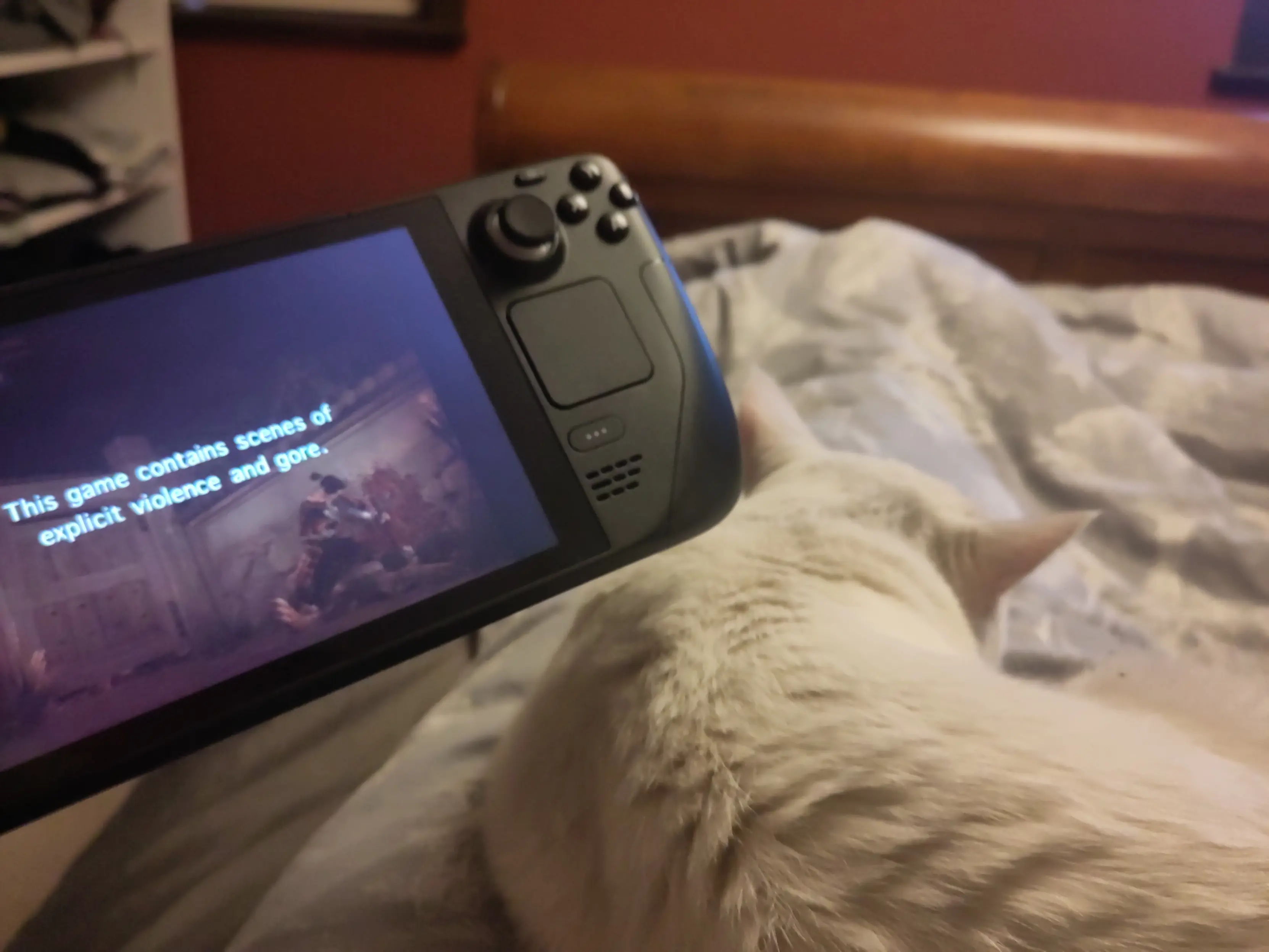
New Backloggd list for games that contain scenes:
https://backloggd.com/u/Caoimhe/list/these-games-contain-scenes/
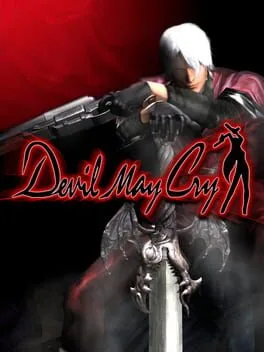
I thought it would be interesting, after replaying Resident Evil 4, to also return to a game that started as a prototype for it and examine the divergent evolution, and structurally it does feel somewhat like a Resident Evil game with an arcade game stabled on top of it. The main setting of the game, an old, ornate European castle (much like a large portion of Resident Evil 4 itself) is a series of interconnected rooms whose that are unlocked through a series of puzzles involving putting the right key item in the keyhole, but instead of the slow exploration and unpicking of the space that one might expect, Devil May Cry is instead divided into a series of missions each of which give you an explicit objective on how to proceed next, where you are given a rank at the end of each level based on how quickly and efficiently you completed it, with a limited pool of lives and saving only available between levels. It reminds of Half-Life 2: Survivor. I feel like I’m playing an arcade mode in a game that is missing its main story mode, where the details about the castle and its castellation that you can read when examining the environment are actually part of the story and not just set dressing, where your file menu has documents you find scattered around rather than just your current objective and strategy tips for enemies, where you can save at the statues of the watcher of time rather than just buying skills. And unfortunately I think I would prefer to play that hypothetical story mode.
Devil May Cry is at its heart an arcade game of the style I don’t gel with very well. It wants to be played over and over again to master it, improve your ranking and level up to the higher difficulty new game+ modes. In true arcade fashion it even starts straight into a second loop on hard mode when you finish it on normal, not even kicking you back to the title screen. I generally want a game that is paced to be played through once, that introduces itself, lets you get familiar with its concepts, and then slowly master them. I do not like the limited lives system and especially how it uses them up automatically when you die instead of offering you to restart from save point instead. If you die early on in a mission and wanted to save extra lives for a boss your only recourse is to reset to the main menu yourself. It is also just quite an unforgiving game in general. Even on normal difficulty Dante doesn’t take many hits before he dies and the pace of fights is very fast, with little warmup before its throwing bosses and very nasty enemies like shadows at you. I know I’m not so old yet that my reactions are that bad, I do fine at Deltarune bosses and besides I remember sucking just as much at this game as a child, though other things came as a surprise to me. I did not remember the swimming sections at all.
I did manage to improve and get my head above the water as the game went on, and really started enjoying dealing with a degree of crowd management when being swarmed by mobs of marionettes and really liked the one-on-one fights with Nelo Angelo especially, though unfortunately none of the other bosses really measure up and must all be fought three times. I did start to use items more as the game wore on, especially against Nightmare and dumping all my unspent points on powerups before the final boss, which in the style of Sonic the Hedgehog starts with a really bad gameplay shift where you are fling in space for a shmup section. I also resorted to setting up a turbo mode for ◻ when I got to Griffon because the button mashing for the guns was killing me.
survival horror game where you start off only getting healing items with the options examine/equip/consume in the iem screen and as you explore and find keys, weapons and ammo they all have the same options. If you use consume on any item it disappears with the same animation as the healing items. It is not initially clear what this does.
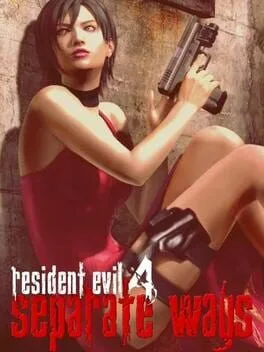
Assignment: Ada is a funny thing to exist to Separate Ways of which it is sort of a prototype version of: A mini-campaign staring Ada that ramps up the pressure and difficulty to deliver a very condensed version of Resident Evil 4. It does have a few things going for it: Short and sweet and with Ada dressed in something less silly than her normal dress, I also like how rather than your inventory expanding as it progresses the samples you collect take up space that could be used for healing items and grenades, forcing you to rely less and less on them as get out of jail free cards and feels in some way like a welcome callback to the earlier games. The final boss being Krauser who appears out of nowhere running towards you in a short cutscene because they didn’t want to record new voice lines for this is also very funny and jarring and reminds me more than anything of watching my friend Ruby play through the main campaign with a randomiser and having Krauser repeatedly show up to replace various minibosses, including a dozen of him showing up in the garrador cage match room, though I did struggle with how much damage he takes to put down without having an upgraded revolver to blast him away with.
Separate Ways itself is a fun little condensed version of the game, but its attempts to tie itself into the main story are comical more than anything else. Having to do puzzles in reverse and place the items that Leon will later find is cute, but also calls attention into all the other ways in which Ada running through these areas and clearing them out immediately before Leon comes along to do so again. Sure, there was another gigante there that Ada killed before Leon arrived to fight one in the same place. Even worse is the areas where you can see or hear Leon in the next room fighting off hordes of ganados, while Leon and by extension the player were completely obvious to Ada doing the same thing. Her grenades apparently explode at a frequency that Kennedys cannot hear. Being a side story in a series that doesn’t tend to treat it female characters very well also means that beating the final boss of course results in getting captured anyway and your final moment is running to grab a rocket launcher to throw to Leon.
I appreciate there being a couple of new areas but the level design relies on Ada’s contextual-sensitive hookshot points for navigation that are not very clearly signposted. The battleship area in particular is a nightmare of being unclear where to go while being absolutely bombarded with bullets and bombs that make stopping to take in your surroundings quite difficult.
It’s amusing how Resident Evil 4 starts with a recap of the previous games when absolutely nothing that follows has anything to do with those plots at all other than the name Umbrella getting occasionally thrown around towards the end. The plot actually makes far less sense if you have played the previous games in the series (and, like me, not played any of the spinoffs). Why is Wesker not dead, why is Leon not reacting at all to Ada not being dead, and who the fuck is Krauser? If you’re coming in without prior knowledge you can assume these characters and their dynamics with Leon are well-established and not bafflingly out of place.
Coming straight from Resident Evil 2 had another problem: Run being on ⨉ and fire being on ◻ kept messing with my muscle memory and for a while when enemies were about to grab me my instinct reaction was to aim and slam the reload button, locking me in place while they were free to get me. Other than that the gameplay, while an obvious departure from the previous games, does, I think, have more commonality than is immediately obvious and that did not necessarily carry over to the general, still-ubiquitous third person action game formula that Resident Evil 4 established. There is still the tension of resource management and balancing supplies of ammunition and healing against current threats, picking off enemies with precise targetting and knife attacks and managing crowds with careful staggering and mêlée attacks, or just blowing crowds away with grenades and and shotgun blasts. It’s a more fluid and dynamic ebb and flow of tension, the game trying to keep you hungry but not starved with its random drops and dynamic difficulty, but trying to figure out how to handle the relentless pressure of hordes of ganados is not a completely alien calculus compared to trying to clear a hallway of zombies by baiting as many as possible close at once and them aiming up with a shotgun blast to try and decapitate as many as possible at once. And while the fixed camera is (mostly) gone the tight field of view still creates large blind spots that need to be accounted for and manage. It’s quite easy for enemies to sneak up on you if you’re not listening out for them. Keys no longer take up inventory space and don’t contribute to inventory management concerns, but keys and puzzles still play an important part in pacing and allowing movements of rest between big fights.
Even tonally the game isn’t as much as a departure as is often stated. As silly as Resident Evil 4 is the first game had mutant sharks, plenty of cheesy lines and a boulder to dodge right out of India Jones and the series had already been trending towards interminable conspiracy nonsense and too much character lore references. Early rereleases of Resident Evil 2 included teasers for Residents Evil 3, 0, and Code: Veronica and was already including intra-Umbrella espionage and double-crossings. Resident Evil 4 just has absolutely no grace about any of it.
Obviously it is still a very different game to its predecessors, but I think the ways in which it is inkeeping with them is what make it stand out from the action games that came in its wake and what makes it so enduring and the HD Project mod does an unbelievable job of giving a fresh lick of paint to the game while being true to the original game. The modders went so far as to track down the original sources of texture references in the game and take new photographs of them in order to recreate the original assets in a higher resolution. The bundled tweaks mod also fixes a lot of bugs and allows a few adjustments to me made for the game, including restoring the fixed camera perspective in the section of the game where Ashley is playable, something that was removed from every version after the original Japanese Gamecube release. It’s a cute little throwback but having just played Resident Evil 2 the controls here definitely don’t feel as good or work as well as the original games. I can see why they changed it in subsequent versions, but without the callback that section feels a bit more pointless.
The only other major tweak I applied was disabling quick time events purely to get past the Krauser cutscene knife fight, which is a pain in the ass and I re-enabled them afterwards. I do actually quite like the reactive
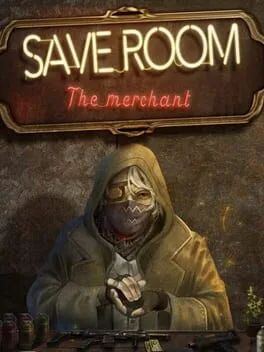
Save Room: The Merchant adds extra systems on top of the inventory management puzzles of the first game, which unfortunately mostly serve as extra steps of busywork that don’t add anything particularly interesting. Each puzzle must in effect be solved twice: Once with a starting inventory of treasures which can then be sold for cash to buy the weapons one must then stack into the same shape. But each puzzle really only feels designed with one or the other in mind, with one inventory slot-sized gems or eggs filling out the rest of the space for the other half, and as it adds in cleaning treasures, buying partial treasures off of the merchant to complete and sell back and upgrading weapons more and more time is spent going in out of different menu screens in between being able to do the actual spacial arrangement. Also I would have enjoyed if the female merchant sounded a bit more like a fucked up bog pervert like the guy from the original game.
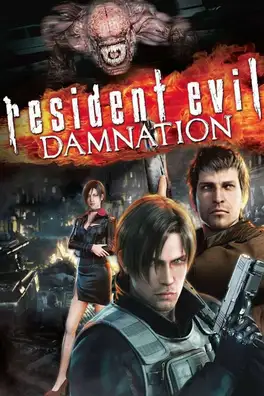
No one can do anything without the backup of the American government.
Perhaps the apex of Resident Evil’s post-9/11 degeneration into bizarre, international, political conspiracy, featuring a confused Ukraine standin called the Eastern Slav Republic, a former Soviet state that seems to be simultaneously an unrecognised polity that is not a member of the
The confusion about what exactly is going on in this country may be because most of the film follows the perspective of Leon Scott Kennedy, an American anti-bioterrorism agent sent into the state to investigate whose understanding of the delicate political situation he finds himself in is such that he doesn’t know who the president of the
But the heart of the film is J.D., a rebel whose entire personality is that loves American action movies and wants to hang with his bros. He has fifty
The film continues on for a while after this with lots of action scenes of varying levels of quality and misogyny until at the climax everything that Leon and the rebels fought for in the end is rendered entirely pointless because the
J.D. is so right action movies rock.
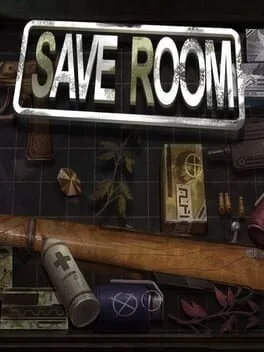
This is such a cute little concept, taking the famous inventory Tetris of Resident Evil 4 and turning it into a series of puzzles. It wears its heart on its sleeve, not only trying to replicate the inventory screen itself, but pulling all of its items from the series, but setting the tone with its own version of save room ambience playing in the background.
And as it layers complexity and more forward planning into the game it continues to pull from the Resident Evil series for inspiration, using gunpowders to make ammunition like in Resident Evil 3, having to figure out the best way to combine and sequence healing items in order to use them as (in)efficiently as possible to free space and, of course, reloading your guns in inventory.
As charming as it is, the puzzles do swing from trivially easy to frustratingly fiddly to fit everything together, but it’s always satisfying to finally get the rocker launcher and submachine gun to finally fit together in a way that leaves room for the magnum.
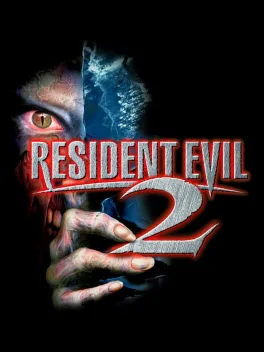
Playing old pre-rendered games in a high resolution on a modern display looks wrong. The models rendered so much more crisply than the backgrounds stand out like an actor on a bad green screen. Instead of any
The fixed camera angles and pre-rendered don’t just look good and are not just solve a technological problem as a way of representing a three-dimensional environment in much higher fidelity than would otherwise have been possible on the hardware, they create a bold style that holds up strongly and allow for some wonderful dramatic framing allow important gameplay elements to be highlighted by the camera itself. Catching a glimpse of a licker for the first time crawling along the outside of a window, only to go into the next room and be met with a high-angle shot of the player character through another window from outside, as if being watched and stalked by something, is particularly memorable. There are some awkward angles and cheap out-of-frame ambushes, but it is more than worth it for the experience they bring and clear sound design and characters automatically looking towards points of interest usually gives one more than enough context for what is off screen.
The tank controls are great. I will not wrap this up in talking about them as “of their time” or a compromise. They are not awkward; they are a fluid means of navigation and with some practise weaving through zombies with them is a joy. Not that they are easy or that I have mastered them—they take concentration and dexterity and I still got bit plenty of times. Safe navigation is part of the challenge and part of the tense calculus of the game. Health, ammunition and inventory space are precious resources and every excursion must be balanced against this. You can save bullets by risking running through the horde, you can take health sprays to mitigate any damage you might suffer from a misstep or from getting corned by a mutant you weren’t expecting to encounter, or you can travel light to maximise the amount of resources you can gather in the field. At least one or two inventory slots given over to keys that are needed to progress, one for a weapon, another for bullets. That’s half of your carrying capacity taken up already before you even bring along any healing items and you will want to be able to bring back any extra resources you can scavenge.
I love how this unpacks as you go through the game. Pressing into the darkness, learning what threats might lurk around each corner, building your mental map of the world. Where are the sa[fv]e rooms? Your home bases, points of refuge with a save point, storage chest and calm, comforting piano against a dark, brooding backing. You learn the layout and safe routes, turning from timid exploration to guided, intentional missions with specific objectives. Zombie hordes are not something to be eliminated without thought, but carefully managed and culled to allow safe passage. The zombie-infested police headquarters slowly becomes familiar operating territory, though it also evolves as you do; zombies spilling into once empty hallways, while lickers crawl their way into once-empty rooms.
I was surprised, though, to be reminded of just how much the game immediately throws you in at the deep end. I played this game many times as a child, but this is my first time coming back to it in two decades with the
After the police station the game turns more linear than I remembered. Even the Umbrella laboratories, while it has some back and fourth, do not have the interconnected layout of of the police station. There’s generally only a single route between any two points and some key items are simply left adjacent to where they are needed. This was somewhat disappointing and can feel like the game is running out of steam but it does play into the escalation of action that is taking place, which itself is already much heightened from the first game. Even outside of the opening gauntlet I was surprised by how many zombies this game throws at you from the get-go and the sheer tankiness some of them can have—the inconsistency in how many shots it can take to kill things and how often they play dead is also something one needs to take into account in one’s risk calculus.
I played Leon’s
Conversely to its surprisingly straightforwardness in the
There appears to be a consensus online that the Claire
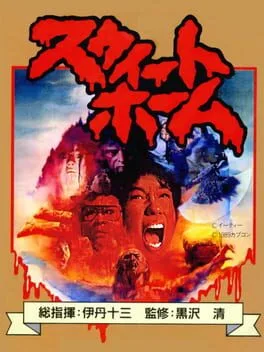
An interesting game, though not the kind that I have the patience to stick with these days. Very clearly a game intended to be played over and over to learn its and try to get further and further in each time, trying to lose fewer party members to the traps and monsters.
But even trying to play it once is a slog. Grinding out random encounters while dealing with very limited healing while keeping track of inventory and stats across five characters would be straining enough without the archaic interface. I am usually the last person to say that games have aged poorly and need a mechanical refresh, but way this game handles gameplay complexity with the limited interface of the
Like an old-school point-and-click adventure game one must select from a list of verbs to interact with things, despite only one action being relevant for a particular type of object. To talk to someone walk up to the, open the menu, and scroll down to the “talk” option. To look at something, walk up to it, open the menu, and scroll down to the “look” option. To pick up an item open the menu, scroll down to the item option, then select an empty slot (of the right kind, weapons can only go in the weapon slot, which is not marked as such in-game, only described in the manual), and select “move” to move the item in front of the current character into the empty slot. An
Party management is similarly fraught, with five characters who can be dynamically split into parties of up to three other characters. This could be interesting, but in practise one will want to keep everyone together most of the time, both for strength in numbers for fights and to carry items necessary for progression as each character only has two free inventory slots. As such swapping between at least two groups (more menuing) is needed.
I knew I wasn’t going to stick with the game and I took my first really disastrous combat encounter with an animated, severed torso as an excuse to call it quits and look at the rest of the game via a longplay.
I think there is an interesting tension here in trying to manage one’s resources, balance limited healing supplies and rescue items with keys and puzzle pieces, trying to make sure everyone is as well-equipped as possible but also ready to take new resources as needed that could be rescued from the excessively menu-based micro-manage, frustrating random encounters and a few other annoying mechanics and you would have a solid base for a tense, interesting game.
And of course, famously, Capcom did do that and it was called Resident Evil.
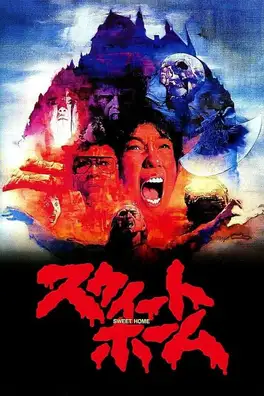
The haunted house plot is fairly generic, but what stands out are the special effects. Sometimes over the top to the point of comedic, often very effectively creepy, but generally great-looking either way.
Resident Evil 10 should be called REX: Dino Crisis
I previously posted lists I’ve made picking one game and one film per year since 1990. 1990 acted as a good arbitrary stopping point as it’s a nice round number, it’s the year I was born and the number of games I’ve played at all from before then is pretty small, and it would be be fairly difficult to pick out shows for each year before then for me too. I’ve made a dedicated page on the site for these picks, made a few substitutions, added a pick for each for 2025 and added one series of television per year as well. All put into one table with the ability to toggle off which media you want to see selections for as well as some dynamic rearrangement based on screenspace, all done with (a horrendous mess of) Cascading Style Sheets and no Javascript.
These are not necessarily my favourite from each year. I have tried to be deliberate to give a spread of different styles and series I like as well including some weirder picks. Especially with games I spent a lot of time weighing choices for particular years based on what series I wanted to include and some years are just packed with formative games for me. 2001 has Metal Gear Solid 2, Silent Hill 2, Commandos 2 and Halo (and Grand Theft Auto 3 and Advance Wars and Worms World Party…). I eventually gave the year to Metal Gear Solid 2 after weighing up that I could have Resident Evil 2 and Silent Hill: Shattered Memories covering some bases for Silent Hill 2, Shadow Tactics was spiritually taking up a place for the Commandos series and there’s already plenty of shooters there to justify dropping Halo.
Similarly Prey is spiritually covering for System Shock so that I can have a childhood favourite Soleil for 1994 and Half-Life would probably beat out Resident Evil 2 in a head-to-head but there’s already two Half-Life games on there and I wanted it to carry the survival horror water for both the aforementioned Silent Hill 2 and for the REmake that got booted out from the previous iteration to make room for Robot Alchemic Drive. And yes after going on about carefully spreading out my choices I did give three picks to Sonic games, one to another Sonic Team-developed game and two more to Sonic-inspired indie games (and four different series of Doctor Who for the TV list). I will not be taking feedback on this.
Again the page is here and the lists are also on my Letterboxd, Serializd and Backloggd accounts as well as a second Letterboxd list covering the years 1970-1989.
Very upset that my title pitch got rejected.