

Sweet Home
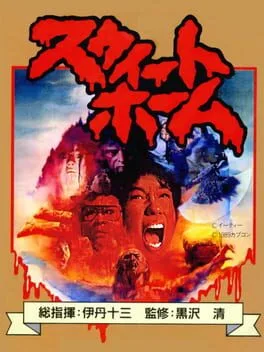
An interesting game, though not the kind that I have the patience to stick with these days. Very clearly a game intended to be played over and over to learn its and try to get further and further in each time, trying to lose fewer party members to the traps and monsters.
But even trying to play it once is a slog. Grinding out random encounters while dealing with very limited healing while keeping track of inventory and stats across five characters would be straining enough without the archaic interface. I am usually the last person to say that games have aged poorly and need a mechanical refresh, but way this game handles gameplay complexity with the limited interface of the NES leaves a lot to be desired.
Like an old-school point-and-click adventure game one must select from a list of verbs to interact with things, despite only one action being relevant for a particular type of object. To talk to someone walk up to the, open the menu, and scroll down to the “talk” option. To look at something, walk up to it, open the menu, and scroll down to the “look” option. To pick up an item open the menu, scroll down to the item option, then select an empty slot (of the right kind, weapons can only go in the weapon slot, which is not marked as such in-game, only described in the manual), and select “move” to move the item in front of the current character into the empty slot. An RPG from any later generation would simply have these actions be contextual.
Party management is similarly fraught, with five characters who can be dynamically split into parties of up to three other characters. This could be interesting, but in practise one will want to keep everyone together most of the time, both for strength in numbers for fights and to carry items necessary for progression as each character only has two free inventory slots. As such swapping between at least two groups (more menuing) is needed.
I knew I wasn’t going to stick with the game and I took my first really disastrous combat encounter with an animated, severed torso as an excuse to call it quits and look at the rest of the game via a longplay.
I think there is an interesting tension here in trying to manage one’s resources, balance limited healing supplies and rescue items with keys and puzzle pieces, trying to make sure everyone is as well-equipped as possible but also ready to take new resources as needed that could be rescued from the excessively menu-based micro-manage, frustrating random encounters and a few other annoying mechanics and you would have a solid base for a tense, interesting game.
And of course, famously, Capcom did do that and it was called Resident Evil.