
silly British politics hypothetical
UK government invents a new nonbinary pronoun stating with H so that they don't have to change all the HMX initialisms for a new monarch
Heir Magesty’s Revenue & Customs
UK government invents a new nonbinary pronoun stating with H so that they don't have to change all the HMX initialisms for a new monarch
Heir Magesty’s Revenue & Customs
This post discusses and shows comics that are misogynistic, transphobic, anti-Semitic and fascistic.
If I there is a throughline to the writing on this bog (other than depression and Sonic the Hedgehog shitposts) it’s me gradually learning to reject shame around sex, and today I would like to talk about an awful, hateful webcomic as a cautionary tale about what happens if you just let that shame fester, instead.
Sinfest is a webcomic drawn by Tatsuya Ishida that has been running daily, with, as far as I am aware, no breaks, since the
The first decade of Sinfest’s publication is characterised by it presenting itself as an edgy, alternative newspaper comic strip, though it never managed to get picked up for publication outside of its own website.
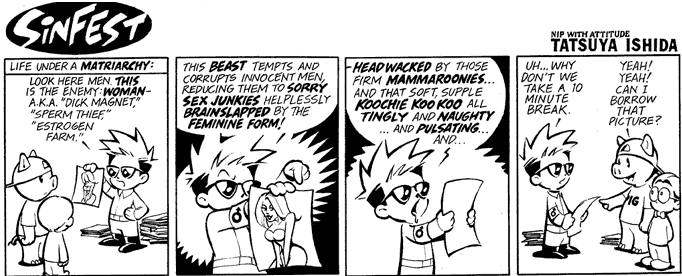
Much like newspaper comics It even had bigger, full-colour Sunday strips:
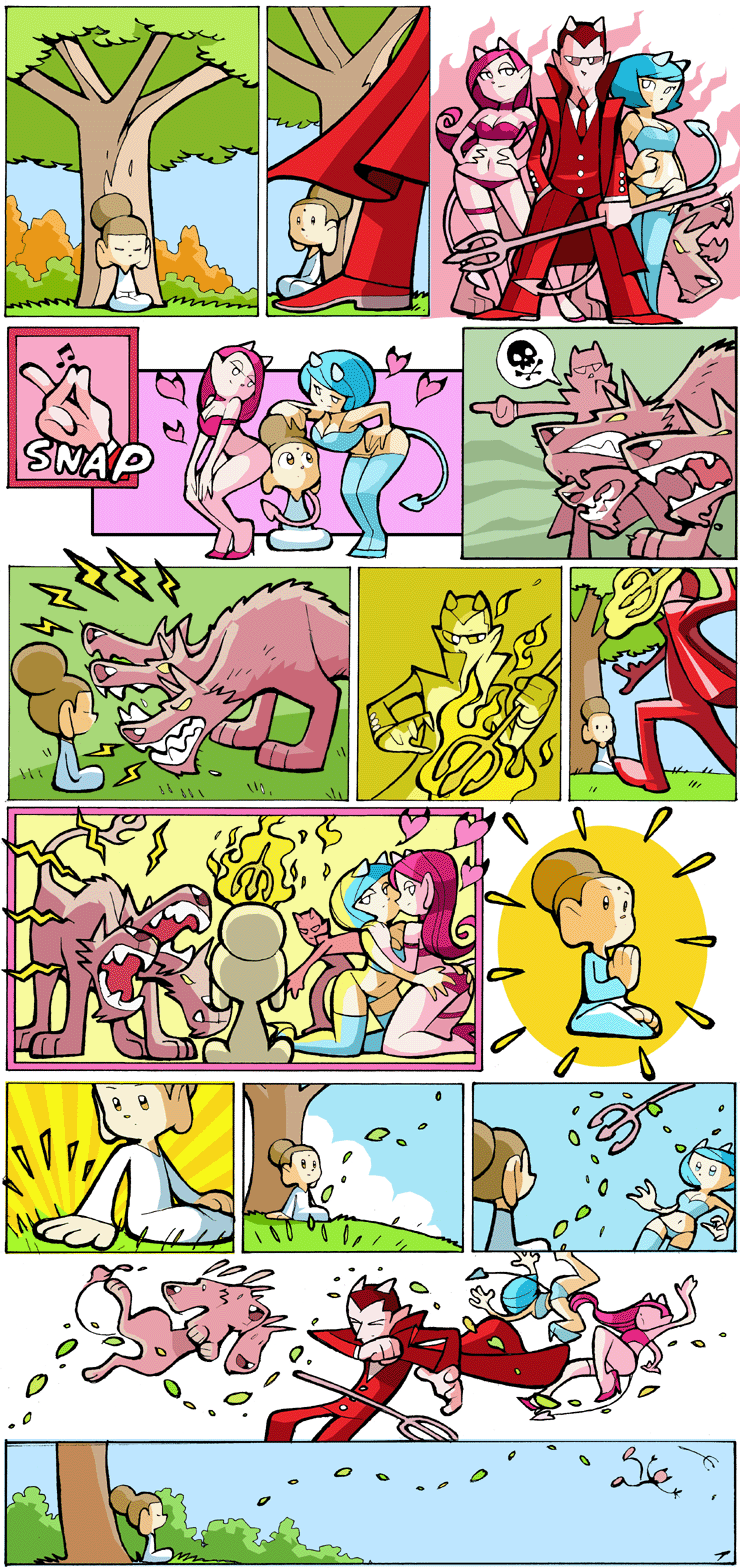
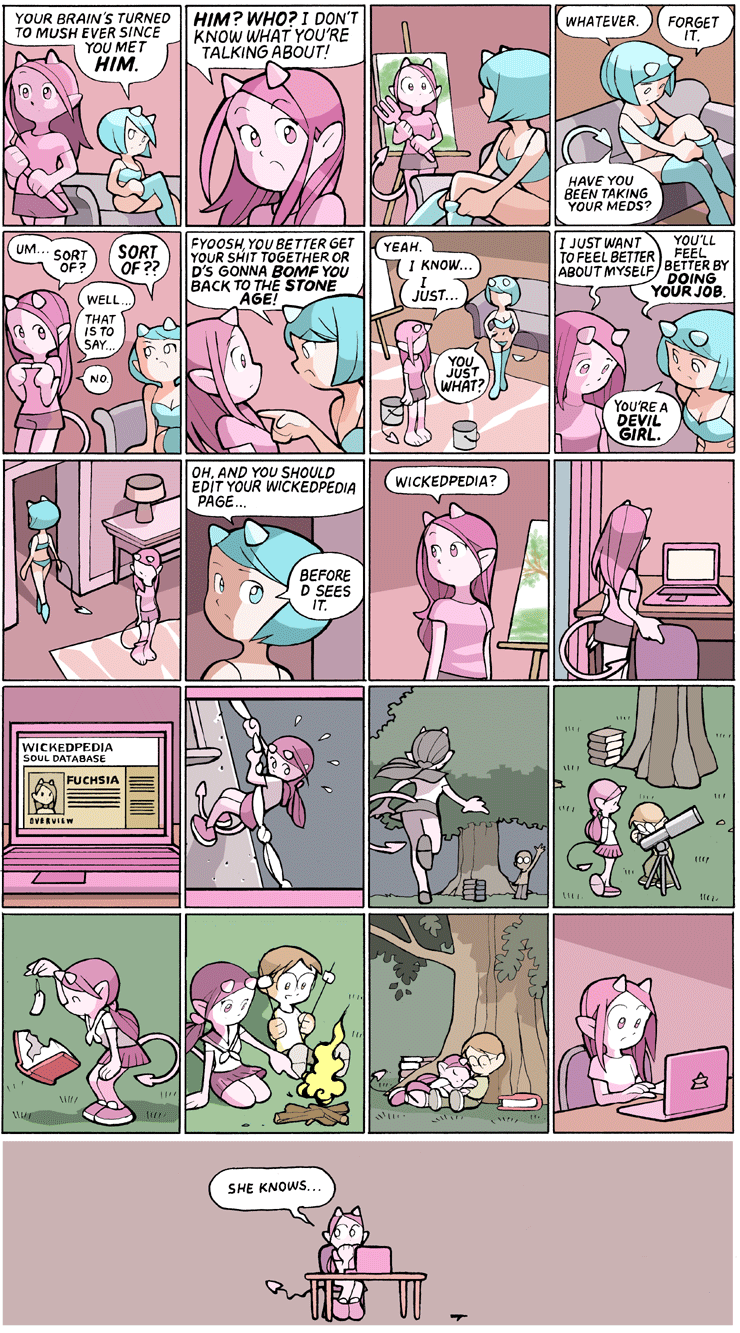
These two strips are not representative of the whole comic, there is a large variety of topics, bits, characters and storylines that emerge throughout Sinfest’s run, but the temptation and sinfulness of women’s bodies runs through the whole thing. Ishida loves drawing sexualised women but is never fully comfortable with doing so. Initially, as seen above, irony is used to distance himself from it. The pinup is part of a joke about horny men, the demon girls, Fuchsia and Blue, are a temptation that is comedically rebuffed. But as storylines for these characters evolve, desexualisation is used as a shorthand for goodness and turning away from sin and evil. Fuchsia starts to lose her interest in torturing the souls of the damned and fall for a boy, and as she does she starts to dress much more cutely and innocently.
This line of thinking eventually leads to Ishida’s embrace of radical feminism.
Starting in 2011, Ishida starts introducing The Sisterhood.
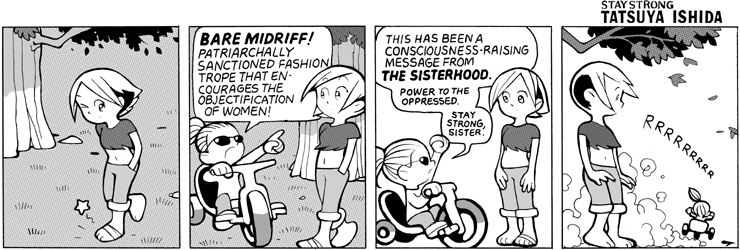
This might read as a joke making fun of the girl on the tricycle for being unreasonable and hypocritical for lambasting a woman for her choice in fashion, but no, this is meant sincerely, even if presented in a humorous way.
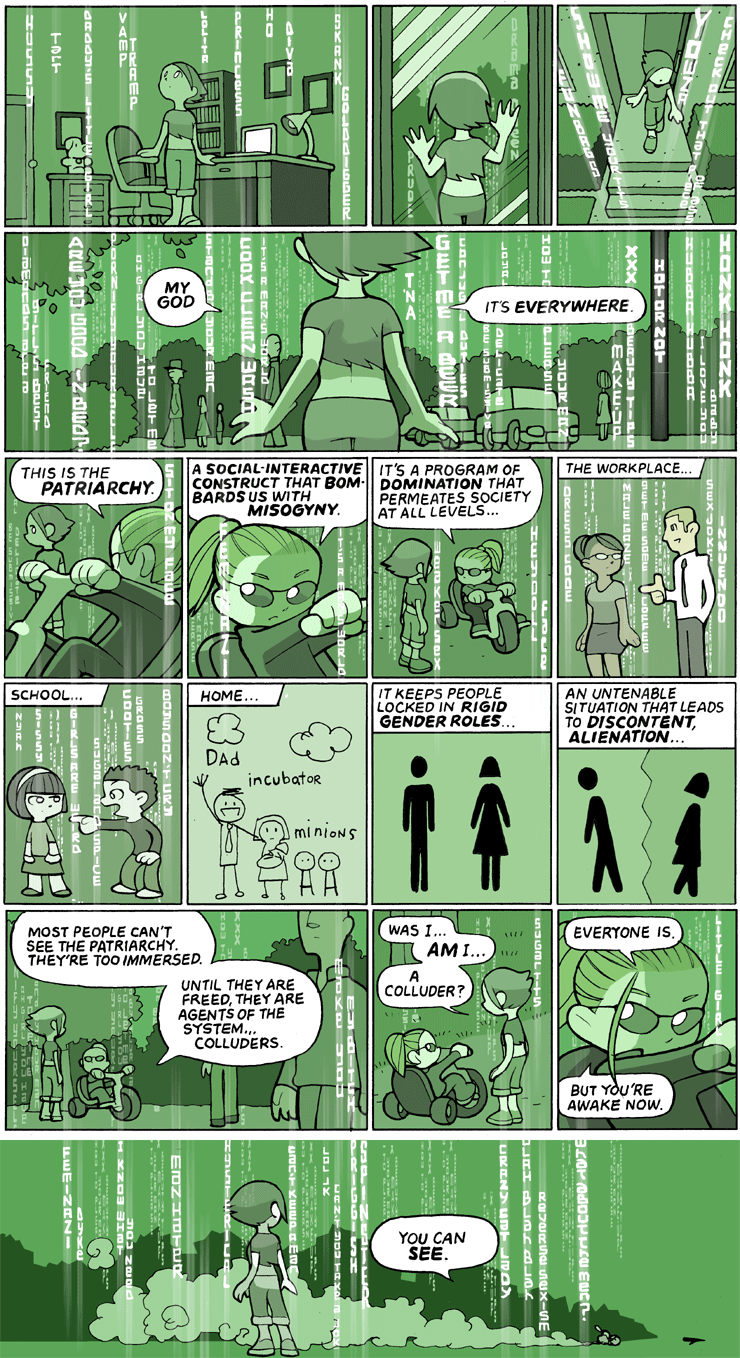
In this period Monique, midriff pictured above, becomes a political lesbian and her one sapphic relationship is depicted as entirely sexless, pure. Lesbians don’t find each other sexy, only men do and that’s evil! Sexualisation in general is somewhat toned down in this period, but Ishida still sometimes indulges in showing how awful the patriarchy is by drawing some sexy, sexy, fembots who need to be rescued by The Sisterhood, who are made of of childlike—and thus desexualised and innocent—militant feminists.
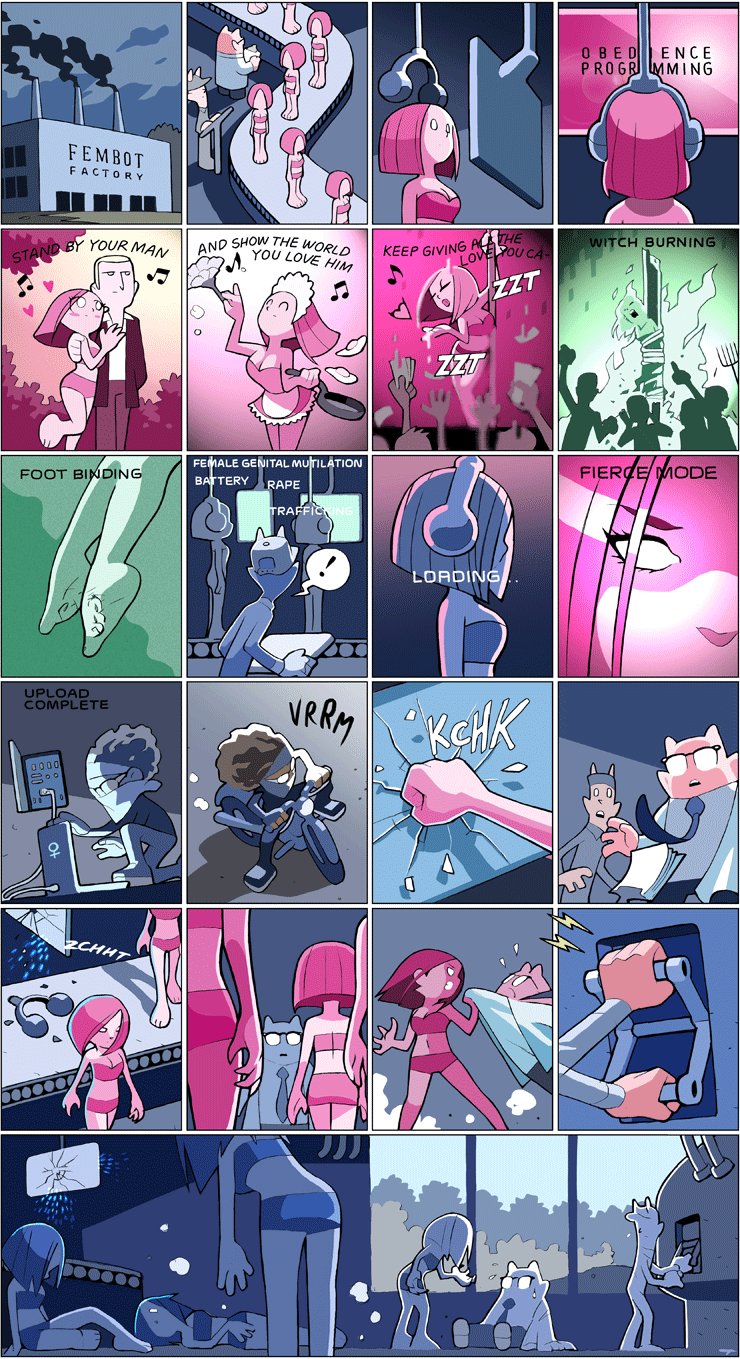
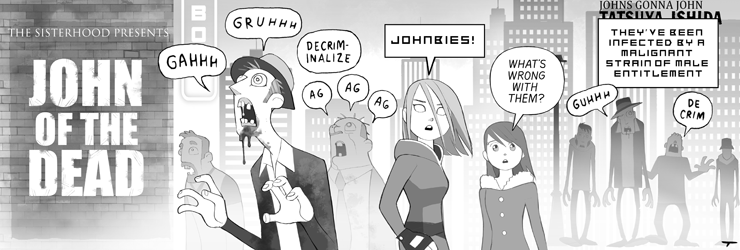
Eventually Ishida focuses specifically on being anti-sex work and introduces Johnbies, framing the position of decriminalising of prostitution as the position of brain-dead, entitled men who just want access to women’s bodies.
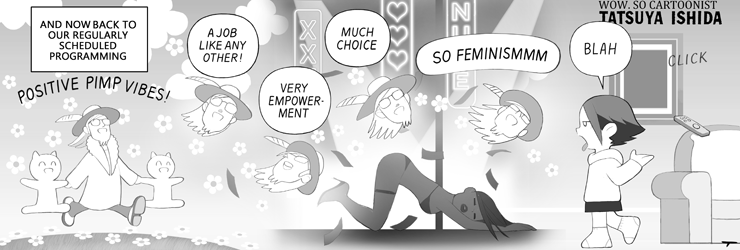
Which, of course, gives Ishida licence to draw some lithe, seductive strippers and hookers to illustrate how vile and immortal sex-positivity is.
Inevitably this obsession with protecting women’s vulnerable, hot bodies from evil men evolves from
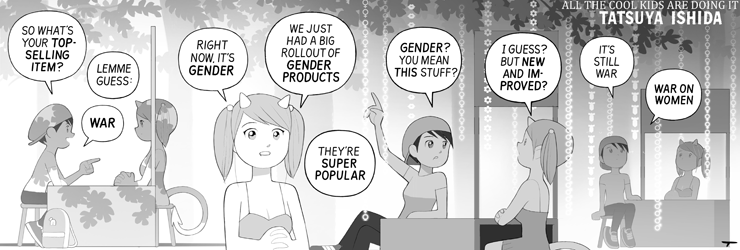
Transition is portrayed as an enforcement of the gender binary, enforcing sexualised, submissive hyper-femininity on women and aggressive hyper-masculinity on roided-out, sex addicted men.
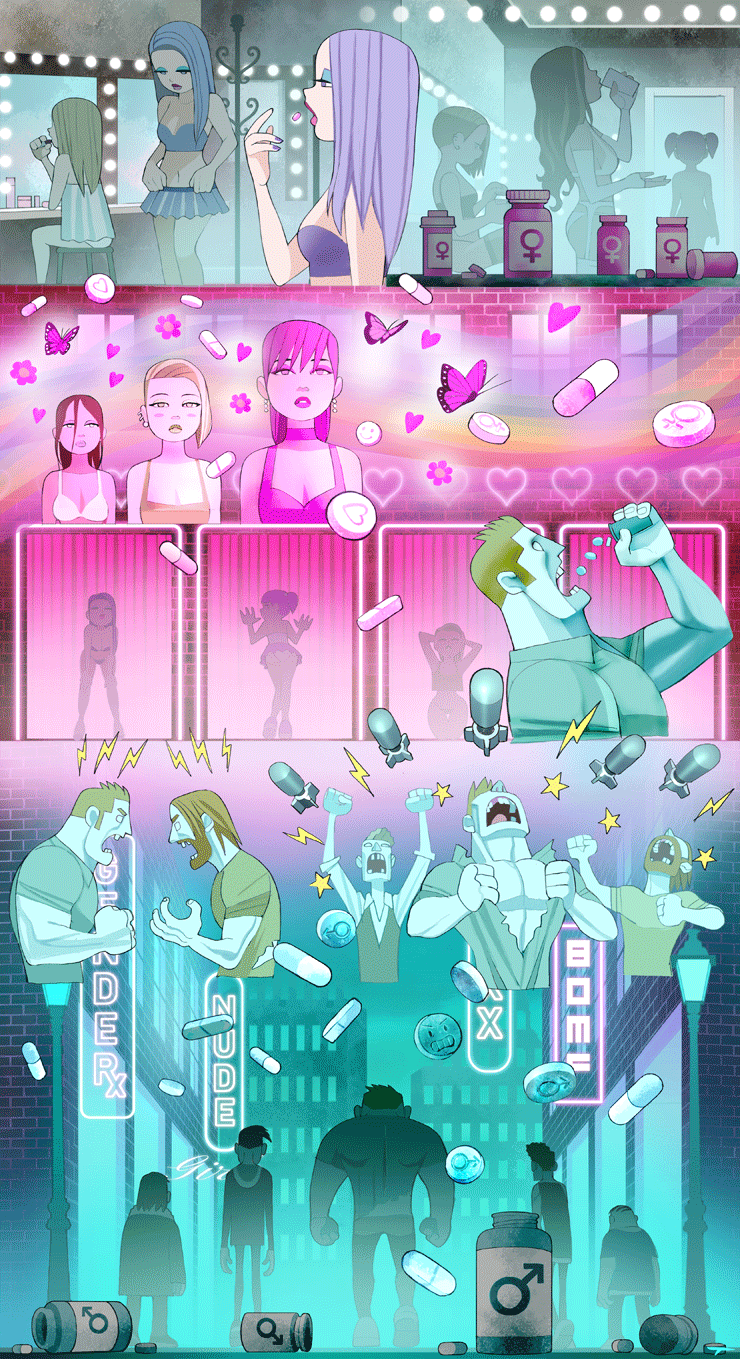
And Johnbies start being used as a shorthand for people brainwashed by gender ideology.

If this is all starting to seem less and less feminist and more and more conspiratorial to you then you will probably not be surprised to learn Ishida’s opinions on
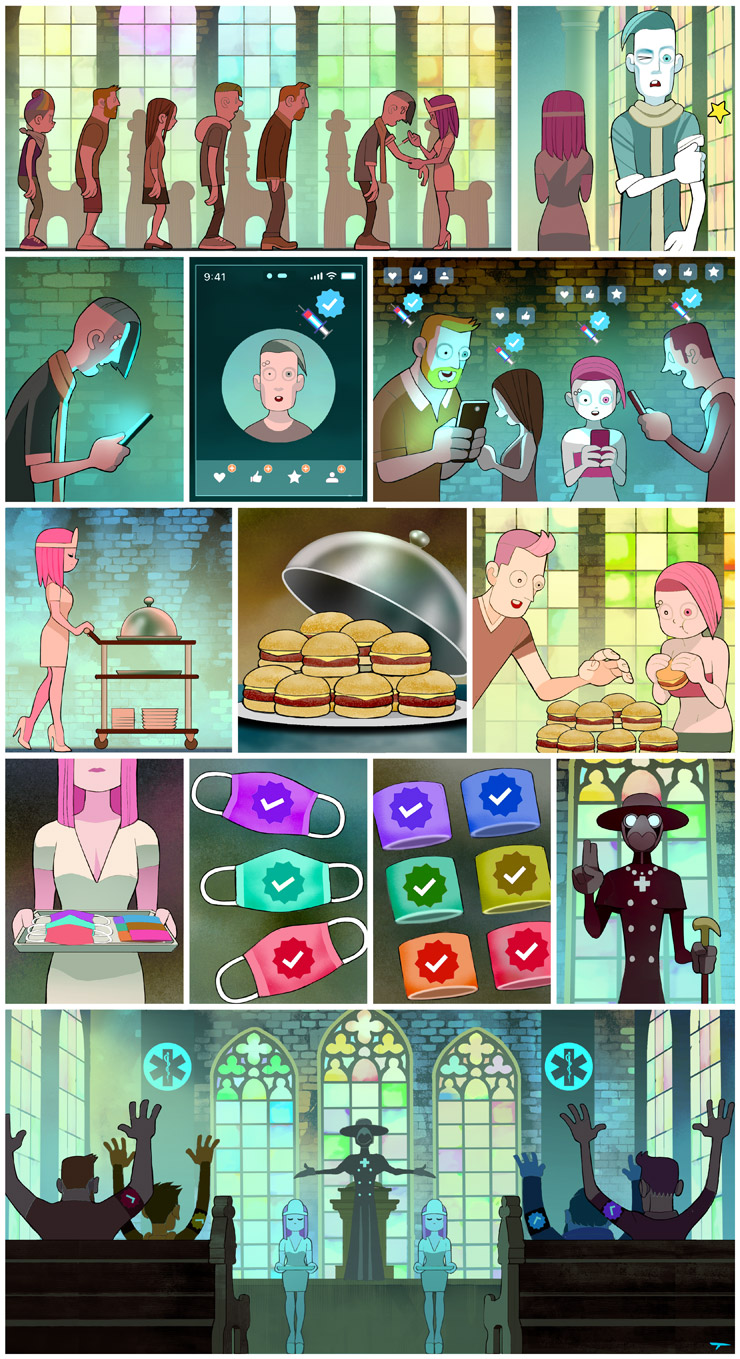
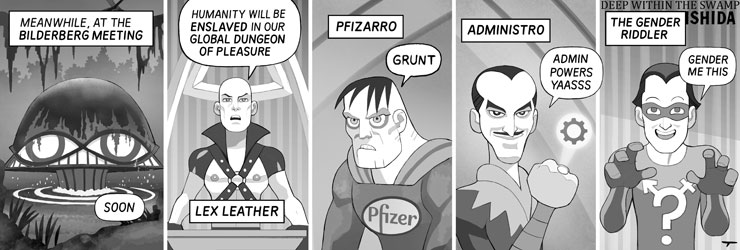
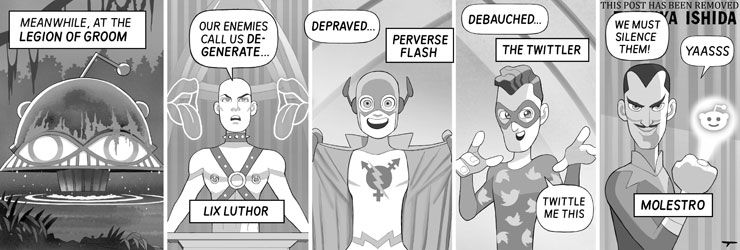
Vaccines, gender, oestrogen-riddled vegan burgers, people who are verified on Twitter, Nazis, the sexualisation and subjugation of women, religious dogma. These are all the same thing. These are all the woke mind virus and it’s coming for your children! It doesn’t take very long after this for Ishida’s feminism to be indistinguishable from
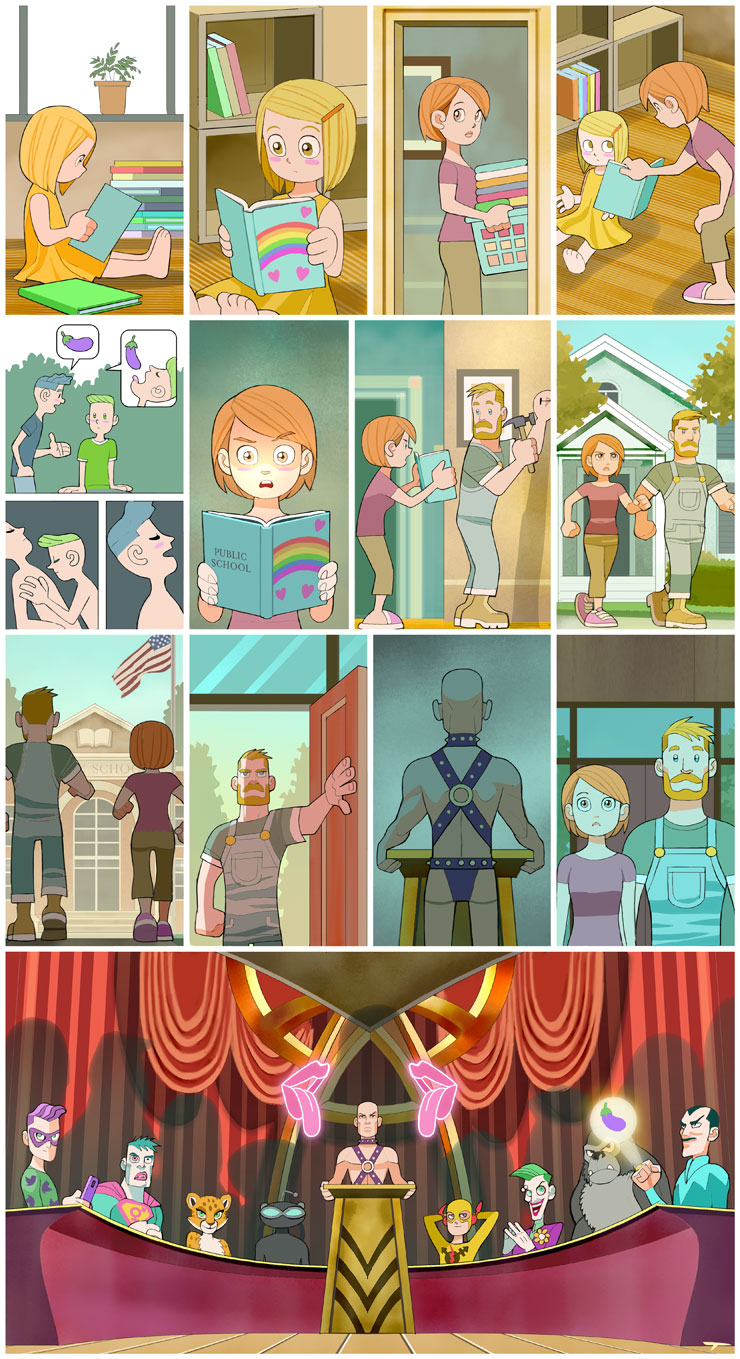
Also just look how bad this art is. See how stiff and lifeless everything looks compared to the earlier strips. The parents don’t even look like they’re moving. How do you draw every day for two decades and get worse and worse at it? And he was so proud of the woke Legion of Doom bit that he did basically the exact same comic in June and then again two months later in August.
I don’t think I need to keep tracing the rest of Ishida’s political trajectory in detail. It will suffice to say that, like many others, his obsession with trans people lead him deeper and deeper down the conservative rabbit hole until he became an open Nazi. And I don’t mean that as a pejorative or exaggerated statement of unpleasant beliefs, I mean he genuinely thinks that the Jews are behind the fall of the West and the Third Reich was in the right.
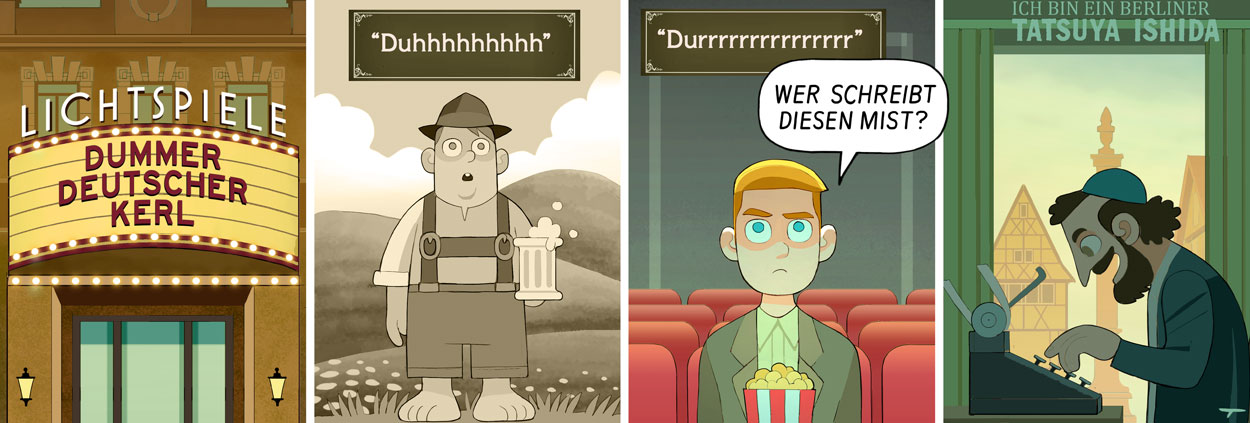

I have never been a fan or follower of Sinfest, even before it’s descent into open fascism, but I would occasionally see people online discussing its weird turns and every once in a while I would have a look at it out of morbid curiosity to see how bad it could get. It was fascinating to watch someone go down this path from radfem to proudly declaring how the white race must reclaim its culture despite, as you might have guessed from the name, Ishida not being white himself. And sometimes he would drop something incredibly funny in how pathetically low-effort it was like the Gender Riddler.
But eventually Ishida published a strip I felt finally made the story of the degradation of this man’s art and soul make sense to me, that made the pieces click together in my mind, and after that I stopped having an interest in subjecting myself to his work.
Sinfest features a lot of rambling, repetitive storylines that start off self-contained an then shift suddenly back to Ishida’s bugbears (though really that has been, for a while, just The Jews), but in April of 2025 he started a riff on Snow White.
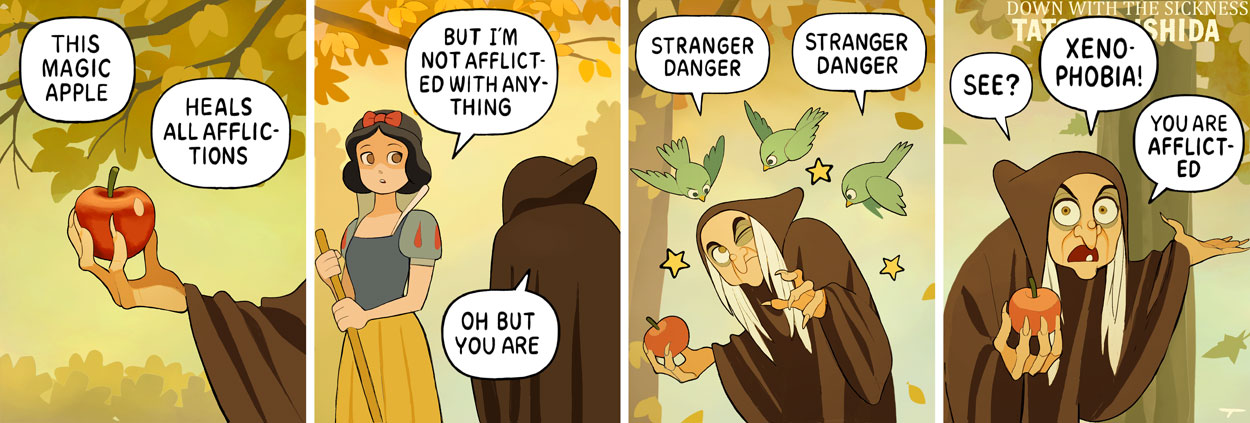
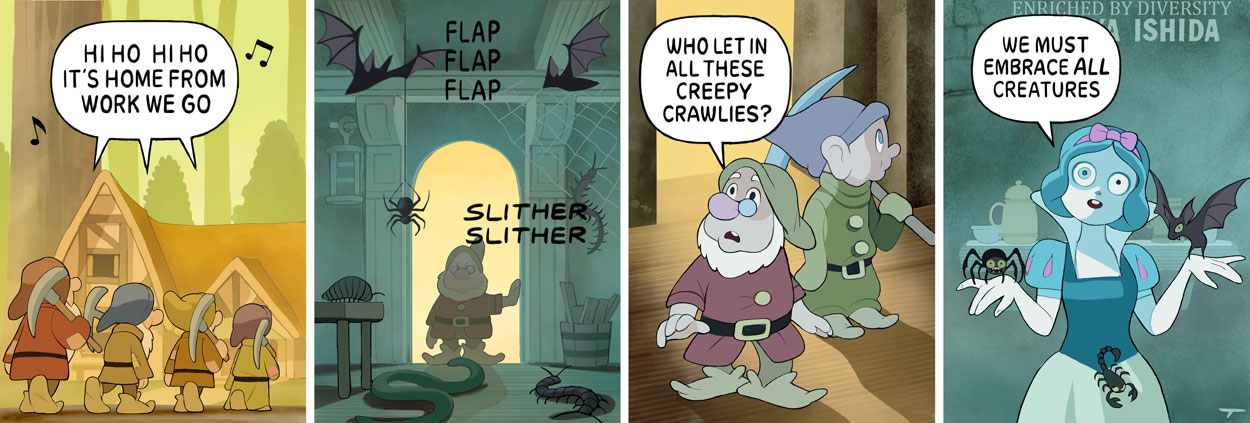
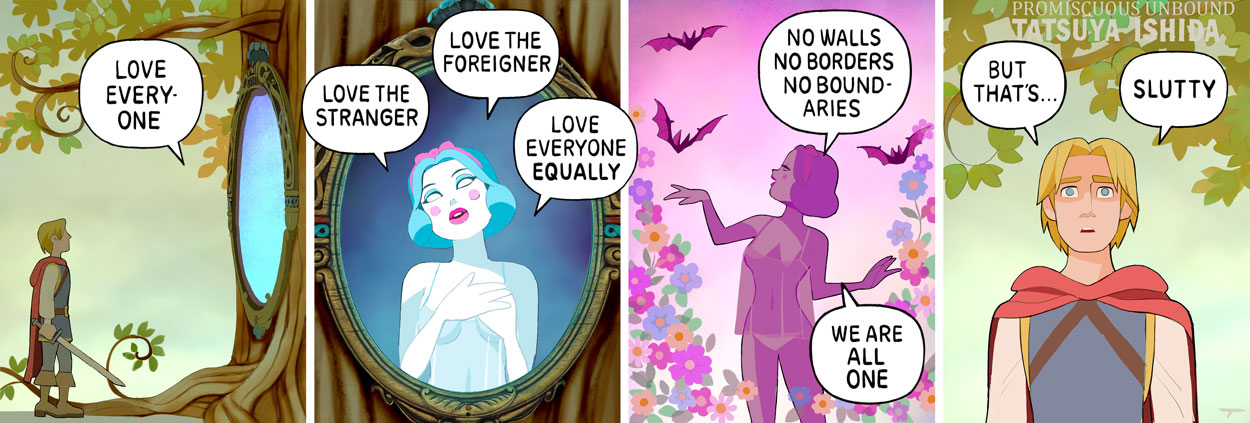
The poison apple is overloaded as a signifier for so many things that Ishida has railed about over and over again. Liberalism is a Jewish plot to trick people into open borders to allow the great replacement, gender ideology and sex-positivity is a Jewish plot to brainwash women into being sluts, porn is a Jewish plot to weaken men, Christianity is a Jewish plot to make the West weak and gay. It is, quite frankly, as tiresome as it is vile. But what stood out to me was not Snow White herself, but the prince.
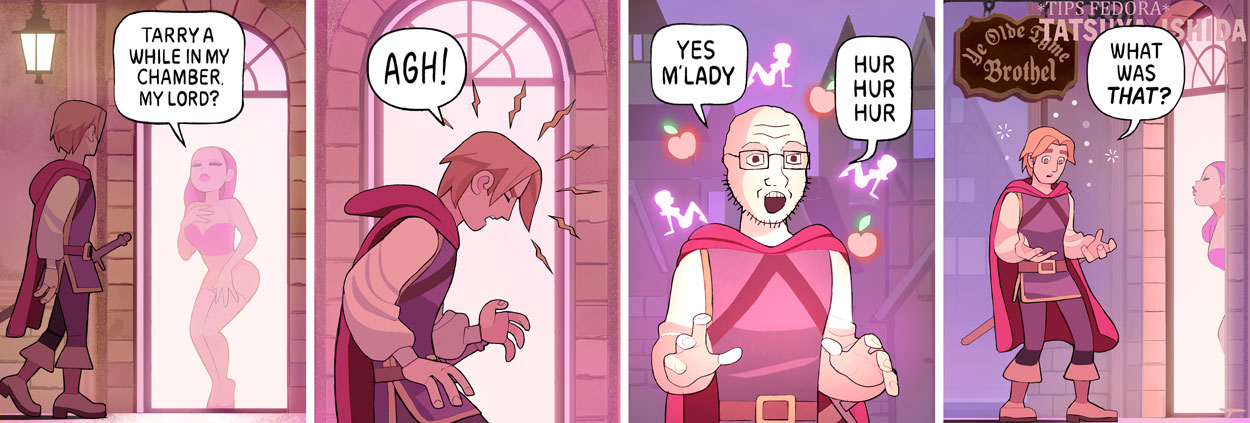
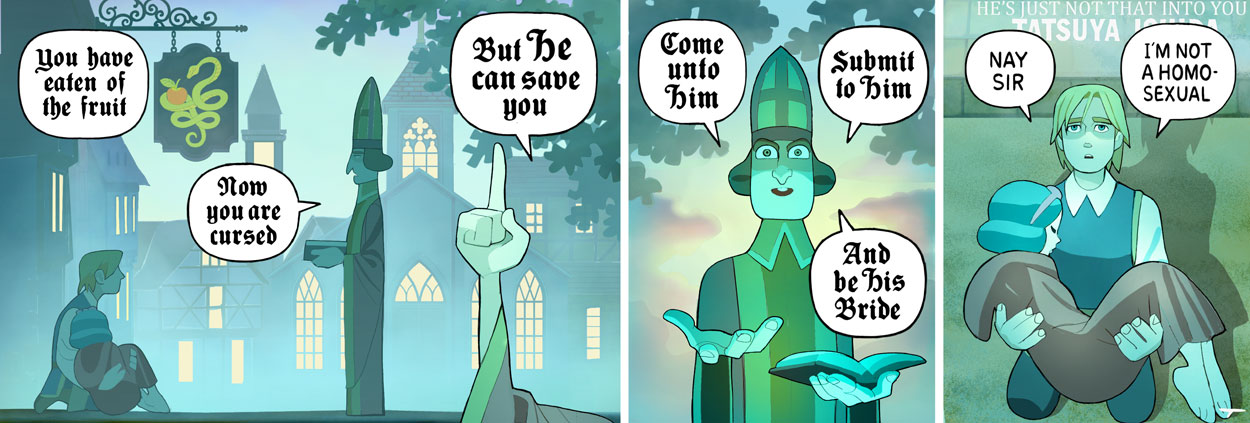
The prince, on a mission to rescue Snow White from being a slutty little slut, also takes a bite of the poisoned apple and starts to fall to temptation, turning into a soyjak Johnbie the moment he sees another sexy woman and then just, dying of being horny I guess?
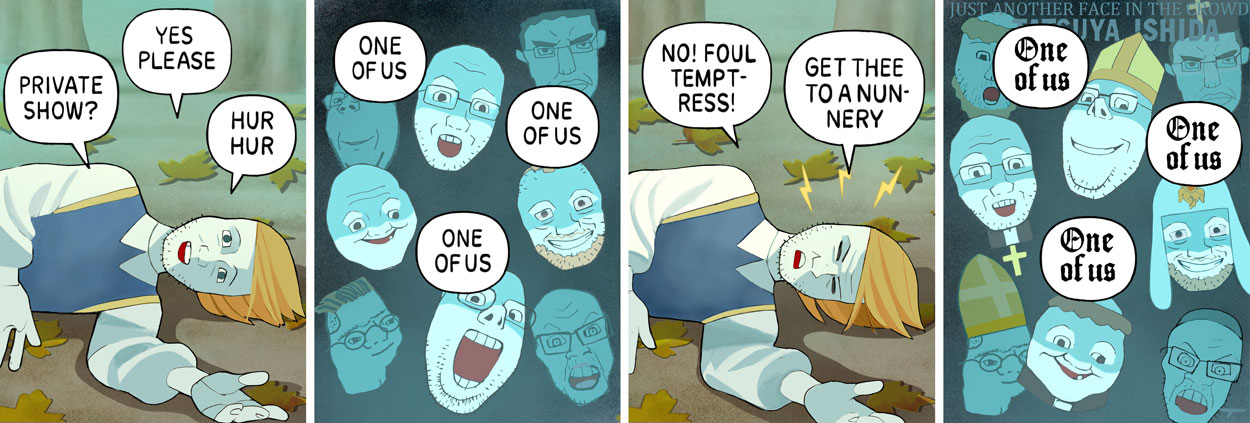
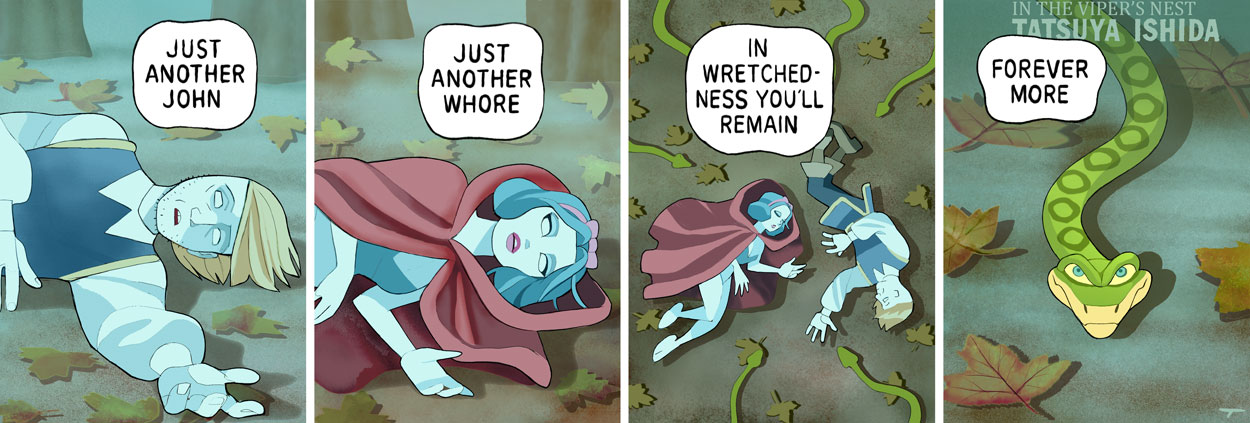
And I feel like this summarises the poison at the heart of Sinfest—its original sin and the constant throughout the entire thing: Ishida feels guilty over finding women sexy and enjoying sexualisation. From the early ironic sinfulness, to the feminism, the anti-trans crusade, the conservatism and the fascism, he loves drawing women’s bodies in a sexualised manner and hates himself for it. He is the prince, failing to live up to his morals and finding enemies to blame for turning women to vile temptresses that he lusts after and cannot reject the allure of. Who is sexualising all these awful whores? The Devil! The patriarchy! The sex-positivity movement! The queers! The liberals! The communists! The Jews! Not Tatsuya Ishida, certainly.
The Snow White plotline does not actually stop there—the power of true love magically saves Snow White and the prince and they become a perfect, chaste, heterosexual couple and comic kind of loses track of any kind of coherent plot as it goes into various tangents about the Jews and woke brainwashing again because Sinfest is just a very bad comic even outside of its politics—but for me that was the real end of Sinfest. I had been fascinated by seeing the
Don’t read Sinfest.
Vols.: Ⅰ, Ⅱ, Ⅲ, Ⅳ, Ⅴ, Ⅵ, Ⅶ, Ⅷ, Ⅸ, Ⅹ, Ⅺ, Ⅻ, ⅩⅢ, ⅩⅣ, ⅩⅤ
I find myself feeling rather inarticulate this afternoon as I sit down to write this, so my comments on each piece shall be brief.
Sandustry is probably the first factory game I've played that really communicates the physicality of industrial waste, the appalling magnificence of it, for all the dinkiness of its 2D artstyle. It's the only factory game that really makes me think of post-industrial landscapes, like those colossal spoil piles above Aberllefenni. It also engineers a weird exuberance inside the concept of 'byproduct'.
It’s been added to my Steam wishlist.
I gestured briefly at the PASSTHRU folder earlier, but I really want to dig deeper into that because this is something very cool. I said before that when you're connecting to a BBS like this, you're connecting to one system rather than the internet as a whole. This is a bit of an exception to that. FirstClass had support for what they called "relays", which allowed BBSs running the same software to talk to each other and exchange messages. It wasn't a realtime connection; this still isn't the internet. It's a little bit more like snail mail. The servers would sync with each other every day, or once every few days, fetching new replies in the conferences they were sharing and transmitting any replies that had been made from a different server. It's quite a bit more "slow internet" than we'd probably tolerate today, but in the pre-internet era the idea you could be talking to these other communities at all would have felt revolutionary.
A really interesting look at early digital communication.
A little over a year ago, I published a post (“I wasted $410 recreating a fake website that shows up for 10 seconds of a TV show almost no one remembers “) about having re-created a website that showed up for a few seconds in an episode “H2O: Just Add Water”. In the title I described it as “…a TV show almost no one remembers”, which was evidently incorrect, because after posting on Mastodon I discovered that it seemed to be widely known amongst German audiences.
There’s one more fake website that appears in H2O: Just Add Water: greekmythicalcreatures.com
This is just very cute.
To understand why every machine since Gutenberg has wrestled this script and mostly lost, you need one structural fact: Arabic is cursive always. There is no print-versus-handwriting distinction, no block letters. The letters connect in stone inscriptions, in manuscripts, in metal, on screens. Each letter therefore changes shape depending on its neighbours (an isolated form, an initial, a medial, a final), and six letters refuse to connect forward at all, which breaks words into joined clusters and gives the script its rhythm. The shapes are not costumes over some underlying "real" letter. The positional variation is the letter.
Really good read on the history of digital typography for Arabic. Seen from Natalie Weizenbaum sharing it. Speaking of…
I really do think you should learn to use the Linux (or Mac, I suppose) command line if you can find the time at all. It is, genuinely, a dramatically more empowering way to use your computer than the alternative, and it will enable to think about your computer as a tool in ways that are completely different.
Cocosigning this post and Weizenbaum also gives a nice quick primer of navigating the command line.
If we were to go by actual lines of code, generated projects easily contain over tens to hundreds of times more documentation and code than human-made ones do. This is intentional by design: the AI companies do not want these projects to be maintainable by anything but their tooling, so you'll have no choice but to keep paying them to work on it.
A good Reddit post from an accomplished game modder on the problems of maintaining or working with generated codebases.
Unlike, say, Brexit which had rights implications but could point to democratic inputs (however flawed), nothing in the story I told above was backed by any democratic input of any kind. In fact, all of it was elites acting in explicit defiance of the democratic inputs they did receive.
Buckle hammers home how utterly undemocratic the movement against trans rights in the
The oft-used phrase, squeezed middle, may indeed apply here – not in the mainstream media meaning of cost-of-living and prices, but rather in terms of position-of-production and power. There is of course a qualitative difference between a pushbike and heavy goods vehicle, but when seen in terms of mode and relations of production that difference somewhat fades.
A Marxist analysis of the class position of the Irish fuel protests from earlier in the year.
Protection of the property-owning class has been the water that Irish politics swims through, invisible to its fishy participants but explaining nearly everything. It is why our housing crisis exists and why it cannot, apparently, be solved. Solving it would mean a political evolution on a scale of growing legs and lungs and actually climbing out of that water.
An essay on the class priorities of the Irish governments of the last century.
Last week I researched the first labor strike in known history. The tomb builders living in a town called Deir el-Medina in Egypt went on strike on November 14th, 1152 BCE. Three thousand, one hundred, and seventy-eight years ago. And their strike looked an awful lot like ours today. They set down their tools and staged sit-ins, they blocked roads, they marched, they engaged in workplace sabotage. They wrote letters to the authorities requesting a redress of grievances. They stole from work. They did everything that we do today.
And a meditation on labour struggle throughout history.
The Jesuits proposed an invasion force to be spearheaded by 10,000 Spanish and Portuguese troops, augmented by 6,000 Filipino auxiliaries and between 5,000-7,000 Japanese Christian mercenaries, leading a two-pronged invasion through Guangdong and Fujian.
A part of colonial history that I had no idea of.
In case you are alarmed by that title and not up to date on Alex Jones’ vile conspiracy theory show: Satirical news site The Onion acquired Info Wars as part of a deal with the families of victims of the Sandy Hook shooting in their lawsuit against Alex Jones and have relaunched it as a satircal Youtube channel. It’s really good. There are various running plotlines throughout each stream, the two big ones being Emergency with Tim Heidecker, which is a fairly direct parody of Alex Jones’ style, and The Jim Haggerty Show, which is more of a parody of general conservative talk shows and features long time Onion character Jim Haggerty having become a conservative grifter, but there are other evolving bits throughout it including various bizarre theme songs and joke ads including ones that are stereotypical viral clips of two podcast bros. They are also selling official gay frog plushes.
Vols.: Ⅰ, Ⅱ, Ⅲ, Ⅳ, Ⅴ, Ⅵ, Ⅶ, Ⅷ, Ⅸ, Ⅹ, Ⅺ, Ⅻ, ⅩⅢ, ⅩⅣ, ⅩⅤ
I keep accumulating links in a drafts for these roundups and forgetting to every post them! Whoops!
I am nearing the end of Furuhata Ninzaburō so in honour of that the musical accompaniment this time will be this remix of the main theme from Dance Dance Revolution
The first people annoyed by basket weaving were not students or faculty but soldiers returning from World War II. Basket weaving was one of many activities used in the relatively new field of occupational therapy. Weaving, knitting, and other crafts were (and still are) believed to help people with mental disorders, which included traumatized soldiers.
I have seen a few people linking to this blog now but I think I may have first saw it mentioned by Laura Michet. Davis dives into the history of terms and jokes that have become so cliché as to fade into the background of culture, their original origin or point unclear. They’re all worth reading but this one in particular shows a fascinating lens on how industrialisation changes culture and the perceived value of skills and how different assumptions that arise from those changes can clash.
The whole design of the traditional English house was based on this peculiar form of life and its associated norms of thermal comfort and management. The English preference for single glazed sash windows and open hearth fireplaces over European-style double casements and stoves was, among foreigners, a baffling but charming eccentricity, generally understood as an adaptation to the wet oceanic climate.
I am a simple girl. Give me an article on how societal conditions shape culture over time and I will probably read it.
Today, virtually every single claim about psychopathy has been either thoroughly refuted or failed to find empirical support in experimental settings. Psychopathy may not exist at all.
It is very difficult to kill an idea, even if that idea has little foundation.
How would an anarchist society enforce traffic laws?” and “how would an anarchist society deal with rapists and other violent criminals?”, and similar, are perennial questions in “anarchism 101” type spaces online. I read an interesting answer on the former question recently. If the goal is increasing public safety, simply demanding that people obey certain rules is not very effective.
The Moon is a Harsh Mistress is a book I have never really known anything about except its title, but I enjoyed this view into it and comparison of it to The Dispossessed and how they illustrate the difference between left- and right-libertarianism.
Another big part of the problem here is the way people engage with stories like this. (Especially young men in their teens or early 20s.) They treat it like it's not a story with ups and downs, but a sport. You root for your favorite characters, and when bad things happen to them that means you're losing.
I am disconnected from fandom spaces in general. Sometimes I catch site of a post, it often involves the phrase “it’s okay to”, that is clearly in response to some utterly baffling piece of internecine drama that reminds me that this is the correct path to follow. Similarly here, but in much greater detail, Bobby Schroeder outlines how angry fans made the character of Lanolin in the
The core problem was this: because it was so difficult to figure out how to do anything at runtime in these games, the only thing the mod was really able to influence was the moment the player received an item. They could see which items the player was getting and replace them with something else. What's more, this didn't work with items purchased from a shop.
Interesting high-level description of making a randomiser mod.
Mapping time to space to make a subjective real time that spans a greater period than is temporally possible. Making time hyper-real. That is beyond Oscar bait. That is Golden Lion. It's not quite Palme d’Or, but it’s definitely Grand Prix. But in video games it’s basic literacy.
I am including a video and you can’t stop me! Danskins puts into coherent words some thoughts that I have had about games, and specifically about Half-Life 2, for years.
I think this gets at the fundamental threat we pose to fascism, and to authoritarian structures more broadly. Authoritarianism relies on classification and stratification, on strict social order. Yet here I am, not only telling everyone in the world that I’m a girl, but having everyone either believe me or politely accept that I see the world differently than they do.
We are going to keep going.
Starmer's Government followed a plan by FG transplant Morgan McSweeney, to tack hard to the right to chase Reform on immigration, bigotry towards trans people and, weirdly, flag-shagging.
This so upset its voters that they got up and left, going to the Green party or just staying at home. It won them precisely zero votes from people who wanted Reform-style policies, who just voted for Reform.
An Irish look at British politics.
Compress the time and the friction does not disappear. You just stop noticing it. Clausewitz called what unfolds when you refused to notice friction a “war on paper,” a plan that proceeds without resistance because everything that connected it to the world it was supposed to act on has been taken out.
Really good read on how automation is actually being used, the ends it is being used to justify and the failure to talk about these things correctly.
In previous posts about the Loughlinstown gender service I have stated that the waiting list is “well over a decade”. New information compiled by Jessica Black suggests that it would be more accurate to say “nearly two decades”. If you are referred to the self-declared national service today then by the time you are seen your referral will be old enough to legally drink in a pub.
Vols.: Ⅰ, Ⅱ, Ⅲ, Ⅳ, Ⅴ, Ⅵ, Ⅶ, Ⅷ, Ⅸ, Ⅹ, Ⅺ, Ⅻ, ⅩⅢ, ⅩⅣ, ⅩⅤ
Oh it is has been a while since I posted one of these and I have built up quite a backlog of links.
Musical accompaniment for this volume chosen mostly to cause psychic damage against my partner.
Interesting insights here into how the uses of text to speech for sighted and blind people are fundamentally different and how functionality for the latter is usually, unfortunately an afterthought.
Supertonic is slightly faster, as it can stream result audio as it becomes available, whereas Kitten TTS cannot start speaking until all of the audio for the chunk is fully generated. But for use in a screen reader, a text to speech system needs to begin generating speech as quickly as possible, rather than waiting for an entire phrase or sentence. Users of screen readers quickly jump through text and frequently interrupt the screen reader, and thus require the text to speech system to be able to quickly discard and restart speech.
A lot of the development efforts (both creative and destructive) in web browsers in the last decade+ has been going into fostering the “web app” vision of the web, to the detriment of the “web of documents” vision. From the removal of native support for RSS and Atom feeds to the introduction of JavaScript APIs like WebUSB or the Web Environment Integrity attempt I already discussed in the past, nearly all work done on browsers has been in this direction.
I feel this a lot. The web of documents now lives in the margins of the web of apps and with Google’s capturing of standards has made maintaining a web browser to keep up with the former impossible without the backing of Google or other huge companies who are increasingly hostile to users having any agency. I feel similarly about operating systems at this point, too. I abandoned Windows on my home computer years ago and since then it has become ever more hostile to users having control over what their machine does. This isn’t new, simply an acceleration of trends that have existed for a long, long time.
As much as I want the “AI” bubble to burst I do wonder if the push for “agentic” systems might actually stick simply from the obscene amounts of money being powered into trying to make users handing over nearly all agency and control of their machines to chatbots actually work or be desirable. Currently Windows still does allow itself to be used as an actual desktop operating system, but clearly Microsoft at this point want to push everything towards locked-down, controlled and monitored black boxes, possibly even worse than phones possibly are. How long till they think they can get away with amputating the shrivelled lump of the desktop operating system, cut off direct user access to the filesystem outside of what you have in Dropbox that you pay a subscription for and lock everyone into software from the app store for everyone but enterprise customers who can pay through the nose? Or at least just keep breaking core parts of the operating system until they’re barely useable.
On a more positive note this article also prompted me to add metadata to the site that will work with the Website Navigation Bar addon for Palemoon if you’re using that because I thought it was cute and it was easy to do as I was already using that information to render on-page navigation elements anyway.
And speaking of the web of documents…
I know I’m going to be preaching to the choir with the kind of people who are reading a personal blog already, but still.
I think it’s also just fun to see what old posts still get traffic. My most popular posts on here are very old ones about how to play the late 90s MMO Asheron’s Call today, ttrpgs based on video games, and the late 90s Microsoft puzzle game Pandora’s Box. It’s more useful and permanent than an unwieldy thread of posts on bluesky or mastodon too, where you would have to refresh it for anyone to even come across it again.
I do still have to catch and reset myself with various bad computer and social media habits every once in a while. It’s easy to fall into when you are tired and sore and everything that would be interesting or engaging or useful just feels like a massive hump to get over.
By this time, however, I had become once again hopelessly addicted to social media. I wasn’t getting notifications, and I wasn’t fixated on numbers any more, but I was still compulsively checking and refreshing, desperate for the feed to give me another hit of dopamine. I lost hours each day to flicking through TikTok any time I had a quiet moment — rather to flood my brain with stimulation than have to sit in uncomfortable silence even for a moment. A partner and I would engage in a habit we called “TikTok time”, where we’d screen-share the videos we’d Liked recently with each other. Increasingly I was finding I had little to show for the hours I’d spent scrolling the feed. It had become akin to a slot machine; I kept scrolling and scrolling in the hopes that maybe the next video would be something I wanted to see — whatever that was.
What else is there to say?
So why is X different? It’s run by Elon Musk. “He’s the richest man in the world, he has close ties to the US government, and he’s incredibly litigious,” says Pfefferkorn. In fact, Musk has previously filed suit against the Center for Countering Digital Hate; in a now-dismissed lawsuit, he claimed it illegally collected data showing an increase in hate speech after he bought the platform formerly known as Twitter.
But of course, if you want to make art…
This is a hegemony of American prudishness, applied globally, incoherently, unevenly, and unseriously. Anybody responsible for these decisions would be vaporized in seconds by a Pinku movie from the 1970s, and if a single person in this chain of command has an arts degree they are pretending they don’t for the sake of an ill-defined idea of business.
And a somewhat more hopeful view on being considering unmonetisable.
The games that exist outside the mainstream, and I think the type of personal empowerment they represent, is what makes them “controversial”.
Especially under the scope of mainstream culture where everything needs to sell, satisfy a commercial value, be consumer centric, or live up to such capitalist standards.Unmonetized self expression is an act or resistance in today’s tech landscape.
Games journalists Jon Hicks, Brendan Caldwell and Graham Smith have launched a new games site called Jank that fails to live up to its name by functioning well and not being bloated with ads, tracking, affiliate links, chatbots and other crap that turns sites into a churn of advertisement-friendly sludge.
Perhaps less obvious is the kind of writing that disappears in the process. Articles about new games, niche games, and experimental work don't get traffic, so off they go. Deeply researched columns from subject matter experts don't get traffic, so they’re cut. Not many people read interviews, unless you can get someone to say something controversial and pull it out as a news story, so it’s rarely worth talking to developers about their work. Articles designed purely to entertain with daft jokes, such as diary series, don't deliver numbers at scale no matter how much their readers adore them.
Will this work out? Can they make enough money doing this to actually make a living? I don’t know but I hope so, and I hope they make enough that they can round up a few other Rock, Paper, Shotgun veterans as well. They are also trialling a partnership with the Total Playtime podcast which I am a fan of as well. Supporting one will give you access to the membership perks of the other, at least for the next few months.
Gamers rise up.
I've assumed for a while that gamers would have mild distaste for genAI material, in the same way that they have distaste for asset store assets and, for some reason, the Unity engine. It turns out that I was wrong - they hate it a lot more than either of those things.
On the more technical side of games I always like reading Joe Wintergreen’s breakdowns of how systems work.
A scenario I’ve found useful to expose a lot of edges cases is
a guy pissing against a wall and leaving a puddle of piss. Support this scenario with no aberrant behaviours and you are doing okay.
How are layers of abstraction perceived? What expectations do they set? At what point do UI elements stop being representational and start to become part of the fiction itself?
It sounds small (and it is), but it was a firm example in my mind of how the game was changing the longer we worked on it. Instead of characters simply appearing and disappearing in abstract space whenever they were needed for gameplay, we were now introducing the idea that they are real characters standing in real rooms that are connected to each other. They can walk, or run, from one place to another. They’re living lives of their own when they aren’t being treated.
Caoimhe wrote a much better narrative of the annual Celeste race than mine.
This part was a delight. Ruby and I swapped the lead as we often did, but with microscopic gaps becoming the norm. A single death in a puzzle would swap the lead, and hesitating would throw away any advantage we may have had. I lose the lead at the end of the 1500 metres section, at a puzzle I know I hate, and pull it back cleanly at 2000 metres. At 2500 metres, I had a small lead, but here is where the dream ends.
Here is a new blog with a strong, realistic, game plan for updates and a fun post about the suffering involved in defining how many animals there.
If you’re an entomologist, or an evolutionary biologist, you might say “well, bees and ants are just wasps, really”, and I respect that. But colloquially, bees and ants aren’t wasps. If this game insists on a purely phylogenic approach, then it’s like, come on, I can’t get a point for saying wasp and ant? That’s unreasonable. If I ask a 2-year-old to list animals and she lists wasp and ant, I’m not gonna break out the DNA sequences like “Ohh well evolutionarily ants are technically wasps”. I’m gonna say yeah, good job, that’s two animals.
A look into how hatred and transphobia gets pushed down from above in the media.
She assigned it to a UK correspondent, who wrote it in the context of UK politics, talked about it being very contentious, talked about the criticisms of its findings. Cass was talking about them herself, this isn't jumping to any conclusions at that point. It really put it in the context of being this very contentious, very political sort of document.
When I saw it, because we're a few hours behind, there were 600, 700 words written. I had a pretty good sense of how the story was going to turn out. But within a few hours the story was to the top New York editors, and I don't know who exactly it was who did that. I assume it was Carolyn or her intermediary. They said ‘oh no, we want the science desk to do that,’ specifically that was Azeen [Ghorayshi], who had been a key reporter in a lot of the other anti-trans coverage.
And another article on the Loughlinstown gender clinic being awful to throw on the pile.
“Oh wow,” she said. “Did you do this yourself?” Immediately, I felt her fingers running through my curls, as if I was a glamorous dog being poked and prodded. Still, I put on a smiley face and went along with this condescending charade. I knew what I needed, and I was not going to cause a fuss — as if I had any choice.
May we.
There's been several eye-opening moments for me in the past few years. Realisations that we can simply do things never before imagined. These rolling revelations haven't stopped. I can live and love in ways I was never able to before, and nothing can stop this.
So we live. But only in a way that works for us. We dictate how we breathe, how we act, how we medicate, how we live and how we die. How long did I spend dancing to other peoples' tunes, hoping and begging to be given basic respect, only to be thrown aside? Never again.
Bloody fuck.
I fear that I may been this person before but I know I have definitely worked with a guy who did this.
I guess what I’m seeing is guys who’ve never learned to resolve conflict, only to “win”, overcorrecting and becoming what might be termed “conflict-avoidant”, but their avoidance strategy is pretending, the moment there is a conflict, that there isn’t one. If they can get this past everyone in the moment, face is saved and they’re off the hook for a true resolution.
I am endlessly frustrated by people thinking that if we just have more renewable energy then everything else about our suicidal systems of exponential growth and resource extraction will be fine.
So in plain language, here is the actual claim: “We have no choice but to meet all electricity demands and doing so via renewable energy increases greenhouse gas emissions by a lesser amount than fossil fuels.”
Now that we have clarity on the actual claim, we can break it down. The reality is this: 1) We absolutely do have a choice because demand is politically, economically, and socially constructed, and 2) The choice between renewables and fossil fuels is a false binary, like telling a healthy person they must chose between losing an arm or a leg.
A brief dive into the complex place of Catholicism in Ireland.
A new state, born of revolution, civil war and counter-revolution, sought stability through moral uniformity. In doing so, it aligned itself closely with a powerful and highly conservative Catholic hierarchy, outsourcing social order, education, health and morality to the Church. This was not a neutral partnership. It produced an official vision of Irishness that was narrow and exclusionary - defining virtue and respectability in rigid Catholic terms.
About a month ago RTÉ Prime Time published an article announcing that the Irish Nation Gender Service (NGS) would be closing its waiting list to new adult patients1. That evening an episode of Prime Time aired that discussed this and featuring an interview with the NGS’s Paul Moran2. The programme made something very clear: This was not really an announcement about the closure of a service, this was a publicity stunt intended to put pressure on the Health Service Executive (HSE) to try and get the NGS more funding. Junior minister for health Jennifer Murnane O’Connor appeared on the show being asked to comment on the announcement, which apparently was sent to the HSE only that day in coordination with Prime Time. The next day the HSE issued statements that the NGS did not have the authority to unilaterally close itself to new patients in a hissy fit. As far as I’m aware there has not been any clarification of what trans people are meant to do about all this since.
The article notes that the waiting list had about 2,470 people on it the waiting time was four and a half years. This is somewhat misleading. They are currently seeing people from about that long ago, but if you are referred now then, at current rates, you will not be seen for well over a decade. The NGS is well over capacity and has been for many years, now. They want more staff, they want their own building. The article notes that they currently operate out of two prefabs. From my experience with them I was mostly seem in regular rooms so they certainly have other hospital resources available to them, but perhaps it is the case that they only have those two prefabs available for their exclusive use. Several larger sites have been explored to house the NGS but each time plans have fallen through, which Paul Moran asserted no blame laid for with the NGS themselves.
I am not inclined to be charitable to Paul Moran or the National Gender Service—I have written them before—but it’s not really hard to believe that the HSE is capable of fucking up such efforts on their own without the NGS’s help. Regardless, I found myself extremely frustrated with the framing chosen by Moran and allowed by Prime Time: That the solution to the problem with the inadequacies of transgender healthcare in Ireland is the further expansion of the NGS, not more clinics, not GP- and patient-led care, not informed consent or international best practises. They want to be cemented as the centralised arbiters of gender for the whole country, just as their self-declared name implies.
And they want to be left alone while they do this, complaining about being intrusively filmed while asking completely unintrusive questions about people’s Tinder hookups, dismissing anyone who does not want to talk about whether they want to be penetrated or not with a doctor they have just met as “not ready for life-changing treatments”.
There is, perhaps, some hope that a different model of care might be pursued. Another junior minister travelled it Iceland recently to examine their informed consent model of care and some opposition TDs have been highlighting the awful state of trans healthcare in the Dáil, but I expect any increase in agency or dignity for trans people is going to be fought kicking and screaming by the men who have gone to court to try to stop trans children being referred for care.
If you want to keep up on any news about trans healthcare in Ireland I recommend Trans Healthcare Action’s newsletter, Trasinscnuacht.
Referrals for trans minors were already stopped years ago. ↩
You can watch the episode here3 with the relevant section starting at 24:12 and the interview starting at 25:45. ↩
This might be geoblocked outside of Ireland. ↩
Ireland does not have trans healthcare
Transgender care waiting list to close due to resourcing concerns
The National Gender Service (NGS), which provides healthcare for transgender adults, is closing its waiting lists due to a lack of resources, Prime Time has learned.
Vols.: Ⅰ, Ⅱ, Ⅲ, Ⅳ, Ⅴ, Ⅵ, Ⅶ, Ⅷ, Ⅸ, Ⅹ, Ⅺ, Ⅻ, ⅩⅢ, ⅩⅣ, ⅩⅤ
Hello. Been a while since I’ve done one of these. Life has been extremely busy. In the interim Ireland has elected a new president and several things I’m going to link to touches on that. Also Mike Egan has moved his own monthly reading roundup posts to their own website. Check out What Else Is On?
Also, Vócalóid…
Tá súil agam é.
When Catherine Connolly began her election victory speech in Irish and continued in it, O’Connor admitted admiration for her fluency but could not resist wondering aloud how the English-only establishment figures beside her must have felt. The implication was that Connolly’s Irish was somehow impolite - as if speaking one’s own national language at the inauguration of an Irish President required apology.
That mindset - the instinct to pathologise authenticity - is the hangover of a post-colonial elite that still measures respectability by distance from our own culture.
I also liked Molly Noise’s thoughts on this.
Irish nationalism has historically avoided crass nativism (an Irishness defined by "blood and soil", if you like) by dint of being anti-colonial and neccissarily recognising a common struggle with other anti-colonial movements and, of course, not ignoring the fact of our massive emigrant diaspora.
the 21st century irish far-right morass, ignorant of its own history and internet addicted, takes on the right wing nationalisms of the UK and USA, oft quite comfortable with NI Unionisms worst trends
And another way Connolly is frustrating the commentariat.
Collins doesn’t need references – he’s a Serious Guy. If you’ve ever picked up a broadsheet you’ve encountered them. They’re usually male and middle-aged, wearing a solemn expression indicating anguish about the prospect of falling house prices in south Dublin. They say things like politics is the art of the possible and this budget should be sensible and at the end of the day, elections are about getting votes. Their mugshots next to the serif font. This is a Very Serious Publication.
And then a somewhat different view into Ireland provided by Laura Michet.
Joe Wintergreen talks about the loss of visual identity in the remake of Metal Gear Solid 3. I am somewhat reminded of Kayin’s more acerbic words on the Demon’s Souls remake, though that is coming from a very different direction.
This connects to something I’ve talked about before: the way the costs associated with the visual end of game development have shifted around in counterintuitive ways. It used to be that photorealistic graphics were the most expensive goal you could strive for. They aren’t anymore – we have very efficient ways to do this now. And the more real the assets look, the more they’re interchangable – the exact same kinda-rotten fallen-over tree trunk is in InFlux Redux, MGS Delta, COD Warzone, and dozens of others. Which is fine in itself, as a labour-saving device, but you have to be careful about which labour you’re saving.
I love reading the Dolphin progress reports and it’s always a fascinating read when the blog does a deep dive into something unusual.
In 1992, the Starlight Children's Foundation partnered with Nintendo to bring video games into hospitals in a way that complied with stringent hospital regulations. Instead of subjecting children to magazines, books, and daytime television (if they were lucky), the foundation wanted to bring premiere entertainment right into their rooms by creating a hospital approved all-in-one media and gaming station. Their belief was that giving kids a well-needed break from the hardships of treatment, injury, and illness would promote recovery.
Arcade Idea is back after a long, Polybius-induced absence, with some pretty scathing words about Snatcher.
This may be a Hideo Kojima game, and many of his tics and tendencies are already right here… but looking at Snatcher’s contemporaries and influences shows these formal tics and tendencies to be common and unremarkable within his scene. It’s only later, especially when he becomes removed from this context, that he becomes an odd specimen, the “auteur” — in particular, the 1992 PC-Engine CD additions to the text are far more akin to what is thought of as Kojimish, including an entire new conclusion which is essentially a 30 minute cutscene full of twist upon twist.
And Misty De Méo documents a Mac game that never saw the light of day that Outlaw Star’s Takehiko Itō worked on.
Spellgram is described as a "space fantasy" incorporating heraldry and hidden spells. Unfortunately, this hint is close to the only taste of what the game might have been; the catalogue is vague about the story they hoped to tell and how it would have played. The screenshots don't reveal much about gameplay, though they imply an interesting setting. Even though the ship designs and space scenes are a bit generic, the contrast between them and the protagonist's elaborate fantasy clothing is intriguing. Based on Bandai's history, it's likely it could have been either a CD-ROM film with limited interactivity or a more-involved Myst-esque graphic adventure.
Some notes on the history of a genre and corrects some common misconceptions that I was labouring under.
This isn’t to say that there’s nothing of AC6 in WARHOUND and its daughters. The AC6 story trailer, a short which heavily centers the handler & hound imagery only vaguely present in the actual game, was the catalyst for the idea which became WARHOUND. But it is that word, catalyst, which is key: it was just a single spark, dropped into a container of already-prepared themes and ideas, to synthesise them into something new, and singular, and cohesive.
I don’t think this is actually a great article. The author is extremely credulous of people describing the behaviours that people are fetishising and takes them as sincere expressions of the things people are actually doing or goals they are achieving and not just part of what they are getting off to and calling it a movement comparable to the Tea Party is ridiculous on its face. But still there is some simple amusement in reading a Harper’s Magazine writer trying to write something in grand and serious terms while using the word goon one hundred and fifty times.
When I asked Gooncultist to describe the average gooner, he insisted that such a person is a “statistical fiction.” The community is too vast, composed of too many distinct and overlapping spheres. Gooncultist himself is fairly ecumenical, as far as gooners go—he has his niche fixations, which I won’t ruin your day by describing, but he seems to dabble in much of what the space has to offer. There are definite camps in Goonworld, as I was quickly coming to learn.
If you call anything I make “content” I will shoot you with a gun.
And I suspect the core problem that has wended its way through the history of cryptocurrency is that the vast majority of people involved do not actually care what the thing they’re flocking to is. What they care about is that it has a graph, and that they get rich if the graph goes up, so they say whatever might make the graph go up. The graph even looks exactly the same for every coin and NFT and Whatever else: x-axis time, y-axis dollars. The only place the thing appears at all is in the title, where you can safely ignore it.
Seen via Rabbit’s link roundup.
It has been a while since I linked to Devon Price. I am a bit less infatuated with him than I was when I first came across his writing and this is a little bit of an agony aunt column but the questions of how to navigate polyamory has come up in my life again and it was a helpful read.
“What do you do about jealousy?” is one of the most common and annoying questions that the non-monogamous get asked from people outside our community. The fact that jealousy happens and cannot always be fixed is a problem that we are expected to answer for, a bug in our relationship structures, whereas monogamous people get to see jealousy as a feature that helps preserve relationships.
First in a series of blog posts trying to put some data to the question of how much work would a typical medieval peasant actually do and the general shape of their life.
Prior to the industrial revolution, peasant farmers of varying types made up the overwhelming majority of people in settled societies (the sort with cities and writing). And when I say overwhelming, I mean overwhelming: we generally estimate these societies to have consisted of upwards of 80% peasant farmers, often as high as 90 or even 95%. Yet when we talk about these periods, we are often focused on aristocrats, priests, knights, warriors, kings and literate bureaucrats, the sort of folks who write to us or on smiths, masons and artists, the sort of folk whose work sometimes survives for us to see.
And finally, some maths.
I get annoyed by people saying that they met such-and-such politician and actually they’re really nice in person. Of course they are! It’s part of their job to be. They are advertising themself to you. I actually dislike them for the policies that they enact and ideals that they espouse, not that I was under the impression that they had poor social skills!
It bothers me more than it should when I hear Irish people, or anyone outside of North America, call a Mega Drive a Sega Genesis. It’s quite common among people younger than me; people who didn’t grow up with the machine itself. They know about it from the internet, from the video game history that gets talked about and passed down online, and that is generally the American history of video games. The great video game crash, the dominance consoles over home computers and the dominance of the “Super Nintendo”1 among consoles—all things that did not really happen here. There were only two countries where the Mega Drive was called a Genesis but one of those two countries is the United States of America which is, of course, the only country that matters.
This is a pretty trivial aspect of the general cultural imperialism of the USA and this is nothing new. The US is a huge country, the largest economy in the world and has spent the last hundred years dominating the media and cultural output of the rest of the world. It drowns out all other voices and perspectives, especially in a small English-speaking, and up until recently, very poor country like Ireland.
And as the internet allows us to be more connected and allow other voices to get out this it also accelerates this. Now the world is not only watching the same Holywood movies but following the same big accounts on US-based and -designed social media networks, having the same conversations about the big American political news. Which, to be clear, there is good reason to do2. America is, again, the biggest economy and most powerful country in the world. What it does impacts all of us but also what its tech companies do shape the information we see and the ways in which we see it.
How we access information and what information is prioritised is controlled largely by companies like Google, Microsoft and Facebook. Facebook’s algorithms, policies and moderation are responsible for genocide. I perhaps cannot as easily level such a claim against Google yet but its search, the most common tool for accessing information in the world, has gotten worse and worse at doing that, prioritising profit, advertising and keeping you enclosed within a Google ecosystem. And now, of course, funnelling you away from links to other sites entirely, links to other resources and perspectives, and towards their chatbot output.
Large language models are swallowing so much of the internet right now and lot of people already swear by them, turning to them for questions, for help with writing, for ideas for when they’re stuck, for therapy and for companionship. There is a lot to be worried about with this but one thing I have been thinking about is how these chatbots—whether Google’s or Open AI’s or whoever’s—is that they are probably all going to call a Mega Drive a Genesis unless specifically prompted against it.
These models are trained using the internet as a corpus, an internet already dominated by American perspectives. They are made and shaped by American tech companies who are increasingly cosying up to an ever-more chauvinist US state which is itself embracing “AI” tools as much as it can.
There is reason to think that the current bubble is unsustainable (and I do hope it bursts), but if these tools become normalised as a primary way of attaining answers, of seeking information and perspectives, I think it will have a horrifying flattening effect and accelerate the general Americanisation of the world beyond what is already happening.
And everything I said above is assuming no outright maliciousness. Twitter has repeatedly shown us that the people who make these chatbots can deliberately steer them to avow certain perspectives, from promoting South African white genocide myths to conspiracy theories about Jews. There is nothing really stopping Google from, say, deliberately trying to seed racist, anti-vaccine or anti-transgender propaganda into its chatbot and search summaries if it thinks that might get it points with the current regime which is already demanding idealogical purity from such systems, in effect ordering the limitation of acceptable perspectives.
Another shibboleth. We called it a “snez” here. ↩
And I am not saying the internet was a mistake or being connected to people around the world is itself bad. It has been a wonderful thing for many of us weirdos to connect with people who actually understand us. One of my best friends is in Australia and even though I have not yet met her in person and I am very glad to have the connection I have to her through the internet. ↩
the president doesn’t have much power or particular influence but if Miggeldy gets replaced by some Fianna Gael gombeen it is really going to drag down the vibes of the whole country a little bit
I started taking ADHD medication one week ago. The path to get these has been humiliating. In the end I went to a private clinic but I have wasted so much time with a public health service that has completely eroded any trust or faith that I might have had with it.
I have known that I have had ADHD and autism for years. The more I talked to people over the year that have them the more it became obvious that their experiences matched my own, the more that I was drawn to people who had them, who were like me and shared my experiences and understood me1. The people who I love most in the world are other AuDHD trans women.
But these are disorders and come with their problems, too. Doing even the simplest things is a struggle sometimes. Taking care of myself, doing the exercises that stop my back from being in pain, keeping things clean and, of course, my job. I have so often fallen behind in work and then in a burst of stress powered through what needed to get done at the last minute. I used to stay in late all the time to get things done that should have been finished hours before. I have lied to people over and over again about work, pretending I had more done than I did, hoping to make it up afterwards. My original masters project fell through when I got caught in a downward spiral of paralysing stress and lies about making progress while continuing to stare at a blank page. Eventually I broke down crying to my supervisor after admitting I really had basically nothing. He helped me start over and my family supported me massively through writing a new thesis. Over time I have learnt how to manage things a bit better, how to recognise my limits and work around them, but I continued to struggle daily.
But I did not seek treatment for a long time. A large part of this was due the the ableism and transphobia of the “National Gender Service”, the largest gender clinic in the Republic of Ireland, located in Loughlinstown, County Dublin. I was referred to the clinic in January of 2019. At the time I was informed that I was number 200 on the waiting list. That wait, sitting so far up a list, proved intolerable. Before I was seen in Loughlinstown I started taking minoxidil to try and prevent hair loss, began laser facial hair removal, started hormone replacement therapy with a private clinic, got a deed poll and a gender recognition certificate to legally change my name and gender, and the National Gender Service lost the records of over one hundred patient referrals. The news of that last thing broke in November of 2019 but it wasn’t until April 2020 that I was sent a letter assuring me that they still had my referral and that the clinic was no longer telling people what position they were on in the waiting list.
I had, as I said, already started medically transitioning, assisted by a private clinic, but that is expensive and I still wanted to go through the public system. It would save me money and it seemed like the way it “should” be done. I hate private healthcare as a concept. Everyone should be taken care of, not just those who can pay. I was finally seen in Loughlinstown in June of 2021, over two years after my initial referral. If you are referred today it will take you over thirteen years to be seen. It was a three hours drive to Dublin, a three hour interview with a psychiatrist, and a three hour drive home. It was utterly exhausting.
I was asked about my entire life and medical history. Like many others, I was ask about sex and masturbation so that my sexuality could be scrutinised by the man interviewing me. I have heard of much worse and more invasive questioning from people. When I was not comfortable answering certain questions I was not pressed on them. I passed enough of the other unspoken tests that meant I was an acceptable, respectable trans woman. I had stability, safety and independence. I was already out to friends, family and people that I worked with. People who are struggling, who have difficulty with employment or who are afraid to socially transition are often denied medication by doctors in Loughlinstown. If your life does not line up to their expectation of stability and normalcy they reserve the right to deny you treatment until you are ready, in their eyes, to transition. For those who do not have the means to seek private treatment they may not see any alternative except a public system that can deny them anyway for not meeting the standards of a comfortable, stable environment (that is, in our society, wealth) that is seen as a perquisite to be allowed to decide what to do with your body.
Patients have stated publicly or reported to TENI that they are being denied or delayed treatment for reasons such as suspected autism, ADHD, unsatisfactorily answering overtly sexual questions or for not bringing family members into assessments which community members continue to report to us, despite public statements by the HSE to the contrary. Assessments include questions about masturbation, porn habits, sexual history, thoughts during oral sex, detailed genital descriptions of themselves and sexual partners and even racial preferences.
Lilith Ferreyra-Carroll in GCN
Trans people of course share these stories with each other. About being rejected for being unemployed, for being fearful of coming out to bigoted family, for having untreated ADHD or autism. And when we do the doctors who run the Loughlinstown clinic accuse us of being “coached” to fast-tracked sex changes. Donal O’Shea, endocrinologist in Loughlinstown, is incredibly concerned about the rise in autistic people seeking to transition. He is worried that it is linked to “visibility around Kardashian personality Caitlyn Jenner” and compares people coming to a doctor and wanting to medically transition to a patient who asks their doctor to treat their pneumonia by amputating a lung.
Paul Moran, consultant psychiatrist in Loughlinstown, is also concerned about screening for neurodiverse people and wrote an opinion piece in The Journal welcoming the findings of the Cass Report, which he consulted on, which has been criticised in a joint statement by WPATH, ASIAPATH, EPATH, PATHA, and USPATH2, which was headed by a supposedly independent pædiatrician who reportedly had previously expressed shock at medical transition practises and strongly recommended anti-transition literature to colleagues, which current Tory leader Kemi Badenoch suggested was commissioned due to “having gender-critical men and women in the UK government” and never would have existed otherwise.
Yale’s Integrity Project’s review of the report described the Cass Report as levying “unsupported assertions about gender identity, gender dysphoria, standard practices, and the safety of gender-affirming medical treatments”, as repeating “claims that have been disproved by sound evidence” and that it “misinterprets and misrepresents its own data.” But it is a wonderful document for those who wish to justify more roadblocks towards transition. Who will forever see the struggles of trans people not as a civil rights matter but as purely a medical question where doctors do not merely assist or facility their trans patients but hold power over them.
And the Loughlinstown gender clinic, originally a regional endocrinology unit that over time started to take more and more trans patients, have decided that they should hold their authority over all trans people in the Republic of Ireland. They declared themselves the “National” Gender Service without authorisation and write letters to people’s GPs to advise them not to do blood tests for trans people who are sourcing hormones from other providers.
I’m not sure where the title ‘National’ derives from [...] I do not consider at this stage that we can view this service appropriately as a ‘National’ service, as I have not received evidence to validate government or HSE recognition of this status.
Siobhán Ní Bhriain, national clinical lead for integrated care, Health Service Executive, in a 2022 letter
The ability of the men who run this clinic to gatekeep who gets hormone treatments is very important to them. They urged for years for the HSE to drop the WPATH model, which the HSE eventually did, walking back a promise from the 2020 programme for government. The WPATH 7 guidelines allowing for other models of care such as informed consent was far too liberal for Loughlinstown.
They frequently coach their language in concern for children, that they are transitioning too young and cannot make informed decisions, despite the fact that they do not treat children and there is currently no public pathway for the medical transition of minors in the Republic of Ireland at all. Paul Moran and Donal O’Shea are, in fact, currently taking legal action against the state to try and prevent children from being treated abroad either. Loughlinstown’s vision of a potential gender service for children is, according themselves, indistinguishable from conversion therapy. In a submission concerning a proposed law to ban the practice they wrote that it “will make it impossible to develop a children’s gender service in Ireland.” When they treat adults they use a system that their own model of care documents call overly complex and inefficient and co-author papers that get the mechanisms of the medication that they prescribe confused.
Loughlinstown is widely hated by the patients that attend the clinic. In research by the Transgender Equality Network Ireland 80% of respondents were dissatisfied with their care from the National Gender Service with a full 60% of them giving it the lowest possible rating. This sort of treatment erodes people’s trust in doctors and can lead to hesitancy around healthcare in general.
There are no correct guidelines, there’s no actual structure in how we’re dealt with. It means that it could be literally one person standing in your way, telling a lie or doing the wrong thing, or they might be bigoted or ignorant. So you’re completely at the mercy of maybe one person and there’s no other protections in the system. That person might be good and might help you. But then again, it’s luck. It’s complete luck and it should be standardised.
Séan, a trans man quoted in TENI’s report Trans and Non-Binary Experiences of Institutional Violence in Ireland.
Faced with this institutional gatekeeping I saw an ADHD diagnosis and treatment not as something beneficial, that could bring relief to struggles that I face every day, but as a weapon that could be used against me, to question my humanity and autonomy, to deny me even more vital treatment for my wellbeing, and that if I tried to seek an ADHD diagnosis through the public system that it would be something that would hang over my head to be abused by anyone else seeking to wield authority over me. This is another, indirect way that people are harmed by gatekeeping. I was afraid to seek treatment for one thing because I wanted another even more desperately. Eventually, though, I’d decided that I’d had enough, that I needed help with my other struggles as much as I did with transitioning, and if Loughlinstown did decide to deny me future care for this or other reasons there are alternatives. Foolishly, I decided to go through the public system again.
I went back to my GP in March of 2023 to ask to be referred for ADHD treatment. Unsurprisingly it took, after several delayed appointments, just over a year to be seen at my local mental health services. I had practised and thought about what I was going to say. I laid out my struggles, staring at blank pages telling myself to to start writing and nothing coming out, not being able to keep things clean, deadlines only getting met at the last minute through stress building up and bursting the dam of executive dysfunction. I explained all this calmly, and was met by a man telling me that I seem to be handling things well. That I met deadlines. That my job gives me flexibility.
I realised that doctors are like dogs: They don’t really understand English; they just follow tone of voice and maybe pick out a few key words. In calmly explaining my problems I was not performing the required level of patheticness to be seen as disabled. He went out to speak to a consultant and left me alone stewing in that room for a while. I realised that to be taken in any way seriously I needed to strip away the walls I normally put up around my feelings and dredge up the self-hatred and misery I feel. I needed to drag up every thought of being stupid and useless and let them out. To make myself into a sobbing mess. This is a deliberate performance, but not a dishonest one, and without it I was not being taken seriously at all. Medicine is the process of engaging in ritual self-humiliation until a doctor deigns from on high that you are pitiable enough to be granted the boon of his charity.
My tears got me a few tissues and the consultant called in, who was quick to make comments about “overdiagnosis” and how pharmacological solutions are not the best for people who don’t have severe enough trouble, before making a pointed comment about how I had brought a book3 to read in the waiting room. I guess someone who reads can’t really have ADHD, or at least not severe enough to need treatment.
Even so, I got a second appointment scheduled for a month later. For that one they wanted to be able to speak to someone who knew me as a child to corroborate on childhood signs and symptoms. This is a standard procedure for the DIVA, the Diagnostic Interview for ADHD in Adults. My experiences two decades ago apparently matter more than the actual problems I have right now. Still, I rang my mother. She was surprised that I was seeking an ADHD diagnosis4. Like many her image of ADHD was that of hyperactive boys unable to sit still and causing chaos, certainly not a description of my childhood. But after after a few conversations where I explained my struggles, and also showing her articles about how ADHD presents often differently in girls she came around a bit.
In any case, she agreed to be on the phone for the appointment. She needn’t have bothered, though, as when I returned to the clinic I was, bafflingly, told by the doctor who had seen me the first day that he had expected a psychologist to be free to see me that day to go through the DIVA but had not booked one and there was no one to do it. I was just given forms to fill out at home and drop back.
This was stressful, I had friends with me while I filled them out for moral support, but also deeply frustrating. The focus on childhood is bad enough but the questions are also sometimes confusing (what the hell does it mean to feel like you are “driven by a motor”?) and sometimes a single line would ask two different questions that have two different answers! “Did you do well in school? Were you a good student?” Yes I did well in school. I was intelligent and interested in many of my subjects. I genuinely enjoyed maths. No I was not a good student. I would ignore my teachers, talk in class if I was bored and thought I could get away with it, did homework at the last minute (often while sitting in the class that was about to start before the teacher walked in or while they were setting up). I struggled massively in university without the structure of school to make me do things and when faced with material that I did not pick up effortlessly. But when it comes to disability how well one performs academically or economically is often seen as the primary metric. Getting a person to produce the desired outputs of those systems is the goal and if someone does then they may not be seen as needing assistance no matter how much they are being ground down as an ill-fitting cog in the machine.
Several months later I am told by a doctor who I have never met before that the local mental health clinic I was going to had liaised with the adult ADHD service and they think that I have ADHD but it’s not severe enough to treat. Later I will be told by a friend who had also sought treatment that she was much more bluntly told that they are only treating people who are “crashing cars and getting arrested.” I ask the doctor in the clinic if I could see that correspondence with the adult ADHD service and she says she doesn’t know. She asks the receptionist and this is refused. I leave while trying not to show the rage and despondency I feel.
At this point I know I need to seek private care instead but I also want to see what the ADHD service actually said about me. I want everything in writing. It could also be useful to have documents to pass on to another doctor when seeking treatment privately. I decide to file a freedom of information request. Even requesting this turns out to be its own ordeal. The public clinic seems to deliberately have no contact email address. I phone them and am informed by the receptionist that all freedom of information requests must be sent, in writing, not by email, to a specific hospital that handles freedom of information requests for all Health Service Executive operations in the city. I am not given a specific person or office to address this to. After several more phone calls across a few days I finally get in contact with someone who is able to send me the FoI form5. I send it back with a simple request for documents relating to my seeking treatment for ADHD. I think that I will wait till I have these before seeking private treatment. It shouldn’t take too long; HSE is legally required by the Freedom of Information Act to respond within four weeks.
Two months later I emailed to ask (in much more polite terms) what the fuck they were doing. I will not bore you with the details of these exchanges but over the course of the following months I persisted, always patiently and politely, to ask as for updates. It would take multiple emails to get a single reply. Sometimes an email would get ignored and when I would send another one I would get a sudden phonecall in reply a few minutes later. They’re busy, they’re backed up, they were on holidays, actually this was passed along to the wrong person in the first place because they handle requests for clinics on the other side of the city.
What a waste of another few months on top of all the time I had pissed away already. At this point I think the public service is simply not going grant me my rights unless I threaten them with legal action and it’s not worth it. This has caused me enough stress as it is.
I went to a private clinic. I paid a lot of money but I got seen quickly and was treated with some basic dignity. There was still the DIVA and the irritating focus on childhood but I was diagnosed with ADHD6—and this time I actually have that in writing—and I’ve started a trial of medications to see what works for me. So far it’s been really positive. I can direct myself and work much more easily. The house is getting cleaner. I can even relax more easily without thousands of ants biting at my brain telling me I should be doing something while not letting me actually focus on anything. I feel so much better in the last few days than I have in a while.
All it took is the destruction of my faith in doctors.
And would also frequently tell me that they thought I was probably autistic too. ↩
The World, Asia, European, Aotearoa and United States Professional Associations for Transgender Health, respectively. ↩
The Dawn of Everything by Davids Graeber and Wengrow if you were curious. ↩
She did say that she thought that I was probably on the autism spectrum, though. ↩
A friend who is much more experienced with these processes has since told me that there is a place I can email a request to and they cannot demand I use a specific form, but this is what I was told at the time. ↩
The psychologist also suggested that I might have autism. ↩