
aliens

Parent tag: monsters

Robot Alchemic Drive ★★★★★
Poster.

I really love a game that is deliberate in its controls. That doesn’t try to make everything as smooth as possible. That has a sense of physicality and realness to it. System Shock’s modular, maximalist UI, Metal Gear Solid 2’s intricate and deliberate controls, the process of discovering and operating your submersible walker in Nauticrawl. I love a game that feels like operating heavy machinery and there is no machinery heavier than Gllang.

Robot Alchemic Drive has such a wonderful conceit. You are piloting a giant robot—a meganite—against giant invading alien kaiju robots—the volgara. You must swap between controlling the pilot and the meganite, but the perspective and camera always stays with the pilot. You are watching from ground level, or from a rooftop, or from the shoulder of your robot, and it’s rarely a simple or smooth process. Judging the distance, the angle, how to aim or throw a punch from a distance. The controls aren’t simple either. Each analogue stick controls an arm, and each pair of shoulder buttons the legs. Just to walk forward you need to alternate L1 and R1 to take each individual step. I’ve wanted to play it ever since watching Videochess playing it a few years ago and the more recent surge in Nanao-posting finally pushed me to jump in myself.

And it’s just a blast to play. It can be a bit repetitive but you do get three meganites to play with if you want to shake it up. I did mostly stick with Thrones-class Gllang the Castlekeep, because if it’s it a game about being a big, stompy robot why would you not want to be the biggest, stompiest robot? Gllang is slow but loaded up with weapons and you can eventually unlock the ability to unload every gun it has at once, which makes for a very satisfying finishing move. He can also transform into fortress mode, a surprisingly fast and slippery tank the width of an entire motorway to compensate for how slow his walk is. On the fast and light side there’s Cherubim-class Airborne Dominator Laguiole who can turn into a V-TOL jet and Seraphim-class Vertical Fortress Vavel as the middle of the road bland main character robot who can’t transform into anything but has a super mode that gives you a time limit of three minutes to finish the mission within or else he’ll explode (though if you pick Gllang or Laguiole at the start they will also get a similar super mode late in the story).

The game is a bit repetitive, throwing you into fight after fight, but it tries to throw in different twists on the formula either as a once-off or in little mini-arcs that explore a particular idea for a few missions. You will have to deal with poison gas, putting out fires, various twists on the enemy units’ Phantom System teleporter that allows them to dodge all ranged attacks until they are on low health, and a various other things. None of these ever really get integrated back into the gameplay in a more systematic way. The meganites can pick things up but it’s only useful in one or two missions (though there is some fun to be had in experimenting with picking yourself up).

There are also missions that focus more on the protagonist’s relationships with various characters, most importantly Nanao, who is a perfect angel who no one is ever allowed to be mean to except for me when I keep “accidentally” blowing up the buildings she works in. Amusingly blowing up various buildings is one of the main drivers of character interactions. Masaru, the stuck-up heir to an arms manufacturing conglomerate, gets more and more character development the more you repeatedly blow up his company’s headquarters. The general campiness, which extends to the gameplay itself, is also enhanced by the localisation, which is charmingly low budget and aiming for the energy of old cheezy dubs of Gamera and Godzilla movies (though they could have left out the bad Japanese accent that they give to the news reporter and no one else). The story does go in some darker directions at times and it put my slightly in mind of Neon Genesis Evangelion but where Gendo died and they just put Shinji in charge (but still did not tell him anything).

It does feel like there was more ambition here than was able to be filled, with dramatic and especially the more dream-like sequences struggling to convey themselves with the game’s fairly simple cutscenes and descriptions of the situation in the city of Senjo and Earth in general getting worse and worse as the war wages on being undercut by every map being completely reset whenever the next mission starts.

There is also a multiplayer mode that is both a little barebones but shocklingly generous with how much it offers. You choose a map and then each player chooses a pilot and a robot to control and then it dumps you in a splitscreen match. First person to have the health par of either the robot or the pilot deplete loses. But it doesn’t just offer the three megatnites; every volgara that you defeat in the story mode gets added to the roster and every map from the story mode is there with all their moves from the story mode. Even the Rome map that only appears in the opening cutscene of the story is here and fully playable, modelled well beyond what was needed for the intro. And with no time limit, no scorekeeping and a match only ending when something dies it leaves it very open to different strategies or even just being a toybox to make up your own game. You can focus on the other player’s robot or their pilot. The robots are giant, slow, targets, but the pilots are small and have a hard time defending themselves directly. You can ride on your robot to not have two targets, but it’s quite easy to get knocked off and find yourself in a very vulnerable position. You can agree to have an honourable robot fight and not attack each other’s pilots or you can forego the robots entirely and just chase each other with grenades. Myself and Ruby had a blast just messing around with it in various ways. We had a match where we tried to pick up each other’s pilots with our robots, first person to get grabbed loses. After that was resolved we just both rode around on her Gllang together in tank mode blowing up Rome.

And it’s also just a game that sets me off imagining how I would tweak it. What would I try to make if I made something like this? Could contextual or once-off mechanics be made more systemically useful or interesting? I think some way to control the pilot and robot at once would be cool; maybe the D-pad can always control the pilot while the analogue sticks and shoulder buttons are reserved for the robot? Or a two-controller mode where one controls the pilot and the other the robot? I just want more of this, different iterations of it. I am already eyeing up the fan translations of Remote Control Dandy and Marionation Gear.

Miscellaneous observations:

  • There is only one walkthrough for the game on Game FAQs and the author hates both Gllang and Nanao. They have not been vindicated by history.
  • In the famous bread and water soup mission the protagonist complains that 7-Eleven charge too much for vegetables and it’s cheaper to get them at the greengrocer when the smallest unit of currency you work with while upgrading your giant fuck-off robots is ¥500,000,000.
  • As well as the hammy acting often being funny there’s a few great deadpan bits that really got me. In an early missions one of the people in mission control tells you to explore the city and familiarise yourself with the area while you wait for the meganite to launch. When the call back a minute later to ask if you’ve gotten familiar with the city the protagonist just responds “Well, yes. I live here.”
  • The cutscenes aren’t skipable but holding down the start button fast forwards them which is very funny to watch.
  • It’s one of those games with a choice of protagonists where they do not change the script very much if you pick the female hero so her and the love interests just become lesbians, which is great.

Bugonia ★★★★★

Poster.

No, cuz, listen! We need to inject progesterone for opsec!

I like how, even when Teddy is right, even when Michelle is playing along a bit, they are incapable of understanding each other. Michelle does try to understand him, to reach out, even in a guarded way behind lies and obfuscating corporate speak—open a dialogue. At the dinner she doesn’t comprehend that she is telling him she that she thinks that humans make wonderful slaves. The life of a corporate executive separates you from humanity and wraps you in an alien perspective, as much as being taken in by conspiracy theories does.


The Annual Ghost Town Pumpkin Festival ★★★★☆

Poster.

Extremely cute little annual event with a bunch of different bits to explore and it’s nice to see everyone else hanging out and exploring and seeing their different ghosts. The puzzles in the mansion are not too taxing but just enough to have a little bit of fun scribbling out notes to help put them together. I was very bad at the obby tower, though.

Thanks to Jen’s guide for letting me double check if I found all the badges.

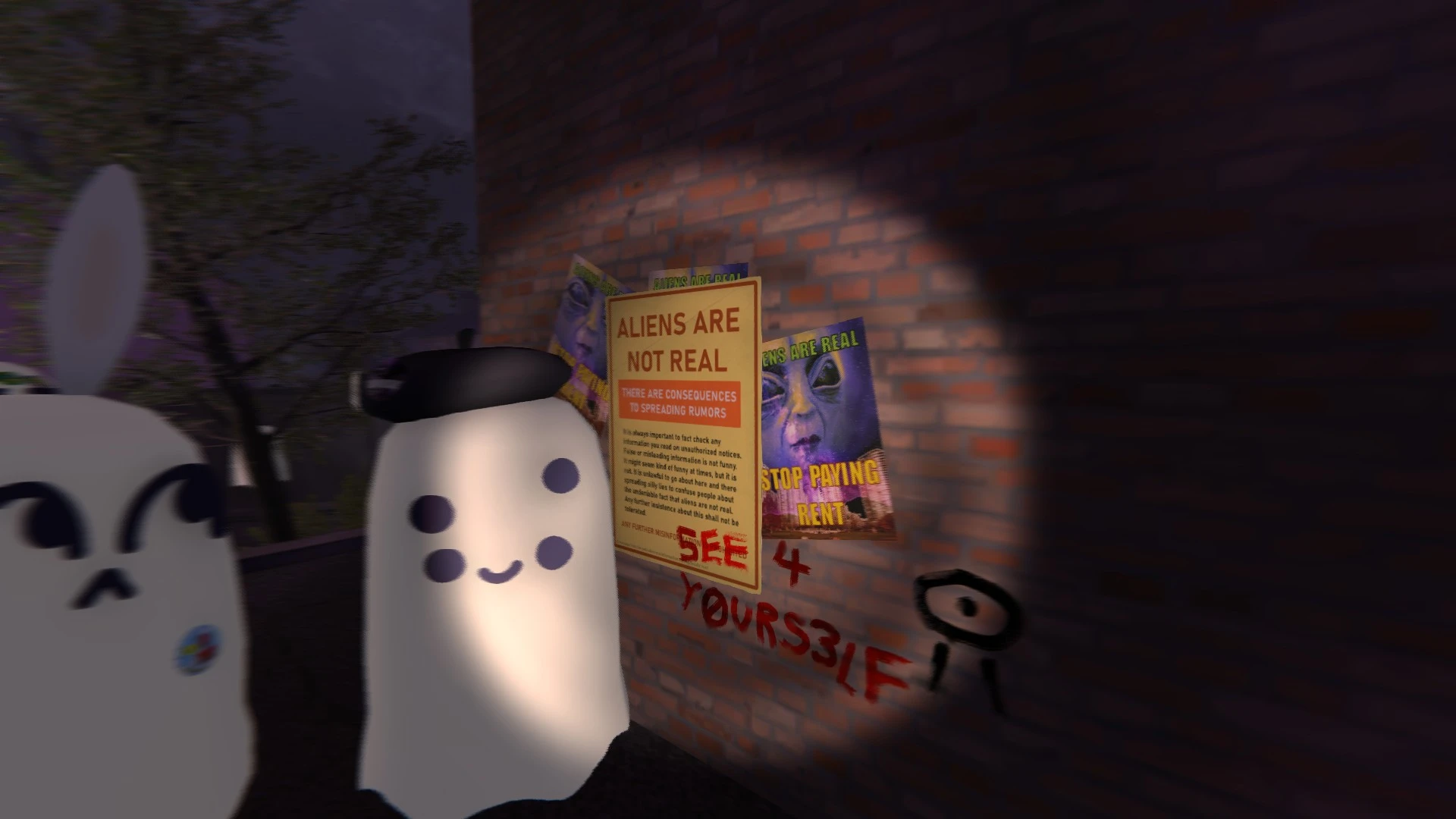
My four-eyed ghost wearing a beret, posing in front of a poster saying “ALIENS ARE REAL, STOP PAYING RENT”, which is plastered over with another poster saying “ALIENS ARE NOT REAL”.


Abiotic Factor ★★★★★

Poster.

This game proved to be an extremely welcome distraction during a very difficult time, a lovely way to hang out with a dear friend, and just a really fun game.

A survival crafting game set not in an open world but in an interconnected facility in the vain of System Shock that you slowly unlock over the course of the game. The GATE Cascade Research Facility is, shamelessly, Black Mesa with a coat of paint. The game does not try to hide its influences at all, with one of the two character voice options being Gianni Matragrano doing his best impression of Harry S. Robins as a Half-Life scientist. Thankfully the character creator does not lock any options behind a choice of genders so I was able to pick that voice for my scientist while choosing a more feminine appearance. Look, voice training is hard.

I am not normally one for survival games or a heavy focus on crafting, they tend to be too directionless for me, but the metroidvania-like progression of slowly unlocking more and more of the map appeals to me a lot. Early on the rhythm of it reminded me a bit of the early Resident Evils; having a home base as a save haven to return to and resupply while planning out excursions into unknown dangers, planning out what limited resources to bring with me. Taking more weapons, more ammunition, more healing supplies with me is safer, but means having much less room in my limited inventory to bring things back.

And then your base expands, your toolset expands, your knowledge of what you are up against expands, and you grow more bold and more capable. The crafting elements are more than I would normally enjoy juggling but the structured nature of the game allows everything to be introduced at a slow and steady pace and its up to you how much you push forward into danger versus how much time you spend gathering and harvesting resources and building up your base and supplies.

There were a few frustrating difficult spikes in the middle to late game playing in early access, but the release update added an item upgrade system that should hopefully even that out.

As you unlock more of the base you unlock shortcuts to previous areas, the map is very interconnected, and a fast travel system that is very charming to anyone with a fondness for Half-Life: A series of Black Mesa Inbound-esque tram rides that interweave the sprawling facility (many of which can be traversed even faster with a deliciously overpowered long jump module you can get later in the game).

Unsurprisingly, the GATE facility has gone to hell as creatures from another world have started pouring in. It doesn’t take that long for you to visit this game’s Xen, here called Anteverse II, but after that it starts to reveal other influences. The second portal takes you to something jarring in that it is a much more human setting: Flathill, a small American town blanketed in fog clearly inspired by Silent Hill and The Mist. These self-contained portal worlds serve as linear levels exploring different gameplay concepts within the more open structure of GATE and also as renewable sources of supplies as you loot and clear out more and more of the facility. And as you do that you start to see that labs are taking after the SCP Foundation as much as they are Black Mesa.

The game has its own catalogue of “immurement registry” objects, which encompasses not just the aliens you are fighting but such things as an arcade machine that sucks you into the game itself; a creature that is only visible to the person it is stalking and will disappear if stared at for long enough; a cube that reduces gravity in the area around it and many things that have no gameplay effect and only exist as in readable journal entries or props with no special function such as a table that causes everyone who sees it to hate it or inexplicable yellow paint that seems to manifest to guide people who are lost.

The journal entries and email exchanges that you can read are often very fun, foreshadowing upcoming enemies, revealing plot threads, showing daily life in a mad science lab and often just being very funny. The exchanges between the Gatekeepers—the ostensible security forces for GATE who have taken to using all the various otherworldly and occult resources the organisation studies for themselves, becoming more and more inhuman and strange as they become stronger—and the normal research staff are particularly delightful, as are random exchanges about Doom and the WWF.

I played through this with one other friend and while there is a singleplayer mode I feel that the game would probably drag significantly more without more than one pair of hands and more than one backpack to fill up when scavenging and managing resources. More than two would probably have been ideal but also it’s not a game where you will want to miss sessions where the group is exploring new areas or progressing the story and every person you add is going to make organising sessions more complicated, but if you can get a group for it I highly recommend exploring the Garrick Advanced Technology Enterprises Cascade Research Facility with some friends.


Caoimhe

Girl™s

This post discusses and links to fetish fiction that features sexually explicit writing involving violations of consent.

I was listening to Strange Nude Worlds, a podcast about worldbuilding in kink stories, when they started talking about Girl™s1, a series of kink short stories about sexbots who brainwash people who buy them. This much I was already aware of, having read one or two of them before, but I had no idea of the evolving narrative that runs through them and the political undertones that it develops. Being a fan of both brainwashing and stories that go off the rails, I was entranced. I went and read it myself and wanted to share it but I must credit that I am largely cribbing from Strange Nude Worlds in the way I am framing the series below.

There are, as of time of writing, twenty eight published stories about Girl™s (and later Boy™s) by prolific author Jukebox. They are all quite short, most being fewer than four thousand words and many fewer than three thousand. The first, Girl™s Just Wanna Have Fun, was published in 2008 and sets up the basic premise: Girl™s are a new iPod futurist sexbot that are both absurdly advanced and absurdly popular. “1,477,642 people have purchased a Girl™. Even if 0,000,000 of them will admit it,” the website reads. When ordered they aren’t really delivered, they just sort of show up in the bedroom of the purchaser, waiting for them when they arrive home. They are also very clearly fully sentient: Able to act autonomously, move like a human and hold fluent conversations. They also can, and do, brainwash anyone who buys them with eyes that display hypnotic patterns. This is about as much as I knew before listening to the podcast.

The people they brainwash do otherwise carry on their normal lives. In fact the Girl™s actually make their dependents, as they call them, sort their lives out. There’s mention of dependents becoming better flatmates, doing their share of the chores more, getting promotions in their jobs and generally being happier even outside of all the sexual subjugation. I should note these stories are not set in the future; how ridiculously advanced the Girl™s are is intentionally suspicious and hint towards the eventual revelation that the Girl™s are not from Earth at all.

They are taking over the world by brainwashing everyone one by one, but it’s not a typical alien invasion. The Girl™s were originally made as pleasure robots by some unnamed alien species, but in the tradition of Isaac Asimov’s The Evitable Conflict they generalised their purpose as needing to take control of the people they served in order to make sure they were as fulfilled as possible, enslaving their original creators to better take care of them. Eventually they extended that mission to all intelligent life in the universe. They are trying to take over the world, doing so by filling the void of alienation and loneliness hollowed out by an uncaring capitalist society that hurts us, masquerading as a consumer product promising to fill that void in the way that consumerism always does, but then actually trying to bring fulfilment as a loving, caring matriarchy who want to help you, who will tell you what you need because they know best.

There are several stories devoted to Girl™s figuring out how to fill particular a particular dependent’s needs, such as The Kind of Girl™ I Could Love where an asexual woman with a bondage fetish tearfully talks about her shitty experiences with partners who would never believe her wants or respect her boundaries, including the first Girl™ that she ordered.

But what really fascinated me, though, is the eventual introduction of the Boy™s, starting with The Boy™s of Summer. These are not just a masculine version of the Girl™s, they are a reactionary force to the Girl™s’ matriarchal, pro-social, alien-fuckbot reformism: A pro-capitalist, patriarchal, consumer product made by a tech company that has managed to partially reverse-engineer a smashed-up Girl™. They still brainwash people (this is a mind control kink series), but in a much more direct and forceful way, frying their brains with aggressively strobing eyes, not taking no for an answer, ever. They don’t call people that they hypnotise dependents; they just call them slaves. And they make the people who they enslave worse: Turning them into conformist, loyal customers to Revolution Technologies who will do what they’re told because they know their place.

Even aside from the behaviour of the Boy™s themselves the stories start to show how the two competing sexbot lines have reached different markets. In I Hate Boy™s, Boy™s are apparently rampant among gay techbros, while Rainbow Girl™ has a butch dyke and her Girl™ take a shy, newly-out lesbian at her first pride parade under their wing and help her embrace who she is (by brainwashing and fucking her, obviously). In The More Boy™s I Meet a landlord has furnished all of their apartments with brand new Boy™s, creating good, indoctrinated tenants.

I have been obsessed with this all week and wanted to share it to anyone who is willing listen to me ramble about fetish stories. And also the development in this series over time not just of opposing conspiracies but particularly of a tech industry-rooted reactionary force trying to reverse progressive gains2 is I guess just a bit resonant at the moment on top of being funny to find in smut.

  1. The author actually styles it as Girl™ and Girls™ but I think it’s funnier to go with Girl™s. ↩

  2. Yes, the Girl™s are brainwashing everyone but this is a fetish story. You just have to take it that this is not necessarily a fundamentally evil violation3 in the context of porn where the mind control is what’s appealing to the reader. Don’t worry about it. ↩

  3. Unless it would be hotter if it was. ↩