Halloween

Ancestor tags:

Caoimhe

what did you do for halloween?

Not that much! Caoimhe³ had been away and was flying back that night and I picked her up at the airport so I didn’t want to go out to any party or anything before that, and I was already tired and feeling a bit anti-social anyway. No costume this year.

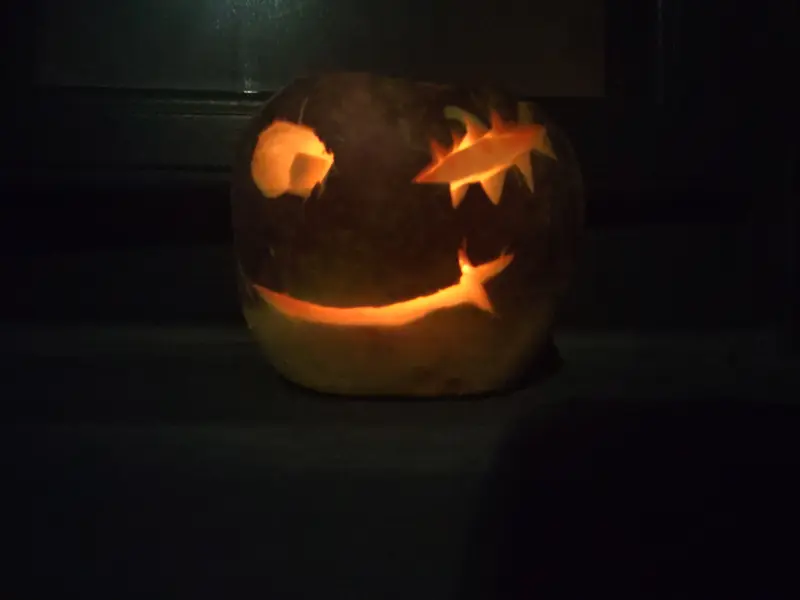
I bought far, far too many sweets in anticipation of trick-or-treaters but only got one, so now I have a mountain of sugar and chocolate tempting me. I did put out a jack o’ lantern to try and attrack visitors but I only went to the supermarket to try and get a pumpkin that morning and they were unsurprisingly sold out so I went with the more traditional (and more difficult) option of carving a turnip instead.

A jack o’ lantern carved from a swede.

I also hung out online with Ruby and another friend to visit The Annual Ghost Town Pumpkin Festival which is a very cute little game that is only online once a year around Halloween. It should still be up for a week or two and it’s free so I really recommend it.


Caoimhe

Mesca Ulad

Oíche Shamhna shona daoibh! The console ports of The Séance of Blake Manor have been released just in time for Halloween and my flatmate has been playing it. This reminded of a fun little bit of Irish mythology that’s mentioned in the game that I wanted to share, and second one related to the first. Both are from Mesca Ulad, known in English as The Intoxication of the Ulstermen, i.e., that time all the heroes of Ulster got really hammered.

But first, to set up some background: Leabhar Gabhála Éireann, or The Book of Invasions, is a medieval manuscript that synthesises many myths into a chronicle of various peoples arriving in Ireland. For the purpose of this story the two important ones are the Tuatha Dé Danann, a tribe of gods who conquered the Fir Bolg for control of Ireland, and the Milesians, named for their ancestor Míl Espáine, who sailed to Ireland from Iberia and are the ancestors of the people of Ireland today (so we’re all actually Spanish, apparently).1

The Tuatha Dé Danann were recognised and worshipped as gods, and really still are, even by Christians. Bríd, many of whose aspects were syncretised with Saint Brigid of Kildare, was a member of the Tuatha Dé Danann, which gives the Gaelic peoples the interesting mythology of having gone to war with, and then tricked, their own gods. The Milesians and Tuatha Dé Danann fought a vicious war over the land, until finally the Milesians manage to come out on top (quite literally) as rulers of Ireland. You see, Mesca Ulad, gives us the detail that after fighting to a truce, the Tuatha Dé Danann and Milesians were to divide up Ireland between them, and that the Milesian poet Amhairghin Glúngheal was the one who got to decide how to divide the island in half between the two factions. Amhairghin, being a smart arse, decreed that the half that the sons of Míl were going to take was the top half, banishing the Tuatha Dé Danann to the underworld—as in, literally underground. Fairy forts and fairy mounds (sidhe, the remains of megalithic tombs) were seen as portals to the underworld where the fairies, the descendants of the Tuatha Dé Danann, resided.

The other funny thing about Mesca Ulad is simply the story itself: There is a bit of a political squabble between Conchobar, king of Ulster, and the hero and demigod Cú Chulainn, who each want to hold competing Halloween parties. A compromise is reached whereby everyone will go to Conchobar’s banquet first, then once that’s winding down they’ll all head to Cú Chulainn’s feast. The problem being that everyone gets utterly pissed at Conchobar’s and drunk-drive their chariots the wrong way across all of Ireland and end up in enemy territory in Kerry. They are tricked and almost killed, but manage to escape back home, presumably while nursing massive hangovers.

  1. Well, really the heritage of the Milesians is traced all the way back to the Tower of Babel, with them apparently being descendants of a prince of Scythia whose son married the daughter of an Egyptian pharaoh named Scota, before wandering the world and eventually settling in Iberia. So we’re all Scythian-Egyptian-Spanish and Scotland is named after an Egyptian woman.2 ↩

  2. Obviously, in reality the causality is the other way around. Scota is a figure of myth named after the Latin term for the Gaels, Scoti. ↩


The Séance of Blake Manor ★★★★★

Poster.

One of the most intimidating games I’ve played in a long time. It does ease you into the mechanics and exploration with some early tutorial segments, but once it has familiarised you with the basics it wastes no time in introducing you to the two dozen people you will be investigating with limited time and actions in a fairly large hotel.

You, of course, do have more than enough time to investigate everything that you need, and the deftly meters out new locations, information and opportunities over the course of the séance weekend, keeping things much more manageable than it might look at first.

And it’s a very enjoyable story to explore, with each character having their own secrets, motivations and background to uncover, pulling from the different parts of Ireland’s past and religions and all of the impacts of British colonial conquest and rule.

And it does not just make the obvious choices in the cast. The Irish diaspora is represented not by someone from the United States reconnecting with their roots, but by an Irish-Brazilian woman fleeing persecution in her own country by returning to that of her father, who had been forced out himself. The most prominent American in the cast is an Afro-Caribbean man from New Orleans whose connections to Ireland include his worship of Maman Brigitte, who is presented in the game as somewhat of a triple goddess with with Bríd and Saint Brigid being her other aspects.

The large cast allows the game a lot of room to breath with bringing in a lot of the different aspects of Victorian spiritualism. We even get a few different interpretations of paganism with a Gaelic revivalist druid Traveller along with a local wise woman with implicitly more continuity in her practises, and with her nephew who wants to marry science and spiritualism with her traditional healing.

With all of this progressing the central mystery is a bit slow but for me it worked pretty perfectly, giving long enough for it to sit that I started to figure the less signposted parts in a pretty organic way that came together just in time for the big finale.

That said, I don’t think the game is perfect. It’s a little buggy sometimes and the loading times got noticeably longer as the game progressed and while the mindmap system is nice way of representing progress while giving hints about what needs to be investigated next, it can very easy to simply overlook a small piece of evidence in the environment (especially if you don’t walk around with detective vision on constantly) and I did find myself getting frustrated and looking up hints online once or twice when I had clearly missed something and consequently hit a roadblock. Some kind of explicit hint system for this would have been appreciated.

Some tweaking of the various menus wouldn’t be wasted either, especially tooltips for character names in places where they only appear as icons and some easier ways to quickly navigate between a character’s mindmap and schedule would be lovely. The choice of arranging people alphabetically by forename rather than surname is also, frankly, baffling, especially when characters are almost exclusively referred to by their surnames in the script. But a small studio has finite time for such things and I am more than willing to forgive these small things in a really lovely game.

I do also appreciate very much the script not being afraid to leave in Hiberno-English phrasing and cúpla focal that would be unfamiliar to international players and the in-game library is there for anyone who is not afraid to spend a few minutes to catch up on relevant Irish history and myth that one might be unfamiliar with.
The Annual Ghost Town Pumpkin Festival ★★★★☆

Poster.

Extremely cute little annual event with a bunch of different bits to explore and it’s nice to see everyone else hanging out and exploring and seeing their different ghosts. The puzzles in the mansion are not too taxing but just enough to have a little bit of fun scribbling out notes to help put them together. I was very bad at the obby tower, though.

Thanks to Jen’s guide for letting me double check if I found all the badges.

My four-eyed ghost wearing a beret, posing in front of a poster saying “ALIENS ARE REAL, STOP PAYING RENT”, which is plastered over with another poster saying “ALIENS ARE NOT REAL”.


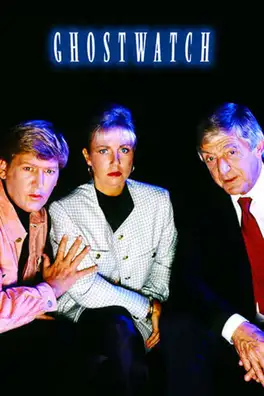
Ghostwatch ★★★★★

This review contains spoilers. Poster.

It starts off incredibly charming. A relaxed pace of veteran BBC presenters doing their best at filling time for a live broadcast where nothing is happening and nothing is likely to happen, but still doing a lot of setup for when things eventually start to take a turn.

But there is also an underlying meanness to it. They are here to make television and Parkinson is not afraid to capitalise on this family’s misery to do it, to twist the knife a bit when the girls are seemingly at their lowest, to keep pressing them when they are past the point of breakdown before affably cutting away to another expert interview.

When the supernatural elements start to assert themselves more blatantly it feels like the BBC is complicit in it. Not just inadvertently creating the conditions for this horrible, nationwide séance, but being invested in the misery of a family for the sake of reality TV and eagerly dragging up and broadcasting every unverified, salacious detail they can. The transphobia and ablism in Turnstall’s backstory is an unfortunate blemish on the film but it feels fitting that the BBC’s careless rush to spread it is part of what allows it to be hijacked and torn down.

It is also just effective, creepy horror. Even having seen it several times before I felt my breath catching in some parts.