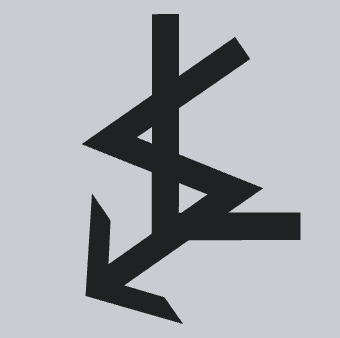
The title of this post is three unusual Unicode codepoints, each having an interesting history as written characters.1 There are many oddities tucked away in the Unicode standard. A recent toot reminded me of ⍼, known as “angzarr”, a symbol that became part of Unicode due to its inclusion in a historical typographic catalogue despite no other prior usage of the glyph having been documented.
My discord has an emoji named "tech debt" - which is just the angzarr, ⍼, the symbol famous for having no known use or agreed-upon meaning but somehow appearing in unicode and now it's just a part of unicode forever.
With so many enormous tech debt bills coming due recently, perhaps you, too, would like to take a moment to appreciate the tasteful angles of the angzarr.
Technical debt is the labour cost of maintaining a system and all previous choices made when establishing that system. By including this symbol Unicode has created meaning for it and generated usage that would be broken if the symbol was ever removed from the standard or replaced with a different glyph, a problem which the glyph itself is, in one Discord server at least, being used to embody.
There are other interesting cases. The first character in the title of this post is ꙮ, “multiocular O”, a glyph that, before its inclusion in Unicode, was only found as a visual flourish in a single 15th century manuscript in the phrase «серафими многоꙮчитїи», “many-eyed seraphim”. Particularly on Tumblr this has taken off an aesthetic marker of “biblically accurate” or eldritch creatures, those beings beyond human comprehension, or as part of a way of writing speech that is impossible for normal humans to speak, hear, or understand.
The last character in the title, 彁, is a ghost character; characters originally in a Japanese Industrial Standards character set despite having no known usages that then made their way into Unicode as well.2 Ghost characters have also seen use that leans into their strange, alien, nature as words that are included in the Japanese language in some official capacity while carrying no meaning. The Taiko no Tatsujin rythm game series features an extremely difficult song called 「彁」 themed after corrupted data (flashing lights warning for this music video). People love to derive meaning from from symbols, even when that meaning is their inherent meaninglessness.
The middle character in the title is actually an Ogham space character, the only whitespace encoded in Unicode that is not blank, a standard of written Ogham that is representative of how it originally existed not as script on a page or even the flat side of a tablet, but as a writing system defined by 3D space, carved onto the edge of monument stones, now leaving a trace in the Unicode standard as a unique space marker. This isn’t really the same as the other examples in this post but I like Ogham and wanted to shoe-horn it in.
Apologies if the characters used in this post don’t render on your computer. ↩
The JIS symbol, 〄, is itself included in Unicode. ↩
Oíche Shamhna shona daoibh! The console ports of The Séance of Blake Manor have been released just in time for Halloween and my flatmate has been playing it. This reminded of a fun little bit of Irish mythology that’s mentioned in the game that I wanted to share, and second one related to the first. Both are from Mesca Ulad, known in English as The Intoxication of the Ulstermen, i.e., that time all the heroes of Ulster got really hammered.
But first, to set up some background: Leabhar Gabhála Éireann, or The Book of Invasions, is a medieval manuscript that synthesises many myths into a chronicle of various peoples arriving in Ireland. For the purpose of this story the two important ones are the Tuatha Dé Danann, a tribe of gods who conquered the Fir Bolg for control of Ireland, and the Milesians, named for their ancestor Míl Espáine, who sailed to Ireland from Iberia and are the ancestors of the people of Ireland today (so we’re all actually Spanish, apparently).1
The Tuatha Dé Danann were recognised and worshipped as gods, and really still are, even by Christians. Bríd, many of whose aspects were syncretised with Saint Brigid of Kildare, was a member of the Tuatha Dé Danann, which gives the Gaelic peoples the interesting mythology of having gone to war with, and then tricked, their own gods. The Milesians and Tuatha Dé Danann fought a vicious war over the land, until finally the Milesians manage to come out on top (quite literally) as rulers of Ireland. You see, Mesca Ulad, gives us the detail that after fighting to a truce, the Tuatha Dé Danann and Milesians were to divide up Ireland between them, and that the Milesian poet Amhairghin Glúngheal was the one who got to decide how to divide the island in half between the two factions. Amhairghin, being a smart arse, decreed that the half that the sons of Míl were going to take was the top half, banishing the Tuatha Dé Danann to the underworld—as in, literally underground. Fairy forts and fairy mounds (sidhe, the remains of megalithic tombs) were seen as portals to the underworld where the fairies, the descendants of the Tuatha Dé Danann, resided.
The other funny thing about Mesca Ulad is simply the story itself: There is a bit of a political squabble between Conchobar, king of Ulster, and the hero and demigod Cú Chulainn, who each want to hold competing Halloween parties. A compromise is reached whereby everyone will go to Conchobar’s banquet first, then once that’s winding down they’ll all head to Cú Chulainn’s feast. The problem being that everyone gets utterly pissed at Conchobar’s and drunk-drive their chariots the wrong way across all of Ireland and end up in enemy territory in Kerry. They are tricked and almost killed, but manage to escape back home, presumably while nursing massive hangovers.
Well, really the heritage of the Milesians is traced all the way back to the Tower of Babel, with them apparently being descendants of a prince of Scythia whose son married the daughter of an Egyptian pharaoh named Scota, before wandering the world and eventually settling in Iberia. So we’re all Scythian-Egyptian-Spanish and Scotland is named after an Egyptian woman.2↩
Obviously, in reality the causality is the other way around. Scota is a figure of myth named after the Latin term for the Gaels, Scoti. ↩
Sandustry is probably the first factory game I've played that really communicates the physicality of industrial waste, the appalling magnificence of it, for all the dinkiness of its 2D artstyle. It's the only factory game that really makes me think of post-industrial landscapes, like those colossal spoil piles above Aberllefenni. It also engineers a weird exuberance inside the concept of 'byproduct'.
I gestured briefly at the PASSTHRU folder earlier, but I really want to dig deeper into that because this is something very cool. I said before that when you're connecting to a BBS like this, you're connecting to one system rather than the internet as a whole. This is a bit of an exception to that. FirstClass had support for what they called "relays", which allowed BBSs running the same software to talk to each other and exchange messages. It wasn't a realtime connection; this still isn't the internet. It's a little bit more like snail mail. The servers would sync with each other every day, or once every few days, fetching new replies in the conferences they were sharing and transmitting any replies that had been made from a different server. It's quite a bit more "slow internet" than we'd probably tolerate today, but in the pre-internet era the idea you could be talking to these other communities at all would have felt revolutionary.
A really interesting look at early digital communication.
A little over a year ago, I published a post (“I wasted $410 recreating a fake website that shows up for 10 seconds of a TV show almost no one remembers
“) about having re-created a website that showed up for a few seconds in an episode “H2O: Just Add Water”. In the title I described it as “…a TV show almost no one remembers”, which was evidently incorrect, because after posting on Mastodon I discovered that it seemed to be widely known amongst German audiences.
To understand why every machine since Gutenberg has wrestled this script and mostly lost, you need one structural fact: Arabic is cursive always. There is no print-versus-handwriting distinction, no block letters. The letters connect in stone inscriptions, in manuscripts, in metal, on screens. Each letter therefore changes shape depending on its neighbours (an isolated form, an initial, a medial, a final), and six letters refuse to connect forward at all, which breaks words into joined clusters and gives the script its rhythm. The shapes are not costumes over some underlying "real" letter. The positional variation is the letter.
Really good read on the history of digital typography for Arabic. Seen from Natalie Weizenbaum sharing it. Speaking of…
I really do think you should learn to use the Linux (or Mac, I suppose) command line if you can find the time at all. It is, genuinely, a dramatically more empowering way to use your computer than the alternative, and it will enable to think about your computer as a tool in ways that are completely different.
Cocosigning this post and Weizenbaum also gives a nice quick primer of navigating the command line.
If we were to go by actual lines of code, generated projects easily contain over tens to hundreds of times more documentation and code than human-made ones do. This is intentional by design: the AI companies do not want these projects to be maintainable by anything but their tooling, so you'll have no choice but to keep paying them to work on it.
A good Reddit post from an accomplished game modder on the problems of maintaining or working with generated codebases.
Unlike, say, Brexit which had rights implications but could point to democratic inputs (however flawed), nothing in the story I told above was backed by any democratic input of any kind. In fact, all of it was elites acting in explicit defiance of the democratic inputs they did receive.
Buckle hammers home how utterly undemocratic the movement against trans rights in the UK is.
The oft-used phrase, squeezed middle, may indeed apply here – not in the mainstream media meaning of cost-of-living and prices, but rather in terms of position-of-production and power. There is of course a qualitative difference between a pushbike and heavy goods vehicle, but when seen in terms of mode and relations of production that difference somewhat fades.
A Marxist analysis of the class position of the Irish fuel protests from earlier in the year.
Protection of the property-owning class has been the water that Irish politics swims through, invisible to its fishy participants but explaining nearly everything. It is why our housing crisis exists and why it cannot, apparently, be solved. Solving it would mean a political evolution on a scale of growing legs and lungs and actually climbing out of that water.
An essay on the class priorities of the Irish governments of the last century.
Last week I researched the first labor strike in known history. The tomb builders living in a town called Deir el-Medina in Egypt went on strike on November 14th, 1152 BCE. Three thousand, one hundred, and seventy-eight years ago. And their strike looked an awful lot like ours today. They set down their tools and staged sit-ins, they blocked roads, they marched, they engaged in workplace sabotage. They wrote letters to the authorities requesting a redress of grievances. They stole from work. They did everything that we do today.
And a meditation on labour struggle throughout history.
The Jesuits proposed an invasion force to be spearheaded by 10,000 Spanish and Portuguese troops, augmented by 6,000 Filipino auxiliaries and between 5,000-7,000 Japanese Christian mercenaries, leading a two-pronged invasion through Guangdong and Fujian.
This post mentions cannibalism and has spoilers for the first series of Dungeon Meshi, though I will try to keep the plot specifics vague.
The question of the relationship of the soul to the body, of what constitutes a living person and the implications of cannibalism within such metaphysics are important to the plot of Dungeon Meshi. In the dungeon souls are anchored to the corpses of the dead, allowing them to be resurrected as long as the body is not destroyed. The more intact the body is the easier this is and even if one has lost a lot of blood or even a whole limb it can all be safely reconstituted back into the body with the right spell as long as it’s nearby. And as long as nothing has eaten it. Consumption and digestion of a body breaks it down, deidentifying it and reconstituting it into the new self. While rewatching the finale of the first series I was reminded of something I once read about Christian theology1. I do not remember where I read this originally but I will try to share my half-remembered version.
The Book of Revelation speaks of the resurrection of the dead. These days most Christians think of the soul as leaving the body when one dies, of the dead ascending into Heaven (or descending into Hell), of reuniting with your loved ones in the afterlife. Early Christian belief tended to have a much more literal interpretation of resurrection. The dead are dead and it is only in the last days that the faithful will, like Jesus, physically rise from the dead and live in the Kingdom of God, which is to be understood not as an metaphysical afterlife but as an actual kingdom on Earth that will be established by Jesus. As such it becomes important to keep the bodies of the dead intact. Cremation as a burial practise died off in Europe as Christianity rose to primacy, only becoming common again in the last century or two. If a body was destroyed, how could it be revived?
Even if one thought that, like in Dungeon Meshi, the constituent parts of the body, if scattered, could be reassembled and brought back together by the power of God for resurrection, what of cannibalism? If your body becomes part of my body, then, come the end of days, who has claim to the rotted meat that is to be resorted to life? Christian scholars took this idea seriously. To me this is a funny little intellectual exercise, but for many this question was important and existential. Can a body be destroyed in such a way as to sever someone from their flesh, putting them outside the reach of God, dooming them to oblivion? Dungeon Meshi ends up asking similar questions, though with the view of saving someone rather than damning them. I suppose it shouldn’t be too surprising that an author who tries to examine and interrogate fantasy tropes and systems of magic—to take them seriously and think through all that they imply—might come to the same ideas and questions that theologians would when trying to seriously consider miracles and acts of God.
I don’t really have a great source and I didn’t want to spend time researching it, but a quick search turned up an old post on a Catholic blog that I am not going to take too seriously2 but at least quotes Augustine of Hippo and Voltaire musings on this question, showing it to be an old one.
To be be clear I am an atheist and do not believe in anything beyond the material. I just find this interesting. ↩
In the same post they link a previous article about how quantum physics might somehow explain resurrection 🙄. ↩
Ogham is an interesting writing system with a lot of unusual features. It was used to write Primitive Irish inscriptions on stone monuments in early Medieval Ireland and parts of Britain, the letters consisting of tally-mark like lines carved along the edge of a stone column. It’s a writing system that originally existed on a three dimensional medium rather than a flat page or tablet. Being written on the edges of standing stones means it is also a vertical writing system and unusually it is one that is read bottom-to-top1 and it’s the only writing system encoded in Unicode with its own unique space character where the space is not blank but a straight line.
I was originally writing more infodumping here but I thought it was coming out very dry and if I have piqued your interest then you are just as capable of reading the Wikipedia article on Ogham as me.
But Ogham is really cool and pretty common tattoo fodder. Years ago I was considering getting my name tattooed in Ogham but at the time I also felt very perfectionist about getting something permanently drawn on my body and never went through with it. It’s just as well as that was pre-transition and I would have then had my deadname stuck on me. Having been transitioning for a few years the idea of permanent changes to my body no longer felt like such a big deal2 and I have gotten a couple of tattoos now without worrying to much about it but I never got that Ogham one.
I was thinking about this recently and have been experimenting with an Ogham design that is deliberately my dead name with my chosen name written over it. It happens to work out pretty well because the rendition of my name into Ogham has more strokes than my deadname and the new strokes can be pretty easily added in to the gaps provided that some space is left between each line (and particularly with some deliberate stylistic liberties in how I am transliterating the names). So maybe I will still get my deadname tattooed in this way?
Also sometimes people try to make modern calligraphic or cursive interpretations of Ogham and I think that’s really cute. Check out Úrogham and Ogham Cruinn.
Though the form of Ogham adapted for writing on paper is generally written left-to-right. ↩
And, of course, slow permanent changes are all happening to all of our bodies through our lives whether we like it or not. ↩
I have been rewatching Fullmetal Alchemist 2003 and talking about it with friends a lot so here is my favourite of all the intros from it or Brotherhood (it’s just the first intro from Brotherhood).
Also just a small rant: I hate how the top results on Youtube for this kind of stuff is always horrible interpolated to 60FPS upscaled crap that ruins the animation.
It’s been a while since I’ve done one of these. I have conflicting urges to want to write more and do more but also I know I need to rest more. Don’t expect me to be Blaugusting. I am actually trying to get as much off my plate as possible and not commit to things, including pruning my RSS feeds quite a bit so I feel less obliged to keep up with so much. Everything is difficult 👍🏻
But I have still been reading and have things to share. No particular order or categories to things this time.
On how a compelling narratives not just get people to buy into ideas, but obscure otherwise very obvious flaws, and how the use of narratives in this way is actually taught and enforced in university education.
No, the real point is that the claims from this study are ridiculous and intelligent people that have been studying for years can’t pick up on it. The real point is that I am actually really confused as to how Piff got his results, but at least I’m not tricking myself into thinking I know what’s going on. Did he fudge the numbers? Was the experiment poorly set up? Just pure bad luck in sampling? Hell, is the result true? I don’t know, but I will say that you don’t know either.
Why is the 11th of each month (other than September) consistently underrepresented in the Google Books database as shown in this XKCD comic? The answer is typographical.
When I began this study, I was hoping to find a hidden taboo of holding events on the 11th or typographical bias against the shorthand ordinal. Alas, the reason is far is far more mundane: a numeral 1 looks a lot like a capital I or a lowercase l or a lowercase i in most of the fonts used for printing books. An 11 also looks like an n, apparently. Google's algorithms made mistakes when reading the 11th from a page, interpreting the ordinal as some other word.
This really resonated with me. The most frustrating projects I have coded for are the ones where people have not thought through the meaning of what they are asking for, where they ask “make this work” with no clear definition of what working looks like outside of the most idealised possible scenario without consideration of real world use, let alone edge cases or failure states. I feel “a programmer is paid to refine semantics” to my bones.
Programming is the act of making a computer enact a semantic task. The computer's silicon internals, its RAM and hard disk and even its pixels, are the syntax here. It has no intrinsic meaning, just a set of ones and zeros and a very complex set of rules for transforming them. The semantics are the human interpretation of what it's doing and why, the understanding of those numbers and pixels as a map to the nearest ramen joint or a simulation of a puppygirl begging for treats.
I really love A Game of Thrones and I used to read a lot of fan analysis stuff and listened to a couple of podcasts just about the series. Turtle-paced is the one person in that sphere that I still follow and I still really enjoy reading her deep dive chapter analyses when she posts them. She does, as the name of her blog implies, post them at the rate of a testudine and it is a nice occasional treat for me.
This is just how it is, per Tyrion. His response is not to address the unfairness but to show gratitude for the benefits he enjoys. The idea that everyone should have those privileges does not cross his mind. It’s a way in which he’s like Cersei. Though again, and as usual for the Lannister siblings, this is also a product of an abusive home. Tyrion’s only protection against the various injustices he faces in life due to his disability come from being a Lannister. The idea that everyone should have Lannister-level privileges is a threat to him - which in turn is a belief born of despair that of course everyone will hate him for his disability, and this can never change.
Putting native Gamecube controller in a new PC game, cool! Seen via Misty.
okay so, something that's been bugging me for 15+ years but i never realized how to put it into words until recently: regular game controllers have different layouts depending on if you're in gameplay or in menus.
Writing about early CD-ROMs means coming across a lot of early examples of things that became famous later. Sometimes that means finding new and exciting angles on something familiar… and sometimes it means something that's only notable for being early. Today's disc is one of those.
Ancient trade is cool! The past was international!
Titianus himself was a Macedonian, as well as a Roman citizen, and reflects just how complex and multifaceted these exchanges truly are. We talk of “Rome” and “China” as unitary civilizations, exchanging speech and goods like two singular individuals, but of course both were mere representations of vast conglomerations of peoples, cultures, and nations, all of which were constantly in flux. At Shatial, in the Karakoram Mountains of the Punjab, more than 1,000 inscriptions and 700 petroglyphs were carved into the rock near a key pass, recording names, dates, and prayers from travelers. They appear mostly in Sogdian, Middle Persian, Parthian, Aramaic, Brahmi, and Kharosthi. Nine are written in the extinct Bactrian language, one uses Chinese characters, and one is in Hebrew.
A short lament about erasing someone’s past from an old device.
Have you ever bought a pre-owned game cartridge or MP3 player or something, and the previous owner’s data is still on it — and for a brief moment, you feel a sense of connection with that stranger through their lingering data, and a twinge of sadness at the idea of deleting it to use the device for yourself?
Hell, I have felt sad in the past about clearing out my own childhood savedata from a cartridge. A few years ago I was able to boot my old copy of Soleil and was greeted with save files under my deadname as well as my brother and sister’s names.
If you could wave a magic wand and wish a new fantasy console into the world…what would it be like? What constraints would it have to force developers to get creative? If it came with hardware, like the Playdate, what would the console physically be like?
This is something I have actually thought about before. One of the myriad little ideas filed away that I will certainly never have time for (and would have to learn many, many new skills to ever do myself) and if I ever do get time for it the moment for it will probably have passed. But the idea of a Pico-8 style fantasy console with its own integrated development environment but 3D with an eye to creating PSX-style visuals in the way that been in vogue, especially with horror games with a Crocotile-style friendly editor for mapping and modelling has been fermenting in my mind for years.
And very importantly it would also be paired with a secondary, 2D, low-spec fantasy console similar to Pico-8 (some musings of this involved it being a Pico-8 clone that could run Pico-8 carts itself, but maybe that would be stepping on Zep’s toes too much) that could play its own separate games as well as link to main console to act as a simple secondary screen like a VMU, either running it in a separate window on the same desktop or else running on your phone linked via wifi connection. Have extra HUD info on the second screen, control a game entirely through your phone with a unique interface, pass it to a friend and allow extra asymmetrical co-op control, download a chao to your phone! I am aware that second-screen peripherals have been done a load of times and it has basically always bombed but I don’t care I love control and interface gimmicks and am eternally enamoured with stuff like the Dreamcast port of Silent Scope allowing you to use the VMU screen as an incredibly low fidelity scope and Zombi U’s gimmick of making you look away to the Wii U gamepad so much to divide your situational awareness in stressful situations.
Medical misogyny is nothing surprising to me but this lays it out very strongly.
There was no medical reason to keep it. You don’t need your uterus to survive, it’s only function is to be a womb. If you keep your ovaries you won’t even go into early menopause. Yet they made it clear that saving my womb was more important than my life.
But at a certain point, you have got to stop accepting the argument that an amateur Daz 3D porn game is worth an international uproar, no matter how transgressive and offensive it's trying to be.
I think this raises an interesting question of why anyone is bothered to take a game like No Mercy seriously at all. I do think there is an interesting idea in how games so very opaque to a lot of people that they don’t necessarily intuit the obvious difference between a shovelware porn game and something with the the actual cultural impact of, say, Call of Duty in the way that they obviously can between a Holywood movie and some random porn film but I do feel like it is something more culturally based than games just been too long and too much of an investment to experience.
This post contains spoilers for Dracula, which is 128 years old.
I have not been keeping up with Dracula Daily as I had intended1 but I wanted to make a post about it today. One of the features of the original Dracula that is often forgotten in adaptation is how modern it is. As an epistolary novel the story is mostly a series of diary entries and in the case of the character John Seward his diary, starting on the 25th of May, it is recorded on a phonograph—an invention that was only twenty years old at the time of the novel’s publication in 1897.
The book heavily involves the collision of the very modern and scientific with the ancient evil that is Count Dracula. The novel opens with Jonathan Harker, a solicitor, travelling to Transylvania in order to sort out a property deal for the count. This journey involves going from the comfort and regularity of well-timetabled trains to a treacherous carriage ride through the old, wild Carpathian mountains. With him, as well as the needed legal documents, he has photos taken on his Kodak2 camera, which is far from the only piece of prominent technology.
The weapons used to fight Dracula are not just wooden stakes and crucifixes3 but also blood transfusions4, hypnotism5, next-day flower delivery from Haarlem to London6, shorthand7, meticulous note-taking, and in-depth knowledge of train timetables8. While it goes unremarked on in the book itself I like to imagine that Count Dracula’s statement that “to live in a new house would kill me” is due to a vampire’s inability to cross running water not playing very well with indoor plumbing. Abraham Van Helsing is not a young, sexy vampire hunter in this novel but an polymath professor with at least three doctorates9. Dracula is not that out of step with Buffy the Vampire Slayer answering the question of how to deal with a terrible and ancient demon with blowing it up with a bazooka.
But there is something else important about John Seward’s phonography: It ends up being extremely funny. Even just reading this and thinking that he is speaking this out loud to be recorded on a wax cylinder it seems incredibly obnoxious:
I questioned him more fully than I had ever done, with a view to making myself master of the facts of his hallucination. In my manner of doing it there was, I now see, something of cruelty. I seemed to wish to keep him to the point of his madness a thing which I avoid with the patients as I would the mouth of hell. (Mem., Under what circumstances would I not avoid the pit of hell?) Omnia Romæ venalia sunt. Hell has its price! verb, sap. If there be anything behind this instinct it will be valuable to trace it afterwards accurately, so I had better commence to do so, therefore R. M, Renfield, ætat 59. Sanguine temperament; great physical strength; morbidly excitable; periods of gloom ending in some fixed idea which I cannot make out.
One presumes that he is saying “memorandum” out loud and not just “mem” as is transcribed. Later, when he records his conversations with Van Helsing he includes the full back and forth dialogue, with all of Van Helsing’s disfluencies, grammatical errors and strange turns of phrase. One has to wonder is Seward imitating his friend’s Dutch accent while recording this? Is he doing voices whenever he is making his diary? What does his Mina voice sound like? We are reading, within the fiction, a transcription of him speaking out loud. And we know who does the transcription because it happens during the course of the plot. The later part of the novel involves the protagonists meeting up and compiling all of their notes together into what is the text of the novel itself.
This is done by Mina Harker and the reason she starts doing this is, again, extremely funny: She walks in on Seward recording on his phonograph and asks to hear some of it. He initially agrees but then starts deflecting awkwardly that most if is about his medical cases. When Mina asks specifically to hear about the last few days of her friend Lucy Westenra’s life he admits that he has no idea how to find a specific diary entry in his phonograph recordings. He has been using this for at least the last four months and he just never thought about it at all. He has not labelled anything. He has no system of any kind. He has just been talking into this and never reviewing it in any way! This is what prompts Mina to start transcribing the entries for him, as well as typing up her and her husband’s shorthand diaries for everyone else to read and compiling all the other letters and newspaper clippings that make up the novel. Going back to the modernity of it all the most in-spirit adaptation of Dracula set in the modern day would surely be composed primarily of screenshots of social media posts and podcast segments.
There is one more interesting angle on the fact that Mina is the author, or at least the typesetter, of the book within the fiction: How she types up the dialogue of Renfield, Seward’s patient and devoted servant of Dracula. Renfield’s dialogue capitalises He, His, You, Your and Master when he is speaking of Dracula, something that is only proper to do when referring to God10. This is obviously meant to ascribe a blasphemous devotion to Dracula to Renfield, but within the story it is Mina who is choosing to capitalise his words in this manner and Mina is also, at this point, partially under Dracula’s influence. While I don’t think that this was Bram Stoker’s intent we could read this an an unconscious sign of Dracula’s influence over Mina’s mind.
I think that in light of recent personal events that should be pretty forgiveable. ↩
Kodak had been founded 1892, five years prior to the publication of Dracula. ↩
Amusingly as an Anglican Jonathon Harker finds the whole crucifix thing all a bit Catholic for his taste. ↩
Some successful blood transfusions had been recorded for decades prior to the novel’s publication, but it was a very risky affair and blood types were not discovered until a few years later. ↩
Hypnotism, a word coined by James Braid in 1841, was very much in vogue as a serious path of medical exploration in the decades prior in both Britain and France. ↩
Van Helsing uses garlic blossoms to ward off Dracula in the novel, not strings of garlic bulbs. ↩
The Pitman shorthand system was published in the 1837 and the Gregg shorthand system in 1888. ↩
Please look forward to a post about the train fiend in a few months. ↩
He signs his letters “Abraham Van Helsing, M.D., D.Ph., D.Lit., Etc., Etc.” ↩
Within the cultural context of the novel. I am not religious. ↩
instead of the great man of history theory I propose the shitty man of history theory: history is mostly shaped by systematic forces but sometimes there’s a huge cunt who fucks everything up
Everyone in Ireland in the eighteenth century seeing a rat for the first time: That cunt is French!
Context
Rats were introduced to Ireland around the 1720s and the word for rat and French are the same, a clipping from luch Fhrancach which literally means French mouse.
Taking a page from Mike I am going to include a suggested piece of music to listen to while you read this; the first track from my Cohost song of the day playlist, the title theme from Robocop for the Game Boy:
I’ve divided this into two sections, the first for people who I haven’t linked to as part of these roundups before and the second for people who I have.
When I live somewhere, I feel like my life saturates it and sinks into the walls, like cigarette smoke. Every strong emotion I feel creates an energy that overtakes the room for a while; if I had a big hard talk with my partner in the old living room, I knew it was over when we moving upstairs to relax in bed, and the feeling would be left behind. And over time, the kitchen isn’t just the place where I cook, it’s where I care for my loved ones; the bedroom isn’t just the place where I sleep, but where I connect with my partner and feel safe at night. The house is not just a house. It is a home, a being, a body that I have a relationship with that requires love and care and patience. Cleaning my house feels like also shoveling out all of that psychic debris. It is an act of care for the place, and an act of care for myself. I have always been part of a house; my home has always been part of me.
Some things are cool because they’re rare, and that’s the whole reason. You can implement a cool feature, say “wow, that’s cool, we should make that happen more”, and just like that, it’s not cool. It’s no longer a story players tell each other. The first time you play Splinter Cell Conviction, and you’re hanging off the side of a building waiting to pull another guy out a window, and a particularly savvy guard actually leans out a window and checks the side of the building – that’s amazing! What a smart, weird thing to do! But then they do it again, always. It’s not reactive or rare, like you thought, so it’s no longer cool. You won’t be saving that clip.
I am not a Formula One girlie but Caoimhe’s passion for saving and sharing the history of it is inspiring.
Long story short, I've been building up a rather popular niche in the high seas community. My archive of F1 media is solid, comparable to plenty of other buffs around the world, but I've made a commitment to sharing it as widely as possible, for as long as possible.
Relatedly, a celebration of media hoarding. Anything on any streaming service, on a website, can be taken away without notice. What’s yours is yours, and also organising a Jellyfin server is very satisfying.
Sure, there are websites where you can find some of this material, like the Internet Archive. But this archive is mine. It’s my own little Library of Alexandria, built from external hard drives, OCD, and a strong distrust of corporations. I know I’m not the only one who has gone to these lengths. Sometimes when I’m feeling gloomy, I imagine how when society falls apart, we packrats will be the only ones in our village with all six seasons of The Sopranos. At the rate we’re going, that might not be too far off.
Kore’s third post about hacking a Hitachi wand, as previously seen in the first and fourth roundup.
So: the Hitachi Magic Wand is a very good device. It, however, has very little granularity in how strong it is. Even the newer Magic Wand Plus only has four, non-customizable settings.
I don't like this and want to fix it. In the process, I'll also be adding bluetooth connectivity, because I thought that was pretty funny.
I have previously linked to Sandifer’s writing on Doctor Who and inane September the 11th memorial comics but another one of her long-term projects is The Last War in Albion, a sprawling series of essays which she describes as “a history of British comics. More specifically, it is a history of the magical war between Grant Morrison and Alan Moore”. After a long hiatus she is back with a book-length article on Neil Gaiman. This is obviously written in light of the sexual assaults that have come to light, but is neither a polemic nor trying to turn his works into some sort of gotcha against him or his fans. It is a clear-eyed and fair assessment of the merits and flaws of his work woven with the story of the man himself and of his craft, his cynicism and his actions.
When one talks about Sandman being foundational to millions of people, one is talking not exclusively but substantially about teenage girls of the 90s and 00s who were into goth subculture. And a fundamental part of its appeal is that its best character—the one who gets all the good lines and who the reader is all but forced to love—looks like them. In contrast to Cinnamon Hadley, who was a bold fashion and makeup experimentalist, at the end of the day dressing up like Death required little more than a black tank top, black jeans, some boots, a cheap piece of jewelry, and a bit of practice with an eyeliner pen. It is difficult to think of another iconic character in comics that was routinely first encountered by people who were already cosplaying her. It’s no surprise that many of those young goth girls passionately identified with her, nor that they became adoringly loyal fans of her creator—fans that he would spend the rest of his career both catering to and preying upon.
Last time I linked to two of Devereaux’s pieces and am doing so again. Following on from his piece about sci-fi body armour we have this analysis of the armour of Dragon Age: The Veilguard.
And that actually makes a fair bit of sense: if you expect to be fighting in close combat, you hardly want anything on your person adding encumbrance or weighing you down or providing an extra easy hand-hold for someone to grab and pull at. And more to the point, your ancient or medieval soldier doesn’t need them because he has nothing to put in a bag or pouch that he needs to grab in combat. His primary weapon and shields, after all, are carried in his hands, his armor is worn on his person, his backup weapon is in a scabbard at his waist…and that’s it. Archers might carry arrows in a quiver, of course and slingers stones in a small bag, but that’s just one small container of clear and distinct purpose, generally at the waist. This is just a design feature one does not find in the kind of technological environment posited in these games.
And the second on the logic of “gold” as a generic currency in fantasy settings compared to historical reality of money and coinage.
But part of the reason these coinage systems work they way they do is that they operated in societies in which a lot of economic activity was non-monetary or at least, non-coinage. And here, we should go back to our ‘money’ vs. ‘currency’ or ‘coinage:’ remember, money came first. So let’s say you live in a small community – like a peasant village working beneath a large landholder’s manor – and you need to transact some things, but you don’t have any actual silver because coins are scarce and valuable (and being a subsistence farmer, you grow most of what you need yourself), how do you do it? Well, one way is to do it ‘on accounts’ – you need wool and so when the shepherds come down from the hills, you trade for some of their wool during the shearing with a family you know and both you and they make a mental note that you owe them for the wool. You might express that amount of debt in silver (as a unit weight – see how we get to coinage as a pre-measured weight of silver?) but there’s no reason to measure out silver (even if you had any) because you see these folks every year and next time they’ll ask you for some grain and so on.
Note that this is not the same as the concept of ‘barter’ – there is, in fact, a notional ‘money’ intermediary, it’s just not a physical coin or bill, its expressed as an account, a purely notional unit of value.
Following on from linking to a bunch of his writing this piece from Devon Price that made me reconsider my relationship to sex a bit and do some self-reflection pushed me to start moving forward with trying to get bottom surgery, something I had previously considered but put off.
I think one of the biggest problems in how people conceive of diverse sexualities is by attempting to place all sex acts upon a single hierarchy from "extremely kinky" to "tame." Under this framework, activities like PIV and oral are viewed as neutral precursors to the racier and more extreme forms of sex that a person must "work themselves up" to – and this obscures that those supposedly neutral sexual activities can be both incredibly exciting & fulfilling to some, and downright disturbing or traumatizing to others.
[…]
According to the Vanilla-to-Kinky Staircase Model, boundaries can only be drawn hierarchically: you can only say no thanks forever to sexual acts that are more “extreme” and higher up on the staircase than the ones you’ve already engaged in. This means that kinky people often feel coerced into sexual acts that do absolutely nothing for them, and non-kinky people are expected to like anything and everything that their social group considers to be ‘standard’ sex.
Last time I linked to an economics-based analysis of the popularity of software development frameworks. This time fascism, yay 💖
These “bonkers” ideologies are integral to the fascist project as a rationale for atrocities and destruction. They are a belief system that promises a bright future to the selected people and provides them with a systemic rationale for letting mass death happen as “AI” will replace the workers.
Chalmel de Vinario recognised that bloodletting was ineffective (though he continued to prescribe bleeding for members of the Roman Curia, whom he disliked)
I.T. staff installing McAfee on her boss’s computer.
The team tested their findings by making pozzolanic concrete from ancient and modern recipes using quicklime. They also made a control concrete without quicklime and performed crack tests. Sure enough, the cracked quicklime concrete was fully healed within two weeks, but the control concrete stayed cracked.
I found this image saved in my phone. I have no idea where I found it. Someone probably shared it on Cohost.
There's so much to consider here. The beefy box of Grape-Nuts holding the man, apparently steadying him. The incredible type setting. The copy itself. The fact that the product's slogan appears to be, "There's a Reason."
It reads like it was written for Orson Welles by an alien.
Mm yes, I love to ingest the food elements Nature has stored up in wheat and barley. And I especially love when they combine, in the blood, with albumen to repair and build up my cells.
Doing another oneofthese. I still intend on doing rebogs as well and I’ve added some more styling to make reposts stand out from my own words and make a more clear divide between them.
Devereaux digs into the origin of the phrase “bread and circuses”.
So the surface reading seems clear: he is putting the Roman people on blast for letting their authority over public affairs be taken away, usurped by emperors who promise them bread and circuses (we’ll come to if this is an accurate representation of the history in a moment). They used to have all of this power, the power to bestow offices and armies, but now they cower fecklessly in the wake of imperial slaughter and arbitrary rule.
Except, of course – wait a minute – isn’t the theme of this passage that power is an unwise thing to ask for? The theme of the whole poem is that you shouldn’t be asking the gods for these sorts of things!
Instead, where real armors evolve against threats, fictional armors evolve as a visual language, borrowing the design elements of other fictional armors far more often than they dip into their own historical exemplars, with the result that the whole thing sort of devours itself.
Fiction referencing exclusively other works for fiction rather than looking to the world is something I think about as well from time to time.
Goldwag reviews a book from the man who coined the word “robot”.
The novel starts with Captain van Toch, a Czech sea-captain in the service of a Dutch trading company, stumbling upon an isolated community of giant amphibians in the Dutch East Indies, living on a single tiny island, their numbers culled constantly by sharks. Van Toch realizes that they’re trainable, and extremely intelligent, and has the idea to plant colonies of them across the Pacific to work as pearl divers. After his death, the Pacific Export Company transitions from luxury goods to mass labor, selling newts across the world as an undersea work force capable of hydraulic and maritime engineering, which results in Newts settling most of the world’s coastlines and becoming an integral part of the global economy. “So now we find the salamanders on the road to their finest flowering; but the human world, too, is enjoying unprecedented prosperity. New continental coasts are being feverishly constructed, new dry land is emerging from where shallows used to be; artificial air support islands are springing up in the middle of the ocean.” (Newts, pg. 165). For all the absurdity, however, Čapek treats his topic seriously. We’re given footnotes, citations, discussions of legal dilemmas and cultural disputes, discourse on the economic impact of newt labor and how it affected different nations and groups, taxonomies on newt evolution and biology. It doesn’t feel like a cheap trick or a gimmick because it’s all done with such care.
In short, to acknowledge transmasculinity, a society would have to first admit that manhood—just like womanhood—is a social class and not a 'natural' category. Its people would have to acknowledge that the desire for independence and self-actualization exists within all of us and is not, in fact, stored in the balls.
Thorn outlines very well the fundamental ideological problems in the NHS and how trans healthcare is handled that I think apply very well to the HSE here in Ireland as well.
There are even more serious charges. The coroners’ reports into the deaths of Sophie Williams and Alice Litman said lack of gender affirming care contributed to their deaths. That is to say, it is a matter of publicly recorded fact that the NHS’ failure to provide gender affirming care has contributed to the deaths of patients. Nobody at NHS England has resigned or faced consequences.
Of course panic, misinformation, and mistrust take hold in these conditions! Of course people come to believe the NHS are making secret plots behind closed doors! These conditions are entirely of the NHS’ own making. Slapping a famous trans person’s face on a new outreach program does nothing to address them. As I told Colonel Korn, if the NHS wants to increase trust they should start by apologising.
But the Colonel expressed his bind to me the same way every other NHS senior official I’ve spoken to has. The Department of Health and Social Care tells the NHS how they have to spend their money. The mandate they get from the Health Secretary tells them what services they have to commission: if it says “Ten more transplant wards,” they need ten more transplant wards, and that’s that. If it says “Spend £90m pathologizing trans people,” that’s what he has to do.
This point bears underlining: every single person I have spoken to in the NHS- from local GPs to the National bosses- told me they are powerless. There is nobody at any level of the organisation who takes responsibility for the state the service is in and the suffering it is causing. Every single person blames the person above them, even the man at the top.
In my last post, I succesfully made a bluetooth/wifi Magic Wand Plus. Unfortunately, though, I completely bypassed the original Hitachi board, which happens to be where all the buttons and LEDs are attached, so it was only usable remotely. To make the physical controls work again, I could either make my own copy of the Hitachi's board, with buttons and LEDs in the same places, or somehow reprogram the original board and make it do my bidding.
The first option requires a lot of measuring, which I find really annoying to do. So, let's hack the Hitachi's microcontroller!
MongoDB’s popularity among managers during its peak was largely down to the idea that you no longer needed a database expert. Just throw the data into the document DB puddle and let your existing less-specialised developers handle it. The promise of the document database during the peak of their hype was that you didn’t need to employ as many specialists.
Electron, PhoneGap, and React Native promised to let companies replace their expensive platform specialists with more commodified generalists.
Standardisation in web development lowers costs, increases predictability, and makes the various browsers more interchangeable. It’s a hedge that reduces the individual market power of each browser, but usually in equal degree while increasing the value of the overall web, leaving each browser vendor better off as a result. Their market share might not increase but they have a bigger cut of a larger pie. Incompatibility tends to drive developers and companies to other platforms, reducing the overall pie.
Standardisation of labour, conversely, does not benefit labour.
Whatever happens to Python or pip is likely to eventually happen to more projects or more frequently. I am concerned mostly about maintainers that are handling this in isolation. If they don't know that AI-generated reports are commonplace, they might not be able to recognize what's happening before wasting tons of time on a false report. Wasting precious volunteer time doing something you don't love and in the end for nothing is the surest way to burn out maintainers or drive them away from security work.
The concept of a palette swap is drawing something with a different set of colors. It’s a good way to get more mileage out of your PICO-8 sprites. There are a bunch of things you can do with palette swapping
create variations on a character
make simple looping animations
fade in or out of a scene
simulate day/night cycles
But what does this mean for us as programmers? How do we represent the concept in code?
Technical website bullshit, but something I’ve been meaning to look at setting up for this site too.
Bots I block fall into one of the following categories:
Bots that only serve to power adtech on other sites. My site has no ads, but I allow bots such as Google’s AdsBot.
Intellectual property snitches. I forbid robots that scan for plagiarism, trademark/copyright violations, brand protection, etc.
Robots that power invasive background checks that border on cyberstalking.
Scrapers that build datasets to train Generative AI (GenAI), such as large language models (LLMs). I don’t block search clients used by GenAI research assistants; I only block scrapers used to train GenAI models.
I used to be one of the people who “corrected” people about the word Gaelic. I am sorry.
The Irish Language was referred to as both Gaelic and Irish until the Republic was formed. “Irish” was mainly used by academics; “Gaelic” was used by the common people.
The Republic chose “Irish” over “Gaelic” for political/nationalistic reasons.
Dahl started an Instagram account in 2023 that parodied tradwife content creators, after her own account was banned by the platform multiple times. Tradwife content (short for “traditional wife) is fetish content, even if the “wife” isn’t showing skin. It’s a fantasy, and always has been, even when it was used to sell ovens to 1960s homemakers.
Kim is the person who taught me that judging a homeless person for wanting to buy alcohol or cigarettes is utter folly. When you’re homeless, the nights are cold, the world is unfriendly, and everything is painfully uncomfortable. Whether you’re sleeping under a bridge, in a tent, or at a shelter, it’s hard to rest easy. You are likely to have injuries or chronic conditions that bother you persistently, and little access to medical care to deal with it. You probably don’t have much healthy food.
In that chronically uncomfortable, over-stimulating context, needing a drink or some cigarettes makes fucking sense. As Kim explained to me, if you’re laying out in the freezing cold, drinking some alcohol may be the only way to warm up and get to sleep. If you’re under-nourished, a few smokes may be the only thing that kills the hunger pangs. And if you’re dealing with all this while also fighting an addiction, then yes, sometimes you just need to score whatever will make the withdrawal symptoms go away, so you can survive.
But it wasn't just that it was super difficult and took a long time. The hilarious part of all of this is that the fact that there was still a battle going on outside meant that the number one reason we didn't get to destroy the shield bunker was that the match had ended. The AI armies we were ignoring went on fighting their war and reached a conclusion before we were able to deal enough damage to the damn thing.
Recently, I decided to rewatch the 2015 movie Mad Max: Fury Road, for the first since 2018. I absolutely loved it when I saw it then, but I was curious if it holds up. Reader, it very much does. I think the extraordinary virtues of this movie have been extolled enough at this point–in my previous review, if nowhere else. It’s a stunningly well-constructed film, a two-hour action scene that is perfectly paced, perfectly established, and full of subtle, complex character development and simple, inescapable themes. It is a masterpiece of storytelling and filmmaking. But you already know all that!
So today, I’m going to talk a little about the potential historiography of Fury Road instead.
In this framing, I am choosing to accept the events of the movie as the accurate, God’s-Eye-View of the actual historical events that led to the Fall of Immortan Joe and the creation of what we may provisionally refer to as the Democratic People’s Republic of the Citadel. Presumably, however, in the post-literate society of the Wasteland, this history will be passed down in the form of oral tales, traditions, ballads, and chronicles, told over and over again, changing and evolving until they are finally written down, in the same fashion that the Homeric epic poems were not codified until approximately four centuries after the events they purport to relate took place. Centuries, perhaps millennia in the future, as civilization in Australia and the world rebuilds itself, scholars and academics will study this corpus of literature to try and understand the legends of the founding of their country. And I think they will be absolutely baffled by the existence of Max, and his role in them.
You see, I imagine that Furiosa will be a generally well-attested to quasi-historical figure. Many of the legends surrounding her will be dismissed as myth, but I think historians will accept that there was probably somebody named Imperator Furiosa who led the Revolution, overthrew the Old Regime and founded the new government, even if she perhaps did not ride a Golden War Rig out of the highways of Valhalla, and strangle Immortan Joe with a silver chain, etc. After all, somebody had to do it, and a major military leader turning on her superior and staging a coup d’etat makes as much sense as anything else. Furiosa also makes a lot of sense as a culture hero, somebody who can be credited with the transformation or establishment of their society. As a member of the Vuvalini, she represents an outside force that can be brought in to replace the previous set of values and ethics, but as a high-ranking member of Immortan Joe’s army, she shows that integration is possible for those who served the old regime. There isn’t a contradiction between those two roles, the historical and mythic. Gilgamesh is remembered today mostly for his eponymous epic, detailing his epic battles with monsters and journey to the Underworld, but he appears on the Sumerian King Lists, and may have been a real figure at one point. Or perhaps a better example would be King Arthur, whose entire modern mythos is clearly a much-later invention, but may well have been based on a historical Romano-British or Welsh war-leader who fought the invading Anglo-Saxons in the 5th or 6th centuries AD.
The point is, these are well-recognized tropes and patterns of myth and history, and I have no trouble believing that historians in the future will be able to recognize them. But what I suspect they will not understand is why halfway through most of the traditional ballads, this random guy named “Max” walks out of the Wasteland, helps overthrow Joe, and then vanishes from the historical record without explanation.
I like to imagine three schools of historical theory. The first we may call “The Interpolation School”. These scholars believe that “The Legend of Max” was a preexisting ballad with entirely separate provenance. Either intentionally or accidentally, some chronicler or balladeer confused the stories and inserted Max into the “Furiosa Cycle”. This is actually a relatively common phenomenon with folk music and folklore, as stories passed down through oral tradition mutate and change with each generation. An extreme example can be seen with the traditional English folk song “Matty Groves“, which eventually became the American ballad “Shady Grove“, a song which features virtually nothing in common with it anymore, or how with the Irish song “The Bantry Girls Lament“, about a young soldier sent to fight in the Peninsular War (1807-1814), which features references to the “Peelers“, the British police force first established by Sir Robert Peel in 1829.
Premier Furiosa of the Democratic People’s Republic of the Citadel
We can also look to the Matter of Britain, the great Arthurian story cycle. As mentioned above, these are stories that first first come from the Welsh and Celtic Briton sources, but as they are eventually increasingly told by French minstrels in the High Middle Ages, they increasingly come to focus on a new character, French knight Lancelot du Lac. If you read Le Morte d’Arthur, you can’t help but notice that the entire Grail Quest portion seems to have an entirely different viewpoint than the rest of the narrative. In Virgil’s Aeneid, his attempt to craft an epic national founding myth for Rome, he deliberately sought to tie his story and characters into the older Homeric Epics, borrowing from their prestige and reputation. And perhaps the most infamous example of this phenomenon is Biblical texts, and the long history of exegesis there. Later translators and transcribers interpolating their own additions is a perennial problem, especially in regards to Christian interpretations of older Jewish texts.
George Miller’s own take on the “cannon” of Mad Max certainly seems to fit into this lens. In a press conference for Fury Road he famously said:
All the films have no strict chronology. It’s probably after Thunderdome, but it’s an episode in the life of Max and this world. It’s basically an episode, and it’s us revisiting that world. I never wrote the story, any of the stories, with a chronological connection.
Where does Furiosa fit into the Mad Max timeline? George Miller says it doesn’t matter, Austen Goslin (Source)
This certainly lends credence to the idea of Max as a recurring folk hero, the protagonist of a cycle of songs and stories without clear historicity or connection. We can image him like Robin Hood, with a set number of “standard stories” that can be retold in any order; “Robin Hood Wins the Archery Contest”, “Robin Hood Meets Little John”, “Robin Hood Fights Sir Guy of Gisbourne”, “Robin Hood Rescues Maid Mariam”, etc. You’ve seen at least one of the movies, right? Likewise, we can imagine ballads like “Max the Patrolman“, “Max the Road Warrior“, “How Max Escaped Thunderdome“, etc, with his insertion into the “Furiosa Cycle” likely a way to spice up the story with a fan-favorite character.
However, I think that other academics would disagree. They don’t have access to the omniscient narration of the Maxiverse that we do, or knowledge of the “true” chronology. I imagine they would maintain that other Max legends–if they still exist–are in fact derivative of his role in “The Ballad of Fury Road”. It seems likely to me that some people would find the idea that their national foundation mythos was constructed from popular stories to be deeply unpalatable, in the way we might reject claims that Benjamin Franklin was a well-known trickster deity, inserted into the story of the American Revolution to help boost sales in France. We could refer to this school of thought as the “Max As Metaphor School”. They believe that Max is a constructed composite character, designed as a proxy for the great unwashed masses of the Wretched to give them a role in the story. In his quest for redemption, the original authors wanted their listeners to see that the Revolution required the services of all people, and that through cooperative service, we could regain our humanity.
Credence here might be lent by the structure of Fury Road–while Tom Hardy conveys an extraordinary amount of pathos and emotion through facial expressions and grunts, it might not be easy to communicate that nuance through orally-transmitted epic poems and ballads. It wouldn’t surprise me if later critics find Max to be a remarkably simple character, one without much motivation or story of his own, seemingly perfectly designed to serve as a foil for Furiosa. Myths are usually messier, with a lot more dangling bits and inexplicable detours. In the film’s final epigraph, we can see a moral here, as the story begins its journey from event to history to legend:
“Where must we go….
We who wander this wasteland, in search of our better selves?”
– The First History Man
Mad Max: Fury Road (2015)
Wandering the wastelands of post-Apocalyptic Australia is here presented as also a spiritual wandering, a loss of essential humanity and self-worth. In Max’s journey from nameless wanderer, with no goal except survival, to a comrade and member of a group who fight for each other, someone willing to give up his own lifeblood to save Furiosa, we can see the narrative of how we too, the listener of the story, can redeem ourselves, can dedicate our life to something bigger, and find purpose beyond mere continuation, merely driving across the salt flats for a hundred and sixty days until you run out of food and gas. Max’s lack of nuance here is a feature, not a flaw, and his return to the masses of the Wretched at the end symbolic of his transmutation. Sometimes, you have to invent a national epic for your people, as with James Macpherson and his The Poems of Ossian (1761-1763), a compendium of supposedly ancient Celtic lore he claimed to have discovered–though it is now widely accepted that he wrote them himself in order to help popularize the Scottish cultural revival.
I suspect, however, that members of the Interpolation School would dismiss this as utter nonsense; a mountain of speculation and motivated reasoning, built upon no evidence whatsoever. To believe this school of thought, you would have to assign a level of intentionally to the Ancient Bards of the Wastelands that can be supported by almost no historical evidence, assigning the motivations of modern Citadelian nationalists backwards in time to people who likely would have no understanding of the context being ascribed to them, the classic sin of presentism. These two interpretations would dominate the academy, and most attempts at analyzing Max and his role in the Matter of the Wasteland would focus on one of these two lenses.
There is also a third school of thought, who maintain that Max was probably just some rando who wandered out of the Wasteland, helped stage the Revolution, and then wandered off again without telling anybody much more than his name. This, however, is a very disreputable theory, widely-regarded as absurdly naive, and all but the most scapegrace scholars hold it in contempt.
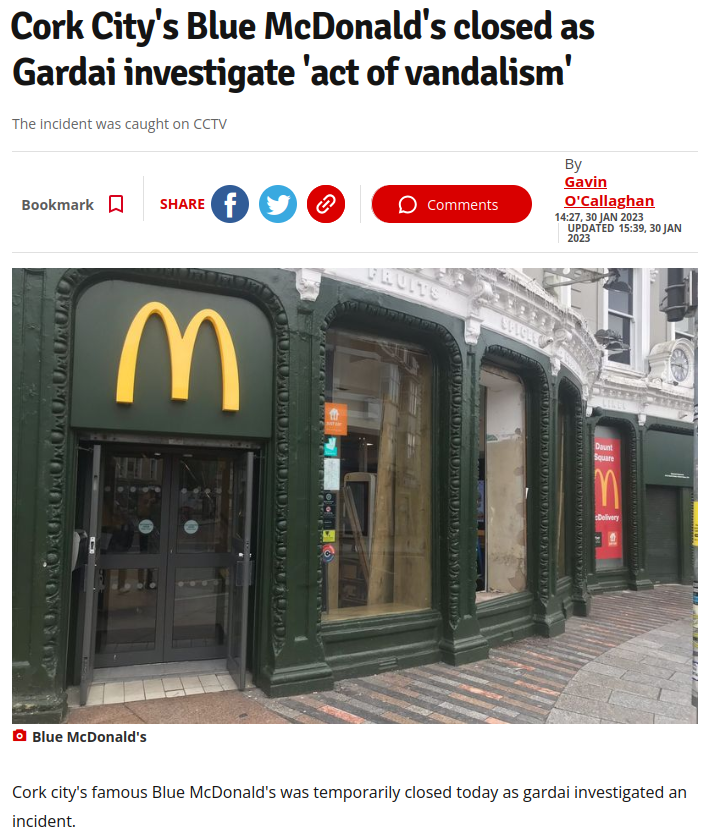
The Blue McDonald’s in Cork sits at the end of Patrick Street at the corner with Daunt’s Square that sits in distinctive, rounded building. This is formerly the site of Woodford, Borne & Co. and the lettering on the side of the building still promises “wines, fruits, spices, coffees, teas, wines [and] spirits”. I guess they really wanted you to know that they had wines. The Woodford bar at the back of the building on Paul St. is also named for this prestigious shop.
But since a certain clown moved in in the 1980s the building has become known to the residents of Cork simply as The Blue McDonald’s and it is still called that to this day.
Despite the fact that it has been painted green for over a decade now.
This post uses obscure Unicode codepoints and custom fonts which may not display in RSS readers and some browsers.
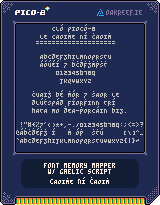
A few years ago I made a Gaelic-style monospaced pixel font that I called Cló Piocó-8.
This was originally just testing out the custom font mode in Pico-8 for fun.
I then ended up making a truetype font using Pixel Forge.
If custom fonts can display it looks like this.
This was mainly for fun and I haven’t used it terribly much.
Around the same time I made it I also made a similar pixel font for Ogham.
I think the reason for making these separately was because the main font was monospaced
but the Ogham one wasn’t? Or perhaps it just didn’t occur to me to include the Ogham
section with the original font at the time. Either way I’ve decided I wasn’t happy with them
being two separate fonts so I made a new version of Cló Piocó-8 that includes the Ogham block.
I also changed another character: R.
The original R character in the font was more straightforwardly based on an Insular R and looked like this: R.
You might be wondering what an Insular R is.
Insular? Why is this R so withdrawn?
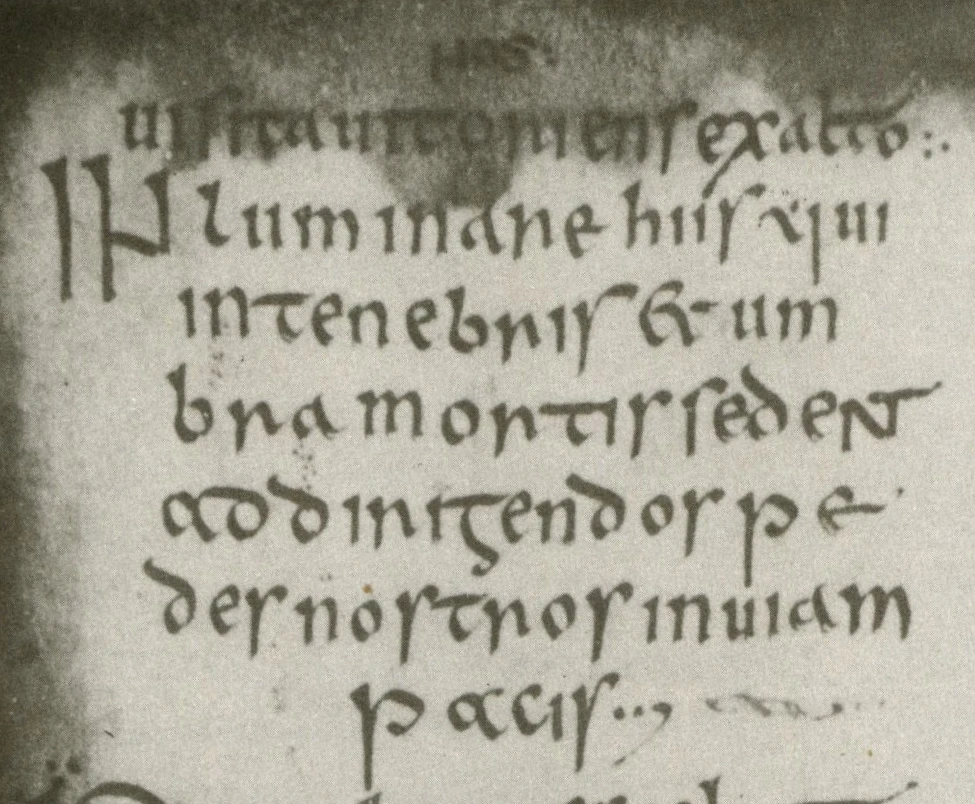
Because in the middle ages Ireland was a pretty isolated place, and Irish monks were left
to their devices, eventually developing a style of writing called Insular script.
When printing came to Ireland, which took a while, most things were printed in English.
Gaeilgeoirí didn’t have much to read (but most of them couldn’t, anyway).
The first book printed with an Irish type was
Aibidil Gaoidheilge agus Caiticiosma in 1571, using a font which had been commissioned by
Elizabeth Tudor, though it was actually a bit of a hodgepodge of Gaelic, Roman and Italic,
with the new Gaelic letters resembling the Anglo-Saxon type made by John Day.
Since then Irish has been printed in both Roman and Gaelic type, the former often simply due to practical
considerations of the availability or expense of Gaelic fonts or because it was seen as more modern.
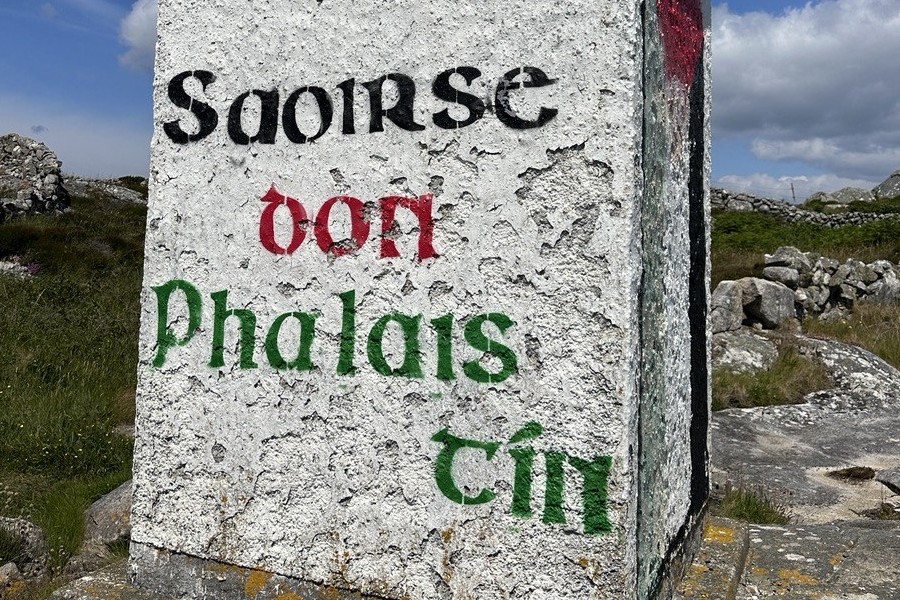
It is rare to see Gaelic script used now except for in decorative text such as signs and plaques.
“Freedom for Palestine” painted on a building in Irish Carraroe via Gaelchló.
But I quite like the Gaelic-style scripts and—as evidenced by my homepage—I quite like playing with typefaces. I use Mínchló from Gaelchló for most the Gaelic script on this site.
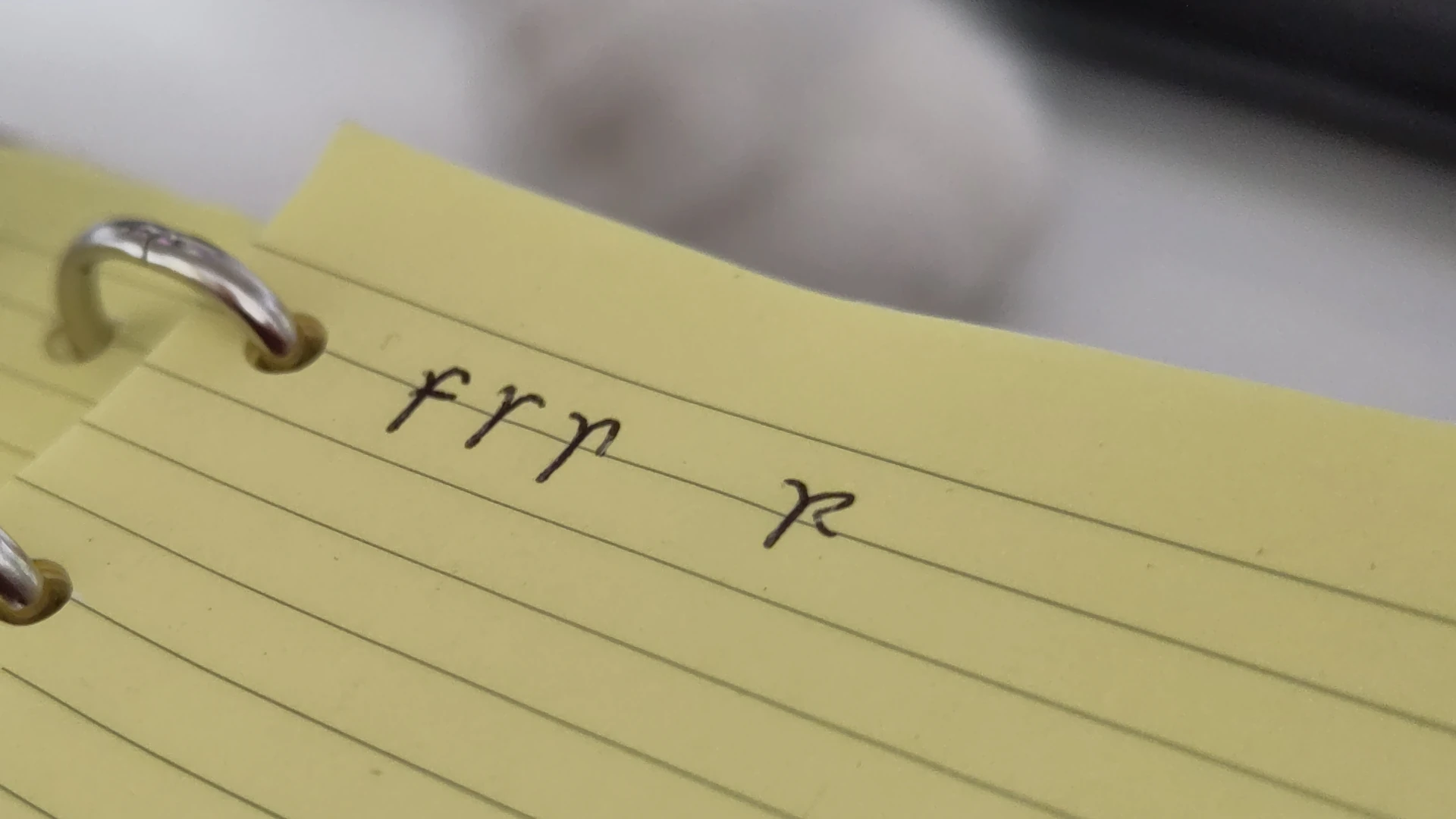
But I will admit there can be some drawbacks to readability. Particularly with f, s and r, or rather their Insular variants, which Unicode has unique codepoints for: ꝼ ꞅ and ꞃ, respectively.
ꝼ ꞅ ꞃ
Compared to a Roman f, the Insular ꝼ almost appears as if it has been hammered into the ground like a post. The tail of the character dips below the line and the stroke is level with it, the top of the character only reaching to the same height as a small letter like e. But it is still distinct and recognisable as an f.
The problem starts with s. You might be familiar with a long s, which is basically an old-fashioned way of writing an s where it looks like an f without the stroke in the middle. The Insular ꞅ similarly strongly resembles an Insular ꝼ and if one is more familiar with Roman type it is very easy to confuse them at a glance. Many modern Gaelic typefaces simply use a Roman-style s instead for clarity, or offer the use of both using stylistic sets. I opted to use a Roman-style s when making Cló Piocó-8 for clarity. When your characters are only four characters high you need to be careful about legibility and it’s very common to do this anyway with Gaelic typefaces for both s and r.
But I still, in that first version, decided to go with an Insular ꞃ, a character that resembles a cross between the Insular ꞅ and an n, or perhaps a Greek η with the tail on the other side. In an attempt to make it not look too much like an n I cut one pixel off the right-side, to try and maybe make it look a bit more like a Roman r, but really it just makes it look weird. I left it like that for a long time, but I was never fully satisfied with it.
Deciding to change it
When I was making my custom cartridge designs for my Pico-8 projects (something else I could write a bog post on, really) I decided to use Cló Piocó-8 to sign my name and the URL of this site on them. This made me have to face that bloody R again. I was never happy with the compromise I made originally and quite frankly people were not going read it as an r. I don’t want anyone typing “oakneef.ie” into their browsers and finding nothing there.
It was here that I came up with my new compromise: R. It is mostly an upper-case Roman R but with a little bit of a tail sticking down for a bit of Insular influence. I have actually started scribbling my r like this when handwriting in Irish as well.
It took me a while to actually bring this change back to the font file itself but when making the 88×31 pixel badge for this site I was reusing elements from my Pico-8 cartridge design and it reminded me to go back and make the change, and I while doing it I also rolled the Ogham font into it as well, which I had also been intending to do for a while.













 I was reusing elements from my Pico-8 cartridge design and it reminded me to go back and make the change, and I while doing it I also rolled the Ogham font into it as well, which I had also been intending to do for a while.

