vampires

Child tags:

Caoimhe

What I’m reading vol. ⅩⅥ

Vols.: Ⅰ, Ⅱ, Ⅲ, Ⅳ, Ⅴ, Ⅵ, Ⅶ, Ⅷ, Ⅸ, Ⅹ, Ⅺ, Ⅻ, ⅩⅢ, ⅩⅣ, ⅩⅤ, ⅩⅤⅠ

Today’s musical accompaniment will be relevant further down the post.


Games

Interview with Satoshi Yokokawa — Ashley Rojas

Cool interview with the enemy designer of Sonic 3 & Knuckles. I’ve always thought that the badniks in Sonic 3 had a more industrial look to them compared to the enemies from the previous games and I’ve always really liked that about it and it pleases me to hear the intent behind that being articulated. I also love Mecha Sonic’s design and it’s really lovely to hear him appreciate the fan art and reinterpretations of his designs. Also look at this short fan animation, it’s really cool.

Given that setting, since the Death Egg had suffered enormous damage from crashing due to Sonic's attack in "Sonic 2," I thought the mecha production facilities inside the fortress must also have been heavily damaged, making it difficult to carry out production as before.

From there, I arrived at the idea that Dr. Eggman, needing a fighting force to oppose Sonic under conditions where the production facilities weren't functioning properly, would gather up usable parts and hastily assemble machines to deal with the situation.


mantle.nes breakdown blog part 1 — Melon

First of (so far) two posts where Melon breaks down the development of their NES recreation of the “original game” in Deltarune chapter 3.

I had previous experience working on NES games already - at least, I had tinkered a little bit and had enjoyed enormously Pikuma’s course on beginning-to-end gamedev with 6502 assembly on the NES a few years back, so I felt confident I could pull it off! Even if the journey seemed daunting, I just had to go one step at a time…


The Web

Self-censorship practices as anti-shibboleth — Laura Michet

Oh do I hate algospeak. I stopped talking to a therapist once in part because I lost a massive amount of respect for him for using the word “unalive”.

In my experience, self-censoring adult terminology on that site in particular is a great sign that you're dealing with someone so incurious, with such a limited experience of online conversation, that they don't understand where they are, or who they're dealing with, or who's accountable for maintaining the peace in the community where they're speaking. I do not want to read the things these people write, and I do not want to talk to them. I'd rather not be the person who teaches them to be curious.


Hulagirl.txt — Deli

An investigation into the origin of a classic, old web GIF.

Perhaps enough time has passed that she is merely an inconsequential sighting to the average webuser, a rarity of a signal overlooked in the noise. There was once a time that she danced her way across webpages all over geocities and brought a small injection of joy and energy to whatever page she graced. Early on, she was a known quantity but the passage of time and memory made her mysterious. Stayed mysterious for a long while since, honestly, who really cares about the provenance of a free-to-use gif that is barely 5kB?


I Found Evidence Of My House Spinning — Blackle Mori

Some fiction for once, recommended by Laura Michet again. Interesting use of HTML as a medium.

This is the story of the most inexplicable thing to ever happen to me. It still keeps me up at night, just rolling it around in my head as I fail to make it make sense. This is the story of how I took a video from inside a recurring dream.


Animating Bad Apple with no JS, no CSS, & minimal HTML — Vivian

Explainer of Vivan’s very cute little Bad Apple animation using a technique similar to Geocities HTML Chat.

I wanted to show the Bad Apple animation without JS or CSS, with an impressively minimal set of HTML tags, by abusing slow chunked response, forcing the browser to load the page piece-by-piece. That's happening now (unless you're reading some archive) but how can we use it for animation?


The Crawler Zoo

Less of an article and more of a cool website: The Crawler Zoo monitors and categorises bots that scrape the site. Visitors can even watch bots wander an infinitely generated maze of junk pages.

Every request that reaches the site is examined at the gate. Bots are identified, named, drawn and filed into an enclosure; people are waved through and counted only as an anonymous daily total. Everything you see is live: the figures update as the bots arrive.


Irish

What to use: the “w” or “v” difference in dialects

Improving my Irish is something I’ve wanted to do for a long time but found difficult to sustain long-term, but I do still have occasional bursts of enthusiasm. In this case I found this article, and especially the videos linked within, a good crash course in improving my understanding of Irish phonetics.

When learners come across this difference in pronunciation, they are usually looking at words like “bhfuil” (i.e. “an bhfuil”) and “mháthair” (i.e. “mo mháthair”). How you pronounce it largely depends on which dialect you choose.


The tale behind the Irish translation of Dracula is something to really get your teeth into — Darach Ó Séaghdha

I’ve written about the Irish translation of Dracula before, so of course I was interested to learn a tiny bit more about the history of the book.

Should the Free State find exciting new literary voices working as Gaeilge and bring them to a wider audience, or should they focus on translating bestselling titles that readers had already heard of?

Finance Minister Ernest Blythe took the latter view. In particular, Blythe was very interested to discover that the Berne Convention for the Protection of Literary and Artistic Works had a clause at the time regarding translation rights.


Politics

Europe’s centrists are finally paying the price of their extremism — Yanis Varoufakis

Valve Software’s former in-house hat economist weighs in on the consequences of “centrism”.

Everywhere, it is the same mechanism: Parties that called themselves sensible, pragmatic, and centrist have pursued one of the most doctrinaire economic programmes in European history – and pursued it with a rigidity, an intolerance of dissent, and a contempt for democratic contestation that the actual political extremes of the 20th century would have recognised as their own method, even if they had rejected the content.



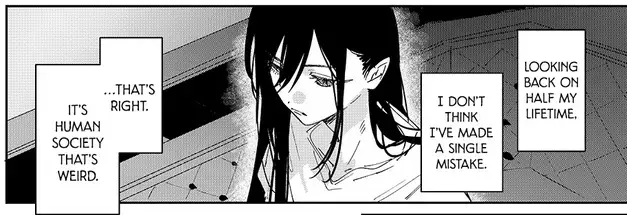
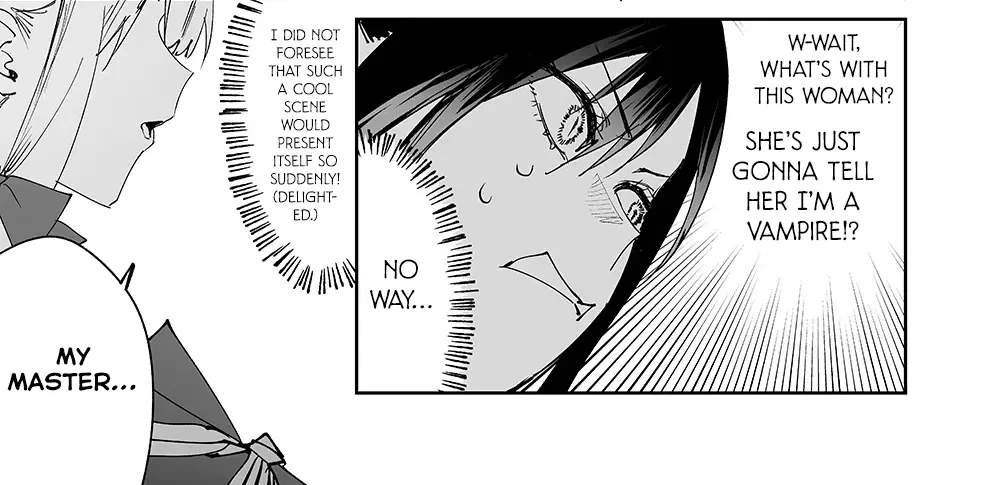
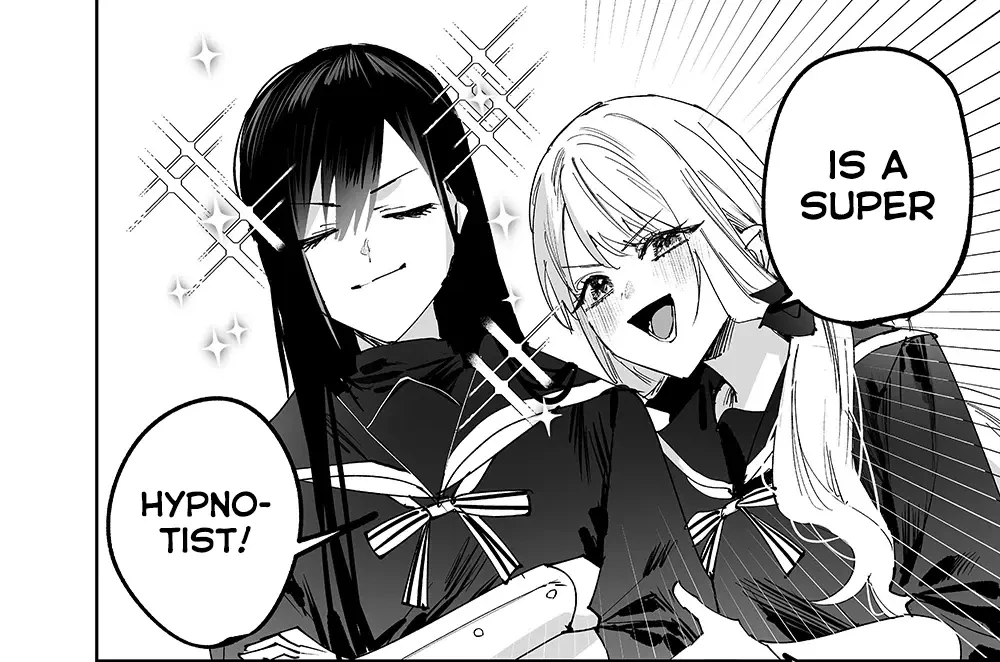
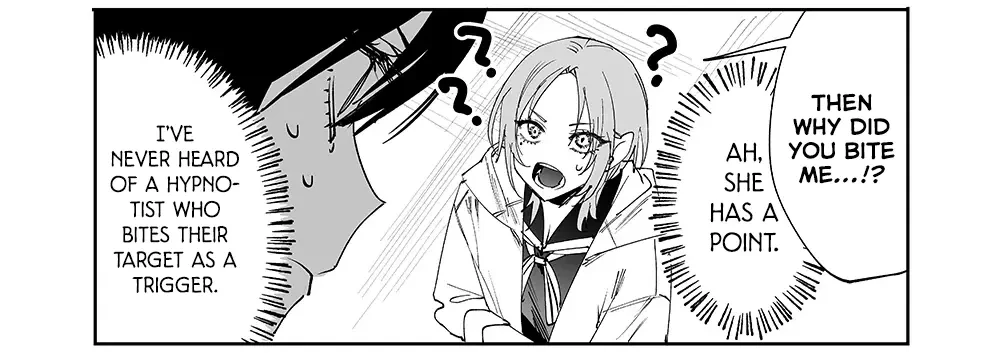
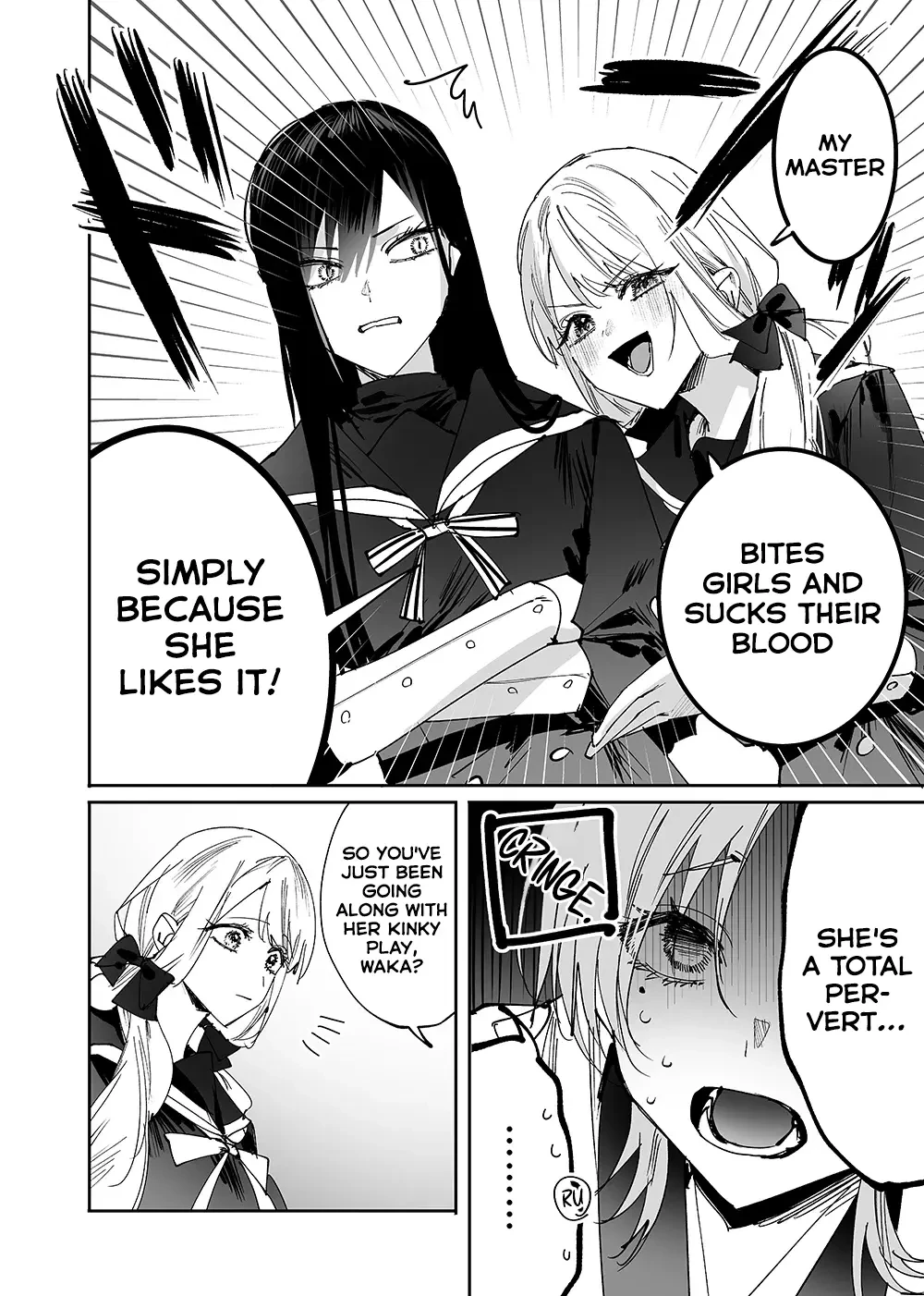
The protagonist of Girls × Vampire is named ルルナ. The scanlation on Mangadex has transliterated her name as Ruruna, while the Kinokuniya USA print has gone with Luluna instead. Only the people doing the German translation at Dokico seems to have noticed that it says Ruluna on the cover art.

illustration of a vampire biting someone, showing blood
Cover art of Girls × Vampire, featuring Ruluna’s signature in the bottom right and a second watermark reading Ruluna along the upper right edge.


Caoimhe

The Train Fiend

I feel so grateful to the man who invented the “Traveller’s” typewriter.

Mina Harker, expressing her love for her laptop.

Applying modern labels and understandings of people to the past is iffy and and remains so when applied to fictional characters who were certainly never written with those as-yet non-existent concepts in mind but also it’s fun so I’m going to do it. Mina Harker (née Murray) is an autistic, bisexual, and cool as hell.

None of what I’m going to say is a particularly original idea and much of what I’m drawing from here is from the general milieu of the Dracula Daily fanbase. This was, of course, a large part of the appeal of Dracula Daily; not just a novel way to read a classic book but also a participatory exercise in going through that work and evolving a fandom understanding of it as it progresses, with all the tenuous headcanoning that such things involve.

Dracula is Gothic fiction wherein the ancient horror is defeated and soundly routed by modernity. Our heroes are doctors and solicitors (and a rich Texan who fancies himself a cowboy) and an important weapon in the arsenal used to defeat the count himself is meticulous note-taking. And it is Mina who transcribes, edits, organises and distributes these notes. Within the fiction it is she who creates the manuscript that is the text of the novel itself and makes carbon copies to provide to the other protagonists. She habitually organises and sorts information and while she often frames it as making herself useful to her husband1 she displays a clear knack and enthusiasm for doing so.

“When does the next train start for Galatz?” said Van Helsing to us generally.

“At 6.30 tomorrow morning!” We all started, for the answer came from Mrs. Harker.

“How on earth do you know?” said Art.

“You forget or perhaps you do not know, though Jonathan does and so does Dr. Van Helsing that I am the train fiend.”

“I am the train fiend”?! This girl autistic as hell.

Mina is also the one who sits down and logically deduces Dracula’s escape plan from everyone’s scattered notes and observations, writing it out her evidence and conclusions point by point.

Ground of inquiry. Count Dracula’s problem is to get back to his own place.

(a) He must be brought back by someone, This is evident; for had he power to move himself as he wished he could go either as man, or wolf, or bat, or in some other way. He evidently fears discovery or interference, in the state of helplessness in which he must be confined as he is between dawn and sunset in his wooden box.

(b) How is he to be taken? Here a process of exclusions may help us. By road, by rail, by water?

[…]

Van Helsing says that Mina has a man’s brain and a woman’s heart1. While this is meant simply as a compliment of her faculties1 the fact that her analytical nature is framed as inherently masculine reminds me of the (nonsense) extreme male brain theory of autism which is rooted in notions of men being naturally more systemising and women being naturally more empathising. This is starting to bend towards me just documenting some free association so I will move on to Mina being gay.

Mina and Lucy in the book have a classic romantic friendship, gushing and fawning over each other to a degree that is difficult not read as somewhat sapphic to a modern reader. Mina takes care of Lucy while she is being secretly preyed upon by Dracula, and while she sleeps Mina notes how beautiful she is, thinking about how it could make someone fall in love with her, about sex outside of marriage, and about the idea of women being able to make marriage proposals1.

Lucy is asleep and breathing softly. She has more colour in her cheeks than usual, and looks, oh, so sweet. If Mr. Holmwood fell in love with her seeing her only in the drawing room, I wonder what he would say if he saw her now. Some of the “New Women” writers will some day start an idea that men and women should be allowed to see each other asleep before proposing or accepting. But I suppose the “New Woman” won’t condescend in future to accept; she will do the proposing herself. And a nice job she will make of it, too! There’s some consolation in that. I am so happy tonight, because dear Lucy seems better.

Later, not having seen Lucy in some time and unaware of her rapid deterioration, Mina sends a letter to Lucy that directly compares the love between her and her husband to the love between her and Lucy and that she could, would, has, does and will love her.

Jonathan asks me to send his “respectful duty,” but I do not think that is good enough from the junior partner of the important firm Hawkins & Harker; and so, as you love me, and he loves me, and I love you with all the moods and tenses of the verb, I send you simply his “love” instead. Goodbye, my dearest Lucy, and all blessings on you.

The novel—the manuscript compiled by Mina herself—emphasises the tragedy of this goodbye and this expression of love by noting that this letter was not opened by Lucy before her death.

Also her favourite spot to hang out in on her holiday in Witby is the graveyard so she’s pretty goth, too.

  1. Dracula was published in 1897. ↩ ↩2 ↩3 ↩4


Bit ★★☆☆☆

This review contains spoilers. Poster.

I wanted to give this another chance but it’s just not a hugely enjoyable watch. Everyone is giving just a flat, boring delivery and it’s so universal across the cast that I feel like it must be a problem with the direction rather than the actors and some core plot points feel very underdeveloped. Duke’s hypocrisy is core to the plot and messaging of the film but we never really see her that much evidence of it other than fucking Dracula showing up and telling us that she’s apparently been sneakily glamouring everyone and the pretty serious conflicts and resentments between Laurel and her family just get dropped immediately when it’s time for the finale and are never discussed again.


Caoimhe

Seaside town elects dog1 mayor

I have posted about how one of Dracula’s funniest moments is from it examining its own format as an epistolary novel but a another amusing use of the format is the inclusion of newspaper articles that give a perspective of some of the events of the novel from the detached perspective of (absurdly verbose) newspaper clippings whose writers have no inkling of the broader events of the story.

A correspondent from The Daily Graph recounts, on the 8th of August, how a freak storm crashes the schooner Demeter into Whitby Harbour with the only living soul on board being a great, black dog1 that leaps from the ship as soon as it beaches and runs straight to a cliff where it “disappeared in the darkness, which seemed intensified just beyond the focus of the searchlight.”

The reporting continues the next day that the cargo of the ship (boxes full of Transylvanian soil) being consigned to a local solicitor and, more importantly, the Whitby SPCA putting out a desperate search for the poor dog who fled the ship, who is imagined to be terrified and hiding in the moors and definitely not a murderous vampire in the guise of a gigantic, ferocious, black wolf.

The newspaper clippings end with the paragraph:

No trace has ever been found of the great dog; at which there is much mourning, for, with public opinion in its present state, he would, I believe, be adopted by the town. To-morrow will see the funeral; and so will end this one more “mystery of the sea.”

  1. wolf2 ↩

  2. Dracula ↩


Caoimhe

John Seward’s audio logs

This post contains spoilers for Dracula, which is 128 years old.

I have not been keeping up with Dracula Daily as I had intended1 but I wanted to make a post about it today. One of the features of the original Dracula that is often forgotten in adaptation is how modern it is. As an epistolary novel the story is mostly a series of diary entries and in the case of the character John Seward his diary, starting on the 25th of May, it is recorded on a phonograph—an invention that was only twenty years old at the time of the novel’s publication in 1897.

The book heavily involves the collision of the very modern and scientific with the ancient evil that is Count Dracula. The novel opens with Jonathan Harker, a solicitor, travelling to Transylvania in order to sort out a property deal for the count. This journey involves going from the comfort and regularity of well-timetabled trains to a treacherous carriage ride through the old, wild Carpathian mountains. With him, as well as the needed legal documents, he has photos taken on his Kodak2 camera, which is far from the only piece of prominent technology.

The weapons used to fight Dracula are not just wooden stakes and crucifixes3 but also blood transfusions4, hypnotism5, next-day flower delivery from Haarlem to London6, shorthand7, meticulous note-taking, and in-depth knowledge of train timetables8. While it goes unremarked on in the book itself I like to imagine that Count Dracula’s statement that “to live in a new house would kill me” is due to a vampire’s inability to cross running water not playing very well with indoor plumbing. Abraham Van Helsing is not a young, sexy vampire hunter in this novel but an polymath professor with at least three doctorates9. Dracula is not that out of step with Buffy the Vampire Slayer answering the question of how to deal with a terrible and ancient demon with blowing it up with a bazooka.

But there is something else important about John Seward’s phonography: It ends up being extremely funny. Even just reading this and thinking that he is speaking this out loud to be recorded on a wax cylinder it seems incredibly obnoxious:

I questioned him more fully than I had ever done, with a view to making myself master of the facts of his hallucination. In my manner of doing it there was, I now see, something of cruelty. I seemed to wish to keep him to the point of his madness a thing which I avoid with the patients as I would the mouth of hell. (Mem., Under what circumstances would I not avoid the pit of hell?) Omnia Romæ venalia sunt. Hell has its price! verb, sap. If there be anything behind this instinct it will be valuable to trace it afterwards accurately, so I had better commence to do so, therefore R. M, Renfield, ætat 59. Sanguine temperament; great physical strength; morbidly excitable; periods of gloom ending in some fixed idea which I cannot make out.

One presumes that he is saying “memorandum” out loud and not just “mem” as is transcribed. Later, when he records his conversations with Van Helsing he includes the full back and forth dialogue, with all of Van Helsing’s disfluencies, grammatical errors and strange turns of phrase. One has to wonder is Seward imitating his friend’s Dutch accent while recording this? Is he doing voices whenever he is making his diary? What does his Mina voice sound like? We are reading, within the fiction, a transcription of him speaking out loud. And we know who does the transcription because it happens during the course of the plot. The later part of the novel involves the protagonists meeting up and compiling all of their notes together into what is the text of the novel itself.

This is done by Mina Harker and the reason she starts doing this is, again, extremely funny: She walks in on Seward recording on his phonograph and asks to hear some of it. He initially agrees but then starts deflecting awkwardly that most if is about his medical cases. When Mina asks specifically to hear about the last few days of her friend Lucy Westenra’s life he admits that he has no idea how to find a specific diary entry in his phonograph recordings. He has been using this for at least the last four months and he just never thought about it at all. He has not labelled anything. He has no system of any kind. He has just been talking into this and never reviewing it in any way! This is what prompts Mina to start transcribing the entries for him, as well as typing up her and her husband’s shorthand diaries for everyone else to read and compiling all the other letters and newspaper clippings that make up the novel. Going back to the modernity of it all the most in-spirit adaptation of Dracula set in the modern day would surely be composed primarily of screenshots of social media posts and podcast segments.

There is one more interesting angle on the fact that Mina is the author, or at least the typesetter, of the book within the fiction: How she types up the dialogue of Renfield, Seward’s patient and devoted servant of Dracula. Renfield’s dialogue capitalises He, His, You, Your and Master when he is speaking of Dracula, something that is only proper to do when referring to God10. This is obviously meant to ascribe a blasphemous devotion to Dracula to Renfield, but within the story it is Mina who is choosing to capitalise his words in this manner and Mina is also, at this point, partially under Dracula’s influence. While I don’t think that this was Bram Stoker’s intent we could read this an an unconscious sign of Dracula’s influence over Mina’s mind.

  1. I think that in light of recent personal events that should be pretty forgiveable. ↩

  2. Kodak had been founded 1892, five years prior to the publication of Dracula. ↩

  3. Amusingly as an Anglican Jonathon Harker finds the whole crucifix thing all a bit Catholic for his taste. ↩

  4. Some successful blood transfusions had been recorded for decades prior to the novel’s publication, but it was a very risky affair and blood types were not discovered until a few years later. ↩

  5. Hypnotism, a word coined by James Braid in 1841, was very much in vogue as a serious path of medical exploration in the decades prior in both Britain and France. ↩

  6. Van Helsing uses garlic blossoms to ward off Dracula in the novel, not strings of garlic bulbs. ↩

  7. The Pitman shorthand system was published in the 1837 and the Gregg shorthand system in 1888. ↩

  8. Please look forward to a post about the train fiend in a few months. ↩

  9. He signs his letters “Abraham Van Helsing, M.D., D.Ph., D.Lit., Etc., Etc.” ↩

  10. Within the cultural context of the novel. I am not religious. ↩


Caoimhe

Dracula an Lae

I’ve made some tweaks and corrections to this post, including fixing some confusion I had about Arthur Holmwood’s name.

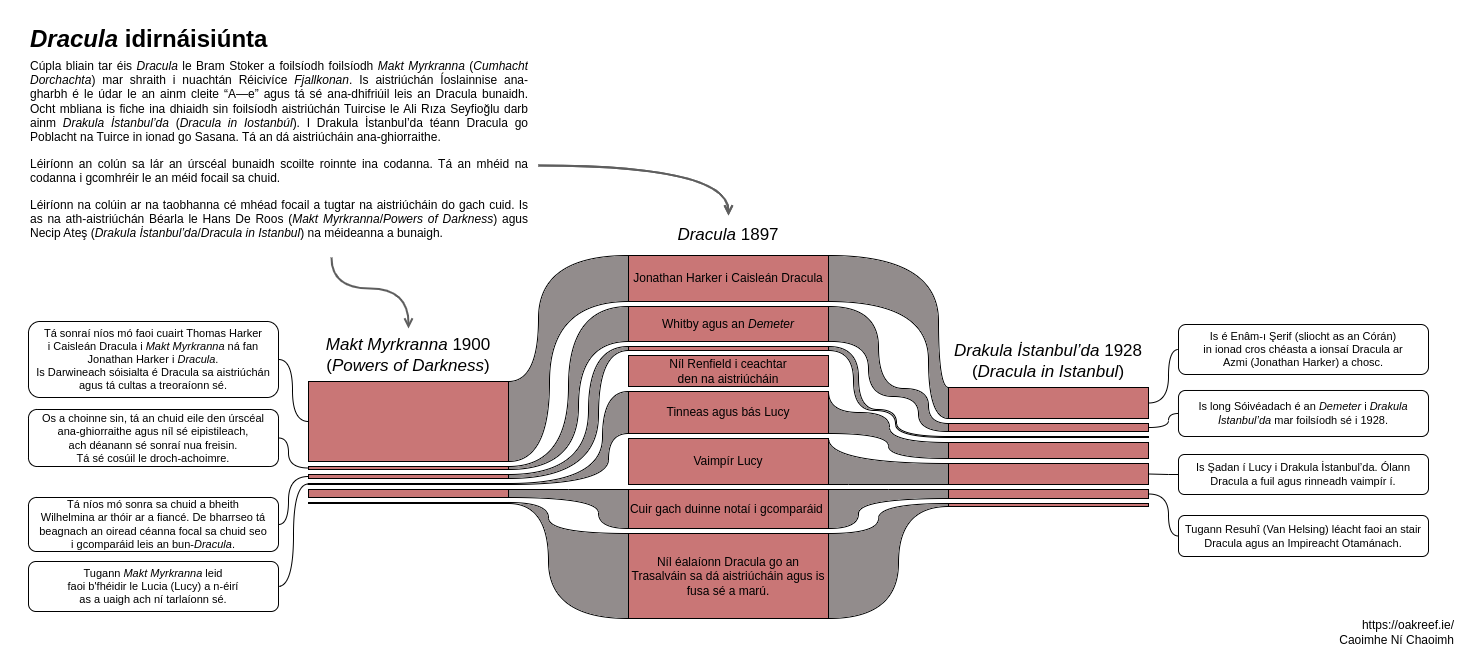
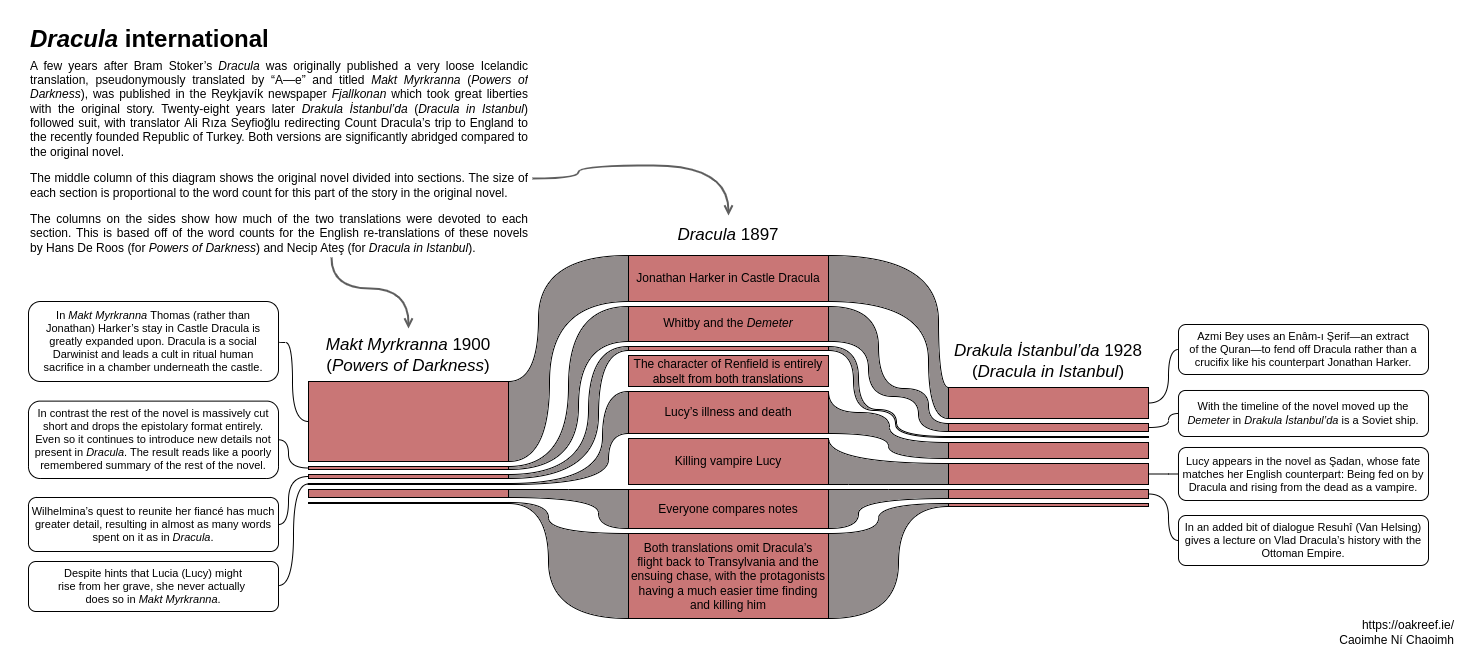
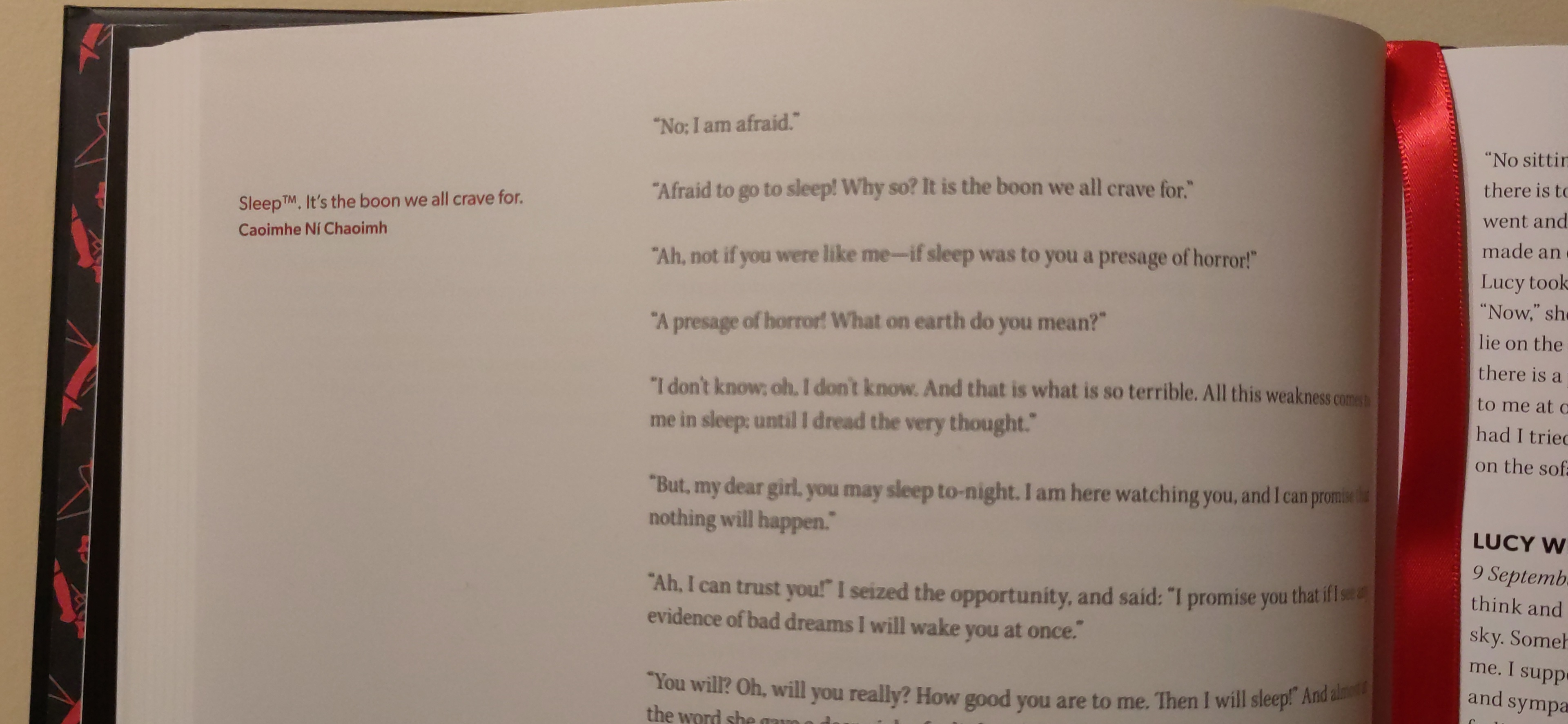
I first read Dracula in 2022, following along with Dracula Daily, a newsletter that sends out sections of the book on the date in which they occur1. One of my posts about it on Tumblr actually ended up in the print version. The following year I read it again, this time following along with two other versions of the book: Powers of Darkness and Dracula in Istanbul, English retranslations of Icelandic and Turkish translations of the original novel respectively. It was interesting to compare the changes made in each version. I made a graphic showing how both version abridge the story compared to the original. That year I also read the comic book adaptation of Francis Ford Coppola’s Bram Stoker’s Dracula.

Last year I did not read Dracula again but this year I had a notion: To pick up an Irish translation and follow through the book simultaneously with my print copy of Dracula Daily2. This has immediately got off to a bad start: I was busy yesterday and so didn’t even start on the 3rd of May, the date of first entry of Jonathan Harker’s journal. The other, much larger and in hindsight very predictable problem is that my level of Irish is not really up to reading this. I had intended to get more practise in on simpler books before this but I have but limited time upon this Earth and a condition that results in poor executive function.

Still, there are some interesting things here even at a glance. I am always curious about how proper nouns are handled in translation. Here there is a mixture of Gaelicisation and leaving things as is. Jonathan Harker is Seon Ó hEarcair3 but Dracula remains Dracula (with his title of count translated as cunta). Most placenames use their standard Irish names—Transylvania is Transalváin—but Munich is actually reverted to its native München.

Flicking ahead I can see that Mina Murray is Mín Ní Mhuirí4 and John Seward is Seán Suaird5 but other names are left unchanged or only partially translated. Lucy Westenra is now Laoise6 Westenra and Arthur Holmwood is Artúr7 Holmwood. Abraham Van Helsing and Mr. Quincy P. Morris are unchanged, with the English honorific still being used sometimes in the text. Other minor characters like Renfield seem to keep their English names. I can’t really tell what the basis was here for deciding which names to translate or not.

Returning to section for the 3rd of May there are some abridgements. The section on the various nationalities of Transylvania is cut entirely8 and more tragically Jonathan’s little memoranda to get the recipes for paprika hendl, mămăligă and împănată to give to Mina are cut as well.

Bram Stoker himself was an Anglo-Irishman from Dublin and a lot of people say that the choice of the name Dracula for the eponymous vampire was not only inspired by the historical Vlad the Impaler but also because it sounds vaguely like “droch-fhola”, a phrase that could be read as “evil blood” in Irish. It’s not true at all, but people say it!

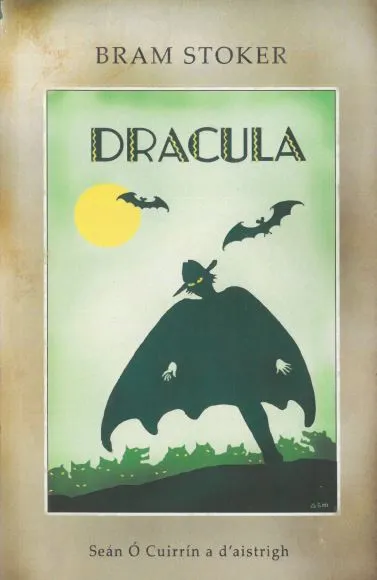
One last thing to note about this translation is that the cover is quite funny.

The cover depicting Count Dracula in silhouette. He appears to be running while wearing a cape and a cowboy hat as some cartoon bats fly overhead. His only visible features are huge yellow eyes and two white hands cut out of the silhouette in the middle of the cape, held out to the sides like he doesn’t know what to do with them.
  1. Dracula is an epistolary novel; it is made up of fictional letters and diary entries written by the characters. ↩

  2. The title of this post, Dracula an Lae, is Dracula Daily in Irish. ↩

  3. Pronounced something approximately like ”Shown O’Harker”. Irish does not natively use the letter J and Gaelicisations tend to use a slender s sound in it place, which is similar to an English “sh” sound. ↩

  4. Something like “Meen Nee Woor-ee”. Murray is an Anglicised Gaelic surname in the first place. The male form is Ó Muirí, something like “O Moor-ee”. She of course later in the novel becomes Mín Uí Earcair, “Meen E Arker”. ↩

  5. ”Shawn Seward”. ↩

  6. “Lee-sha”. ↩

  7. “Ar-toor”. Once his father dies Artúr inherits the title of Tiarna Godalming. ↩

  8. Perhaps the translator, in 1933, did not wish to have to research (or invent) Irish or native names for Wallachs, Dacians, Magyars, Szekelys and Huns. ↩


Caoimhe

What I’m reading vol. Ⅲ

Vols.: Ⅰ, Ⅱ, Ⅲ, Ⅳ, Ⅴ, Ⅵ, Ⅶ, Ⅷ, Ⅸ, Ⅹ, Ⅺ, Ⅻ, ⅩⅢ, ⅩⅣ, ⅩⅤ, ⅩⅤⅠ

the little lies robots tell us — Melon

The longer we tolerate the little lies that robots tell us, the bigger the lies become, and the more difficult it becomes to untangle them from our everyday lives. This is not an inevitability, however; we can find in ourselves and in our connections with eachother the self-confidence to learn how these things work, to unpick the threads, to see through the smoke and mirrors that they are only barely veiled behind.

How To Post — Mike Egan

Always remember to Post Hog.

And yeah, sometimes I want to do that, if I'm writing about my experience playing a game or something, but I also have a HUGE list of ideas for blog posts that I plan to write "eventually" that I'm very much not posting because I think I don't have time to do it right. Because I think it has to be some level of "interesting" or "good" or "having a point."

I've forgotten the lesson of Post Hog.

TIL cool math. Also we need knowledge engines that we can trust (that is: not chatgpt) — Llaura

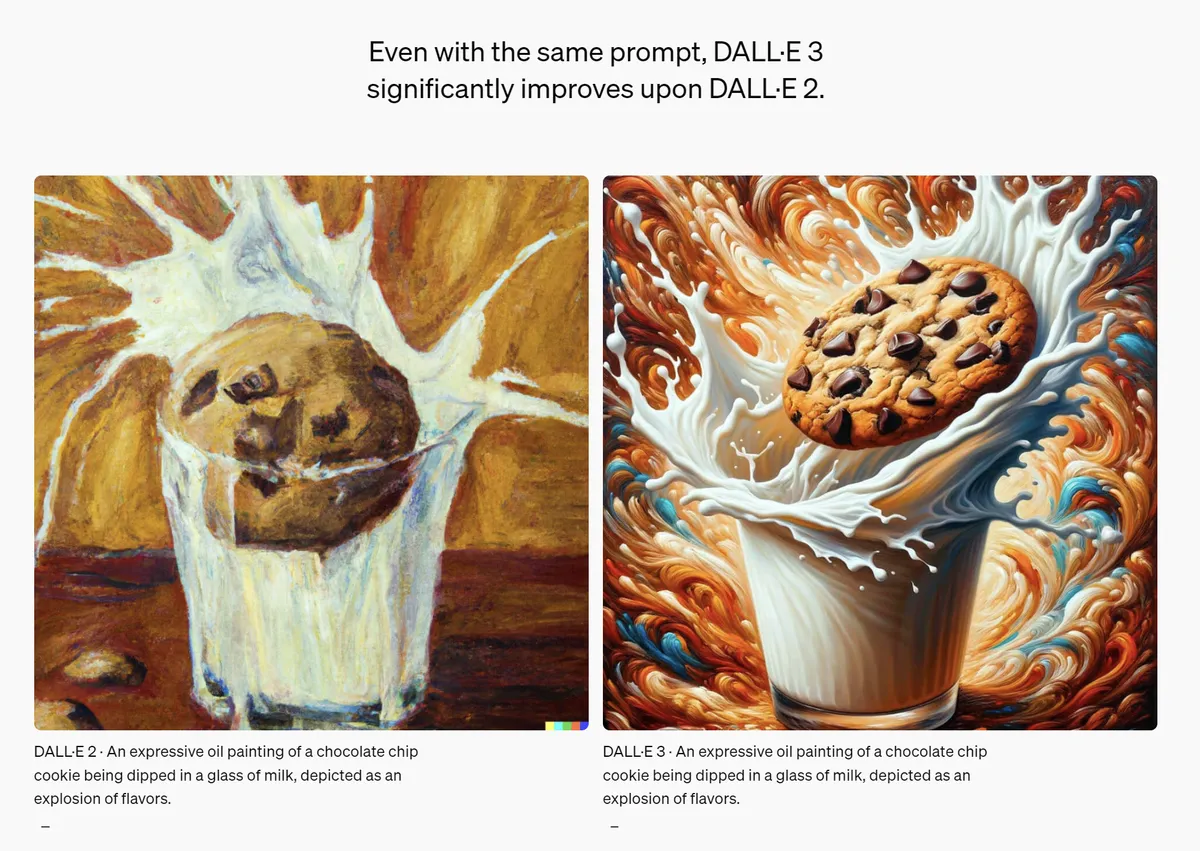
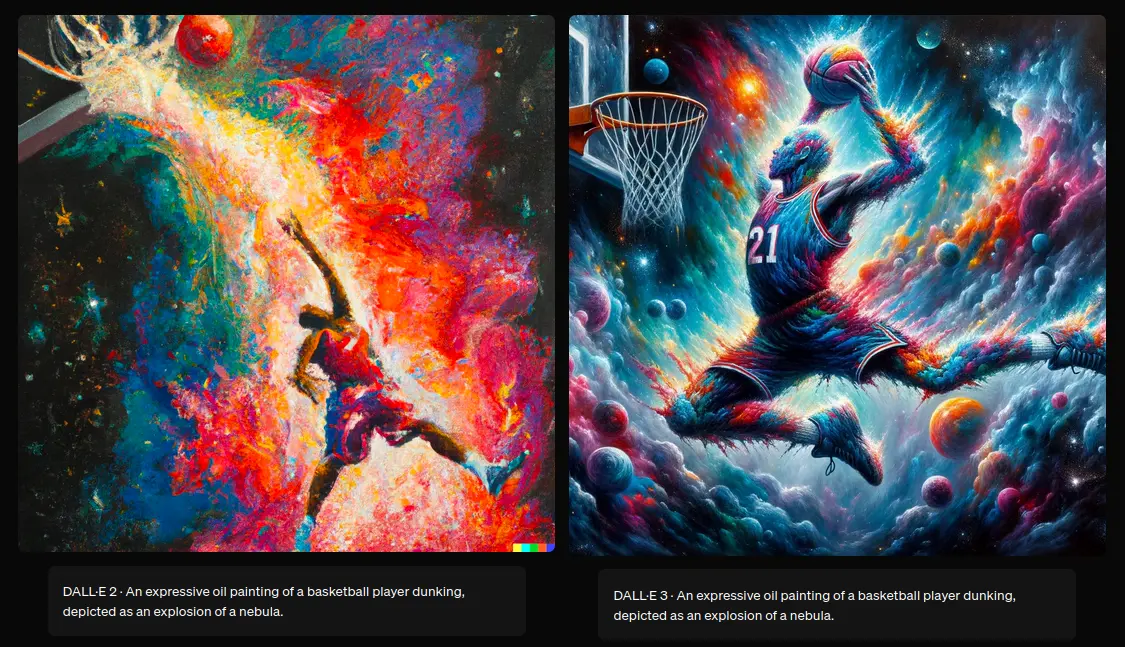
I am honestly mostly linking to this for the absurdity that is the comparison image that Open AI used to show how “DALL·E 3 significantly improves uon DALL·E 2”. Look at this:

Two machine-generated images for the prompt “An expressive oil painting of a chocolate chip cookie being dipped in a glass of milk, depicted as an explosion of flavors”.

The older one looks somewhat like an actual oil painting while the “improved” version is a cacophonic mess that fails to represent what it asked of it while being aesthetically ugly as shit.

It almost makes me think that perhaps generative AI could actually produce output that is meaningfully better than it currently does and is at least partially hampered by simple obstacle that people who are making and curating these systems have truly atrocious taste.

The cookie example doesn’t seem to be on the site any more but the comparison they’ve replaced it with shows the exact same problem.

My 6 Favorite HEPA Filters & Air Cleaners — Joey Fox

The PC fan CR box was a recent invention to find a method to achieve high clean air delivery rates with very low noise. Noise is the greatest limitation of in-room air cleaners and PC fans are the best option to address it. There are no other air cleaners on the market that have the capability to supply 150 lps of clean air at 35 dBA. Nothing comes close.

Via House of Nettles. I am also still following Natalie’s posts about reblogging and keen to try my hands at doing similar with this site now that my rewrite to make posting easier is done. Also also from Natalie: This amazing look.

TERF Island — Sophie Lewis in Lux Magazine

A distilled history of the TERF movement and its roots in reactionary feminism.

For the twenty-first-century feminist who has never heard of this schismatic moment and has perhaps swallowed the narrative that transphobia and biological essentialism were intrinsic to feminism’s Second Wave, reading the movement magazine the Lesbian Tide is an education. Morgan’s keynote was reprinted in the May-June 1973 issue but placed at the back in small type, sandwiched between contributions that all criticize Morgan and oppose her sabotage of the gathering. MacLean’s diary conveys participants reactions to the conflict on stage: “This can’t be happening. This woman is insisting that Beth Elliott not be permitted to perform because Beth is a transsexual.” “That’s bullshit! Anatomy is NOT destiny!” In her own contribution, “Of Infidels and Inquisitions,” Elliott testifies that the solidarity she experienced “kept alive my faith in womankind.” Concerning Morgan herself, however, she states with dignity that “I personally distrust those who hate men more than they love or do anything positive for women.”

the embroidery tips page that forgot to close its <h3> tags

Via the Internet Archive, via Emma Zhou, via Peter Krupa via a reblog from Sin Vega.

Fandom has toxified the world — Alan Moore in The Guardian

This fairly mild and nothing that hasn’t been said over and over again, but it’s still sort of nice to hear it directly from Alan Moore?

Soon thereafter, caught up in the rush of adolescent life, I drifted out of touch with comic books and their attendant fandom, only returning eight years later when I was commencing work as a professional in that fondly remembered field, to find it greatly altered. Bigger, more commercial, and although there were still interesting fanzines and some fine, committed people, I detected the beginnings of a tendency to fetishise a work’s creator rather than simply appreciate the work itself, as if artists and writers were themselves part of the costumed entertainment.

The V*mpire — P.H. Lee in Reactor

A short story about being groomed on Tumblr. Mind the content warnings.

Friendly reminder that not inviting vampires into your house is viviocentrism. Stop being viviocentric!

OP, I don’t want to demand more emotional labor from you, but I really don’t understand what you mean. Should I really invite in every vampire?

Disrespectfully, go fuck yourself. It’s not my job to educate you.

ᵃʷᵒ°

ᵃʷᵒ°

ᵃʷᵒ°

See, this is exactly the sort of bullshit that living “allies” always impose on us. OP made it extremely clear: Not inviting in a vampire is viviocentrism. INVITE IN EVERY VAMPIRE.

You may think that nested quote looks horrendous but I am just providing the genuine 2010s Tumblr experience.

Why play a fascist? Unpacking the hideousness of the Space Marine — Edwin Evans-Thirlwell in Rock Paper Shotgun

Edwin pulls together multiple articles that are worth reading in and of themselves to look at how Space Marines have been sanitised away from their satirical roots.

It's saying something about how accustomed I am to the ostensibly parodic figure of the Space Marine being portrayed as a hero that I didn't really question this desire to make you "like" and "get" the "fanatical killing machines" at the time. To be clear, I don't think Saber are deliberately and consciously trying to kindle empathy for literal fascist enforcers in Space Marine 2. Much of the above reasoning is grounded in ostensibly neutral, best-practicey questions of craft and characterisation.

A Maze of Murderscapes: Metroid II — S.R. Holiwell

An old classic that I think about a lot. I hope Stephy Rei Holiwell is still doing well out there. This and some other now-deleted writing of hers meant a lot to me.

Games about killing should probably make you uncomfortable. They shouldn’t be carefully crafted to be pleasant. Metroid II is openly about killing. It makes me uncomfortable with wordless specificity. This is one of the game’s saving graces.

This article was also, I believe, a large and overlooked part of the critical re-evaluation of Metroid II, being the basis for Game Maker’s Toolkit’s appraisal of the game when discussing its remakes.

Sex in the '60s in Cork… and the racy agony aunt who faced death threats — Teddy Delaney in Echo Live

An extract from someone’s memoirs published in a local paper. I don’t think the book would be the most interesting thing in the world if I’m being honest but I found some of the quoted letters to an agony aunt column amusing.

We are four worried 17-year-old teenagers. We are going to our first dance soon and a friend has told us to refuse a mineral from a boy because if you accept it you are supposed to spend the rest of the dances with him. We would like to know if this is true. Also, if a fellow asks you to go outside does this mean that he is bad? And what should you do if a boy asks you to go outside?

And to explain the terminology: An agony aunt is someone who pens an advice column and mineral here means soft drink or soda. Sorry if I ruined the picture in your head of teenagers in the 1960s exchanging rocks at a dance.