 Ursula Le Guin
Breaking my 2012 Kindle Paperwhite
My post on jailbreaking my 2012 Kindle Paperwhite is by far the most visited and commented on part of my website. I have gotten a lot of comments from people thanking me for helping them keep their old reader going. Unfortunately there are limits to making things last and sometimes one is just a bit too careless.
An e-reader is particularly useful for travelling, allowing one to bring myriad books with them in a smaller, lighter, package than even a single novel would be. While coming back from my trip to Warsaw I discovered that I had accidentally smashed the screen of my Kindle. I think I may have thoughtlessly sat on my bundled-up coat while it was still in the pocket. Now all but the bottom-left corner is stuck displaying the cover of Ursula Le Guin’s The Wind’s Twelve Quarters.
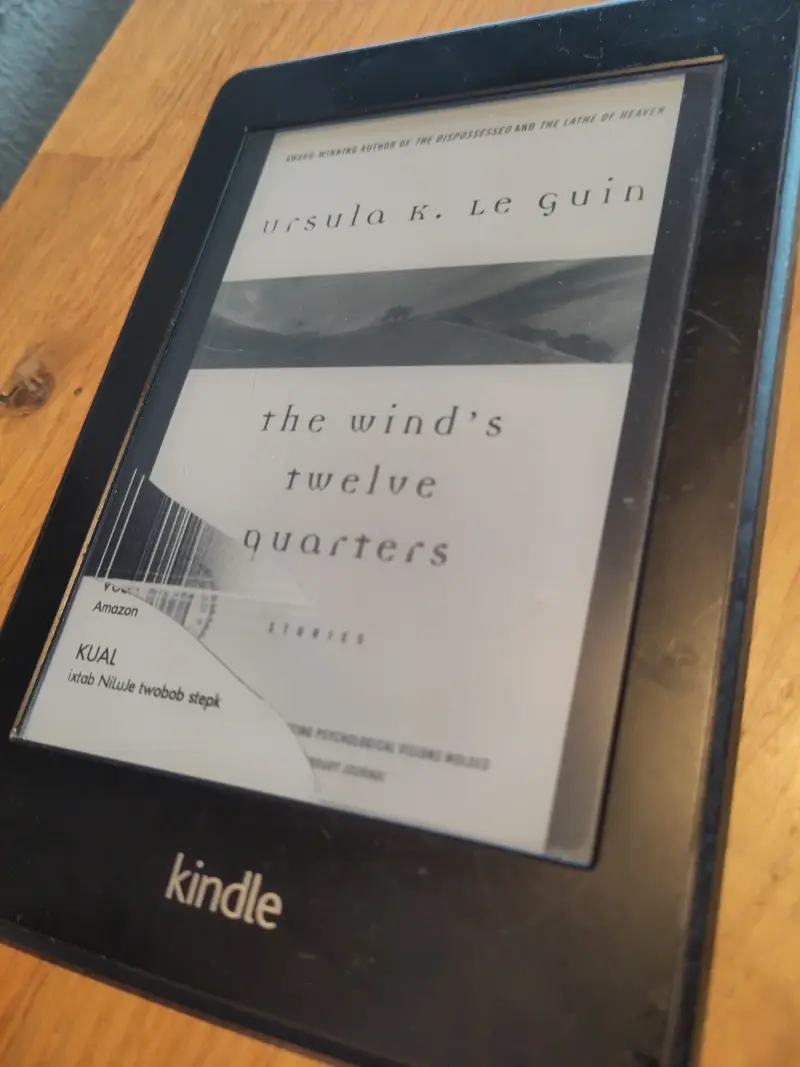
I doubt that it’s repairable so I am now on the lookout for a new e-paper reader and I’d be happy to take recommendations. Qualities I would be looking for are EPUB support, responsiveness, good battery life, USB-C charging and data transfer, brightness adjustment, easy dictionary lookup, and ruggedness. A lot of those are standard features, but I figured it was worth stating them all explicitly. I have generally liked KO Reader when using it on my Kindle, so support for that particular reading software would be a big plus as well and I don’t care about it having internet access.
A few people have already recommended me Kobo as a good standard and the colour displays interest me if they’re have the same quality and responsiveness as the more typical black and white e-paper displays, but I also recall Laura Michet posting about XTEink readers and I do find the idea of the tiny little reader I can easily carry in pocket all the time intriguing as well.