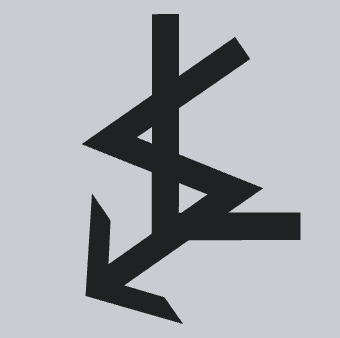
The title of this post is three unusual Unicode codepoints, each having an interesting history as written characters.1 There are many oddities tucked away in the Unicode standard. A recent toot reminded me of ⍼, known as “angzarr”, a symbol that became part of Unicode due to its inclusion in a historical typographic catalogue despite no other prior usage of the glyph having been documented.
My discord has an emoji named "tech debt" - which is just the angzarr, ⍼, the symbol famous for having no known use or agreed-upon meaning but somehow appearing in unicode and now it's just a part of unicode forever.
With so many enormous tech debt bills coming due recently, perhaps you, too, would like to take a moment to appreciate the tasteful angles of the angzarr.
Technical debt is the labour cost of maintaining a system and all previous choices made when establishing that system. By including this symbol Unicode has created meaning for it and generated usage that would be broken if the symbol was ever removed from the standard or replaced with a different glyph, a problem which the glyph itself is, in one Discord server at least, being used to embody.
There are other interesting cases. The first character in the title of this post is ꙮ, “multiocular O”, a glyph that, before its inclusion in Unicode, was only found as a visual flourish in a single 15th century manuscript in the phrase «серафими многоꙮчитїи», “many-eyed seraphim”. Particularly on Tumblr this has taken off an aesthetic marker of “biblically accurate” or eldritch creatures, those beings beyond human comprehension, or as part of a way of writing speech that is impossible for normal humans to speak, hear, or understand.
The last character in the title, 彁, is a ghost character; characters originally in a Japanese Industrial Standards character set despite having no known usages that then made their way into Unicode as well.2 Ghost characters have also seen use that leans into their strange, alien, nature as words that are included in the Japanese language in some official capacity while carrying no meaning. The Taiko no Tatsujin rythm game series features an extremely difficult song called 「彁」 themed after corrupted data (flashing lights warning for this music video). People love to derive meaning from from symbols, even when that meaning is their inherent meaninglessness.
The middle character in the title is actually an Ogham space character, the only whitespace encoded in Unicode that is not blank, a standard of written Ogham that is representative of how it originally existed not as script on a page or even the flat side of a tablet, but as a writing system defined by 3D space, carved onto the edge of monument stones, now leaving a trace in the Unicode standard as a unique space marker. This isn’t really the same as the other examples in this post but I like Ogham and wanted to shoe-horn it in.
Apologies if the characters used in this post don’t render on your computer. ↩
The JIS symbol, 〄, is itself included in Unicode. ↩