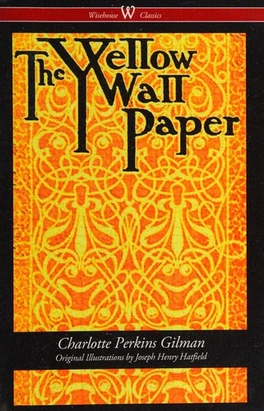
If a physician of high standing, and one’s own husband, assures friends and relatives that there is really nothing the matter with one but temporary nervous depression—a slight hysterical tendency—what is one to do?
The dismissal, infantilisation and isolation faced by the protagonist is still infuriatingly resonant. Her husband, a physician, knows what’s best for her and refuses to let any objection or evidence to the contrary create a chink in his paternalism as his wife spirals further and further. And as a horror piece, the descriptions of the wallpaper itself are wonderfully vivid and horrid, and the changing relationship of the protagonist to it as, with her life emptied of anything else, it worms its way into her mind is great.
I pray God will curse the writer, as the writer has cursed the world with its beautiful stupendous creation, terrible in its simplicity, irresistible in its truth—a world which now trembles before the King in Yellow.
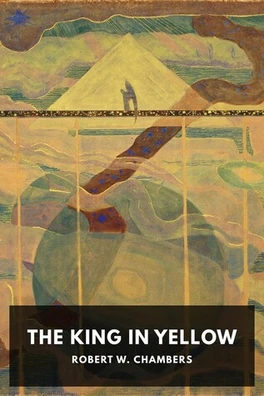
As it turns out the copy that I got from the library only included the first four stories from the original 1895 anthology; the ones that directly reference The King in Yellow—within the stories the title of a play that drives all those who read it mad. This is well known to narrator of each story and appears to be widely known within the setting, but despite this the play appears to be widely published and available. There is, apparently, nothing clearly objectionable or untoward in any specific detail in the play, at least nothing that would justify censorship, but yet it has the effect of seizing the minds of all those who read it.
The first story, “The Repairer of Reputations”, beings with a description of a speculative history where the United States of America, following a war with Germany over Samoa, has taken a very authoritarian turn. Power has been centralised in the presidency, cities have been drastically razed and remodelled, policies of ethnic segregation put in place, and suicide chambers have been erected across the country. This is not, really, directly relevant to the plot of any of the short stories, which mostly concern the personal struggles and decline of various artists in New York and Paris, and none of the other three stories expand on this setting much, but it paints a backdrop of a world itself going mad, as if the presence and spread of the malignant play in the world has lead to a general madness and decline as much as it has the downfall of each individual protagonist.
But the final story of the four, “The Yellow Sign”, calls this all into question. The narrators, up until now, have been unreliable, driven to madness by the play and clearly gripped by hallucination in some way, but “The Yellow Sign” calls into question even the basic facts of the world. It makes explicit reference to the protagonist of “The Repairer of Reputations” and makes it clear that those events are in the past, but then also directly contradicts the opening lecture on the recent history of the United States: The statue of Garibaldi in Washington Square Park was said to have been replaced with one of Peter Stuyvesant, yet, in “The Yellow Sign” Garibaldi still stands, no mention being made of the change, or any of the other radical differences outlined in the first story, being evident.
It calls into question not just the more fantastical or dreamlike elements of the stories, or the parts that are clearly signalled to be delusions. There is not just a breakdown in the individual, but an infohazard causing a divergence in the shared social reality—on what people agree to be the basic facts of the world. I am often frustrated by storytelling that calls itself into question like this, that posits that perhaps it was all just a dream, but in this case it feels like a strong echo of the initial picture of a world declining into madness, where base reality itself is in question, and I think it also echoes both the present moment of social divide and also the age of yellow journalism that the stories were published in. The King in Yellow and the Yellow Kid; two sides of the same coin.
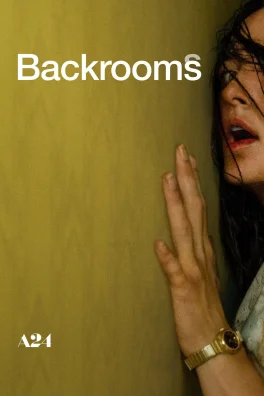
I do not have much experience with or particular attachment to the backrooms concept, but the film’s set design and vibes are enough to carry it and keep it interesting for much of the runtime despite the weaker parts of the narrative. I do quite like the rationale behind the logic of the backrooms and how it allows for the (I am told, controversial) inclusion of “monsters” that is thematically relevant rather than just it’s spooky place with a scary grabber.
I would not have expected a film that takes game mechanics and game logic and translates it so directly and unchanged (to the point of having the instructions on the wall for the protagonist to read) to work this well, especially when it revolves around looping through the same hallway over and over again. Manages to keep it interesting and engaging the entire time as how they interact with the hallway changes over time.
Cute little thing. Trying to spot any subtle small change on each loop draws one into a hyperawareness that makes one very vulnerable to the scarier anomalies, with a tension that grows each time you reset to 0, always second guessing yourself as you definitionally don’t know what it is that you missed caused this (I was not very good at this game).
I think one of the most powerful aspects of Robert W. Chambers's The King in Yellow, and one which sets it apart from a lot of later Weird Fiction about academics who become too invested in the world of the arcane, is the idea that there just isn't anything explainably wrong with the play. People know there's something wrong with it, especially once you get to the second act... but if you just looked at the text itself, you wouldn't find anything.
'No definite principles had been violated in those wicked pages, no doctrine promulgated, no convictions outraged. It could not be judged by any known standard, yet, although it was acknowledged that the supreme note of art had been struck in The King in Yellow, all felt that human nature could not bear the strain, nor thrive on words in which the essence of purest poison lurked.'
The Repairer of Reputations
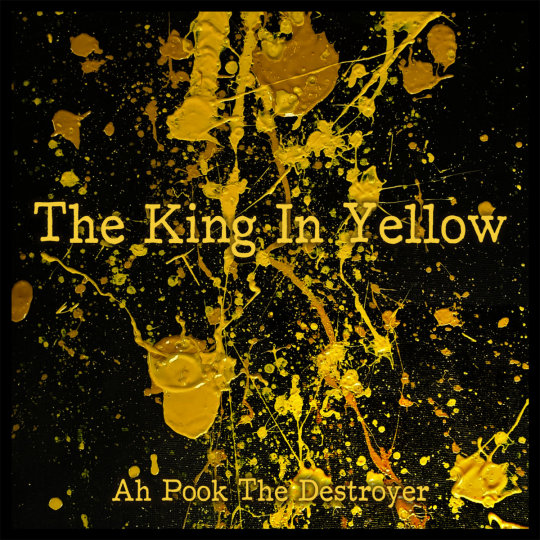
Despite how central it is, I completely missed it on my first reading (mainly because I was young and grappling with a particularly bad printing of it which made the text really small). I only started to grasp it when I listened to the concept album The King in Yellow by experimental post-rock band "Ah Pook, the Destroyer".
This album is largely inspired by Chamber's work, using that premise - an idea that you can't see but can still cause genuine harm - to talk about the current political climate. Songs touch on a wide array of cults and conspiracies - from the modern-day antisemitic ramblings of Qanon and Lizard People conspiracies to the strong figureheads and interpersonal conflicts of cults like Heaven's Gate. They even find time to touch on the Time Cube somehow, all under the framework of the King in Yellow propagating harmful ideas and bringing about the New Age of Madness.
But it's not as simple as just looking at these people and calling them mad. Okay, sometimes it is that (best exemplified in the gospel stylings of "The Tribulation of Alex Jones"), but there are cases where the characters are presented with genuine empathy, such as in "The Road to Carcosa" where we hear about the life of a man who, through exposure to the Yellow Sign (which here is attached to Right-Wing conspiracy theories) ends up destroying his relationship with his family. The singer gets a moment of lucidity in the refrain "The fall of my life came after; And all of my mind was scattered", though this fades away as we hear the end of this story: Him living alone in a gun-filled squalor.
Another thing that elevates this album is how it turns it all back on the listener. There's obviously a specific audience of Left-leaning listeners a project like this would attract, and those people are very unlikely to also share the beliefs of the average Qanon-minded person, but (much like in the book) it constantly emphasises that the actual specific beliefs don't matter as much as the spread of ideas. This is most visible in the refrain heard throughout the album:
The fall you believe
Is not far as it seems
And the deep can not be so alive
The blithe poison meme
That you did not believe
But you saw and it entered your mind
Belief doesn't matter. Sheer exposure to these toxic ideas means that, in a way, you've already been harmed no matter what you take away from it. This idea is also present in the book, most directly in the story "The Yellow Sign".
In it, Mr. Scott is fully aware of the King in Yellow, but has actively tried to avoid its influence, partially due to the unfortunate fate of Hildred Castaigne (who featured in the story "The Repairer of Reputations" and at the very least wanted to do a monarchist coup of America that would place him as King - all after reading The King in Yellow). By all means, he should be doing the right thing - he has no interest in The King in Yellow and is actively avoiding the play... and it's not like anyone's staging it anymore, so he should be fine... and yet, after strange dreams, an erie watchman, and other bizarre events, he and his model, Tessie, are driven to read it. This is also a story the album quotes right at the start:
'Then, as I fell, I heard Tessie’s soft cry and her spirit fled: and even while falling I longed to follow her, for I knew that the King in Yellow had opened his tattered mantle and there was only God to cry to now.'
The Yellow Sign & Beautitudes
It's an idea I think is also evoked in the structure of the anthology. While the first 4 stories directly feature the King in Yellow in one way or another, the rest are tragic, sometimes supernatural romances with seemingly no connection to the title character, to the point where some reprints just do the first 4 and ignore the rest... though I feel it's deliberate when keeping this idea in mind. While the King is absent, Yellow is a recurring motif throughout the book, often emphasising death or danger, and reminding the reader of that titular presence. You have been exposed to the King in Yellow, and now your mind is his domain.
This post includes plot details for Shadow Generations, Sonic Generations and Sonic Adventure 2
There is a part of Shadow Generations that I got unreasonably excited about, but it is going to take some explanation as to why.
There is a boss in Sonic Adventure 2 called Egg Golem. When you defeat it Sonic taunts it by saying “Nice try, rocky!” during the victory screen.
Also in Sonic Adventure 2, in a scene aboard the Space Colony ARK, Sonic the Hedgehog tries to fool Ivo “Eggman” Robotnik with a fake Chaos Emerald created by Miles “Tails” Prower, which Robotnik spots immediately.
These scenes don’t have much to do with each other, but in 2020 I watched videochess stream a Sonic Adventure 2 randomiser that not only randomises the levels and characters, but also all of the cutscenes, playing them in a random order and with every voice line for each character swapped with a random line of theirs from elsewhere in the game. The results are mostly nonsense but sometimes they line up in funny ways.
In particular a version of the fake Chaos Emerald cutscene plays where Robotnik says his line identifying the Chaos Emerald as fake early, to which Sonic responds by pulling out the emerald and saying “Nice try, rocky!”, apparently to the emerald itself. This resulted in several people watching, including myself, immediately declaring Rocky to be the name of the fake yellow Chaos Emerald. Eggman then tells Sonic to put Rocky down and back off.
Most of rest of the randomised dialogue is the usual ill-fitting nonsense, but the appropriate dialogue from Ivo with the Rocky line in the middle cemented this moment permanently in my mind. Rocky is my beautiful fake son and I want to protect him. And in Robotnik’s next line he insults Rocky and calls Rocky “sand” and says his machines hate Rocky and shoots my poor boy into space! It’s fucked up.
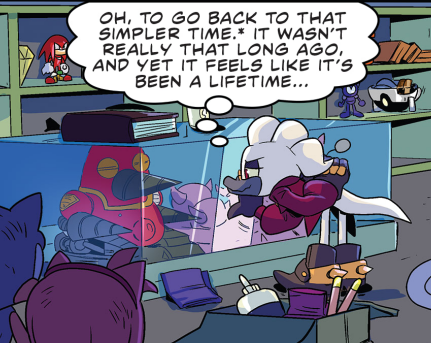
But Rocky does not have a large part in the Sonic series. The general idea of fake Chaos Emeralds gets revisited briefly in Sonic X where Sonic uses fake emeralds to turn into Dark Sonic and in the IDW comics Eggman tries to grow the “Eggperial City” using giant fake Chaos Emeralds. Also in the comics, specifically in Imposter Syndrome #2, a yellow gem that might be Rocky appears as a background detail on a shelf in Starline’s collection.
The real yellow Chaos Emerald appears throughout the series of course, including in Sonic Generations where it’s the emerald that you get for defeating Shadow the Hedgehog in a fight. And with Sonic Generations’ rerelease bundled with the new Shadow Generations campaign one of the many things that delighted me about the game is Rocky’s triumphant return and the silly way that it tied back into the original Sonic Generations.
In the promotional animated short for the game, Dark Beginnings, Shadow already has the yellow Chaos Emerald before the start of the game and holds on to it throughout the story. At the end of that short he flies to the Space Colony ARK and in an early cutscene in the game before being attacked by the Time Eater he finds Rocky still chilling on board the ARK and pockets it, now having both Rocky and the real yellow emerald.
Then, midway through the game, there’s a cutscene showing Sonic and Shadow’s fight from the Sonic Generations from Shadow’s perspective, where after losing he passes off Rocky to Sonic so that he can keep using the real emerald for his own fight.
It is, I admit, quite fan-wanky but I just admire pulling these disparate threads together and how this plotpoint is only possible because the fake emerald in Sonic Adventure 2 and the one in the Shadow rival battle in Sonic Generations both just happen to be the yellow one. And it means that Rocky is back! And he did such a good job! And he even retroactively gets to appear in Sonic Generations now too!