

The King in Yellow ★★★★☆
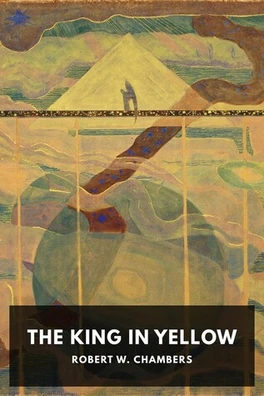
I pray God will curse the writer, as the writer has cursed the world with its beautiful stupendous creation, terrible in its simplicity, irresistible in its truth—a world which now trembles before the King in Yellow.
As it turns out the copy that I got from the library only included the first four stories from the original 1895 anthology; the ones that directly reference The King in Yellow—within the stories the title of a play that drives all those who read it mad. This is well known to narrator of each story and appears to be widely known within the setting, but despite this the play appears to be widely published and available. There is, apparently, nothing clearly objectionable or untoward in any specific detail in the play, at least nothing that would justify censorship, but yet it has the effect of seizing the minds of all those who read it.
The first story, “The Repairer of Reputations”, beings with a description of a speculative history where the United States of America, following a war with Germany over Samoa, has taken a very authoritarian turn. Power has been centralised in the presidency, cities have been drastically razed and remodelled, policies of ethnic segregation put in place, and suicide chambers have been erected across the country. This is not, really, directly relevant to the plot of any of the short stories, which mostly concern the personal struggles and decline of various artists in New York and Paris, and none of the other three stories expand on this setting much, but it paints a backdrop of a world itself going mad, as if the presence and spread of the malignant play in the world has lead to a general madness and decline as much as it has the downfall of each individual protagonist.
But the final story of the four, “The Yellow Sign”, calls this all into question. The narrators, up until now, have been unreliable, driven to madness by the play and clearly gripped by hallucination in some way, but “The Yellow Sign” calls into question even the basic facts of the world. It makes explicit reference to the protagonist of “The Repairer of Reputations” and makes it clear that those events are in the past, but then also directly contradicts the opening lecture on the recent history of the United States: The statue of Garibaldi in Washington Square Park was said to have been replaced with one of Peter Stuyvesant, yet, in “The Yellow Sign” Garibaldi still stands, no mention being made of the change, or any of the other radical differences outlined in the first story, being evident.
It calls into question not just the more fantastical or dreamlike elements of the stories, or the parts that are clearly signalled to be delusions. There is not just a breakdown in the individual, but an infohazard causing a divergence in the shared social reality—on what people agree to be the basic facts of the world. I am often frustrated by storytelling that calls itself into question like this, that posits that perhaps it was all just a dream, but in this case it feels like a strong echo of the initial picture of a world declining into madness, where base reality itself is in question, and I think it also echoes both the present moment of social divide and also the age of yellow journalism that the stories were published in. The King in Yellow and the Yellow Kid; two sides of the same coin.